Voyager-1 is one light day away from Earth. Where is Voyager-2?
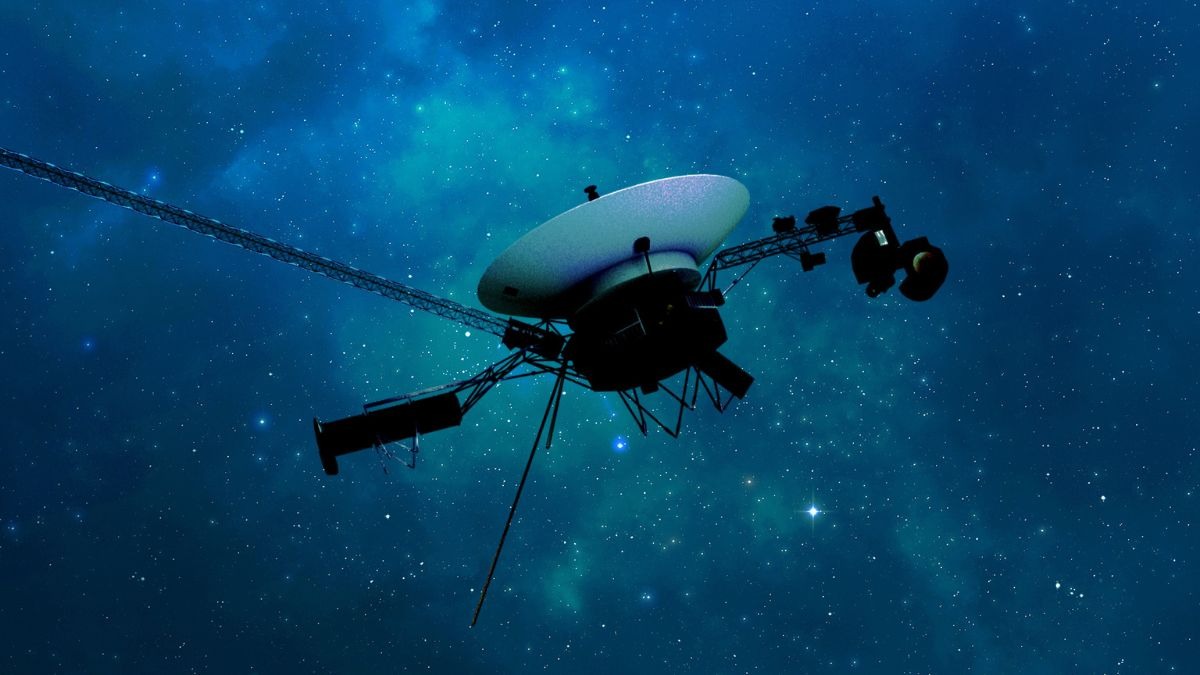
As Nasa's Voyager-1 makes history by becoming the first human-made object to travel one light-day away from Earth, its twin spacecraft, Voyager 2, is following a different path through interstellar space.
Although launched just 16 days before Voyager-1, the second spacecraft is still several billion kilometres closer to Earth and has yet to reach the same milestone. The Voyager-2 spacecraft, encapsulated within its payload fairing, is seen in August 1977. (Photo: AP)
According to Nasa's latest spacecraft tracking data, Voyager-2 is approximately 21.7 billion kilometres from Earth, compared with Voyager-1's 25.9 billion kilometres.
This puts it roughly 4.2 billion kilometres behind its twin in their journey into deep space.
At its current distance, a radio signal travelling at the speed of light takes around 20 hours and 6 minutes to reach Voyager 2. For Voyager-1, that now takes approximately 24 hours. An image of the planet Uranus, taken by the spacecraft Voyager 2 in 1986. (Photo: Nasa) WHY IS VOYAGER-2 CLOSER TO EARTH?
Voyager-2 was launched on August 20, 1977, while Voyager 1 followed on September 5 that year.
Despite its earlier launch, Voyager-2 took a different route through the solar system, visiting Jupiter, Saturn, Uranus and Neptune.
It remains the only spacecraft to have visited all four giant planets.
What it also means is that Voyager-2's trip to Uranus and Neptune meant it followed a different trajectory from Voyager-1, which took a shorter route towards interstellar space after its encounters with Jupiter and Saturn.
The two spacecraft also travel at different speeds and in different directions, explaining why their distances from Earth have continued to diverge. An artist's concept of the twin Voyager spacecraft speeding away. (Photo: Nasa) WHEN WILL VOYAGER-2 TRAVEL ONE LIGHT DAY AWAY?
A light-day is not a measure of time but of distance, but is how far light travels in 24 hours, which is approximately 25.9 billion kilometres.
Nasa estimates that Voyager-2 will reach this milestone on November 1, 2035, nearly nine years after Voyager-1.
Both spacecraft have crossed the heliopause, the outer boundary of the Sun's protective bubble of particles and magnetic fields, and are now travelling through interstellar space. A table comparing the journeys by Nasa's Voyager spacecrafts. (Photo: Nasa)
Despite nearly five decades in space, the two probes continue to send scientific information back to Earth, providing scientists with invaluable insights and data to study the realms between the stars.- Ends