
Walk 4,000 km to compete with me: Rahul cites PM Modi on distinct political identity
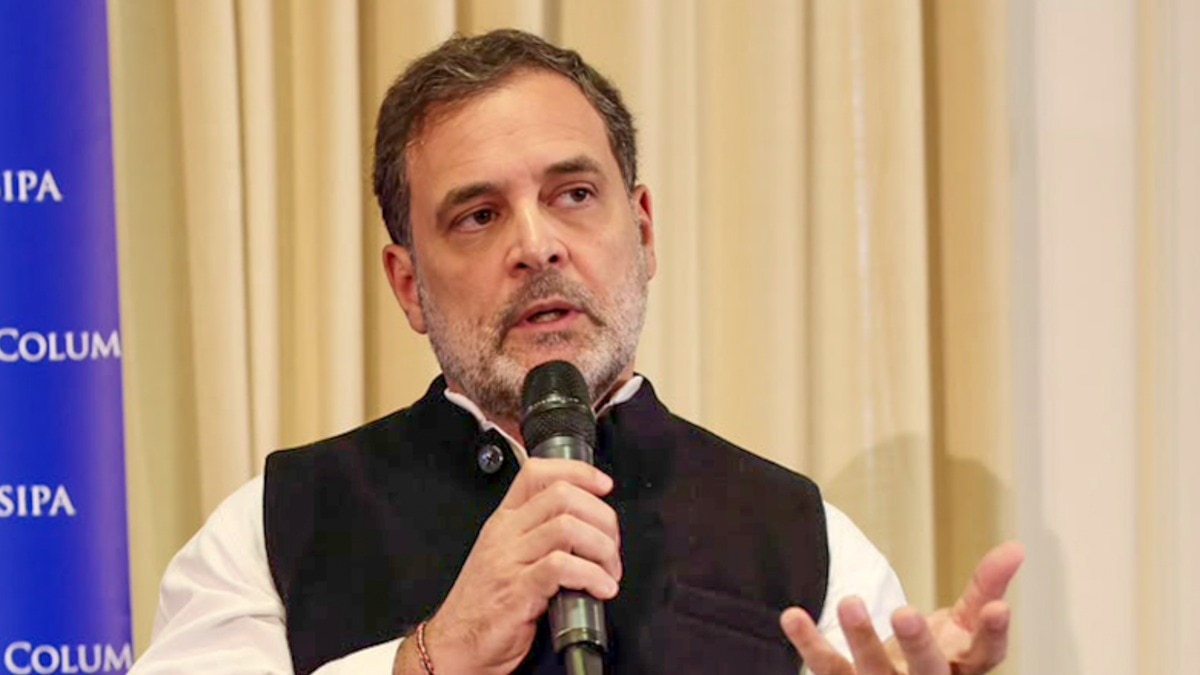
Congress MP Rahul Gandhi invoked his 4,000-km Bharat Jodo Yatra while explaining the idea of political uniqueness at an event at Columbia University in New York. Citing Prime Minister Narendra Modi as an example of a politician who has carved out a distinct identity, Rahul Gandhi said that anyone seeking to compete with him on the Yatra front would have to undertake a similar journey.
"If you want to compete with me, you've got to walk 4,000 kilometres. But if you walk 4,000 kilometres, then people say you're copying me," the 56-year-old Wayanad MP said on Tuesday.
The Leader of Opposition in Lok Sabha cited PM Modi as an example of a politician who occupies a distinct political space. "As a politician, even Mr Modi does not actually compete with it. If you think about it, he is fundamentally different from all other politicians," he said.
The Congress leader was explaining his belief that success lies not in competing with others but in creating a space where one's identity is distinct from everyone else's.
Recalling a conversation with his nephew about competition, he said, "If you're competing, you're already dead, right? Because then it's just a question of who's going to run faster. And you'll find somebody who runs faster than you."
Rahul Gandhi argued that the way forward was to keep doing something distinctive without stopping, until others eventually fell behind.
He also spoke about challenging what he described as unwritten norms in politics, including the belief that politicians cannot be nice, honest or use love and affection. "For me, there's a norm in politics, an unwritten norm in politics, which is that you can't be nice, you can't be honest, you can't use love and affection," he said.
He stressed that honesty and love, often seen as unusual in political conduct, could be powerful tools. "You would think that saying the truth is not such a big deal in politics. But once you start doing it, you realise it's a very, very powerful weapon," he said.
Concluding his argument, the former Congress president said being good at something was ultimately about recognising what made one different. "So, being good at something is understanding your uniqueness," he said.RAHUL GANDHI'S ECONOMIC DISASTER REMARK DRAWS BJP'S FIRE
The Columbia University interaction also saw Rahul Gandhi launch a sharp criticism of the Indian economy, describing the country as sitting in an "economic disaster". He cited massive unemployment, problems in the education system and a struggling manufacturing sector, arguing that India's economic model had stopped delivering results nearly a decade ago.
Questioning the effectiveness of the NDA government's flagship initiatives, including Make in India and Start-up India, Rahul Gandhi argued that services alone could not generate enough jobs for the country's workforce. He called for rebuilding manufacturing and strengthening small and medium businesses, which he described as the backbone of the economy.
He also questioned the concentration of economic growth among a handful of large business groups, specifically naming Gautam Adani and Mukesh Ambani.
The remarks drew a sharp response from the BJP. Party spokesperson Pradeep Bhandari accused Rahul Gandhi of engaging in "anti-India propaganda" on foreign soil and said his comments undermined India's economic progress and democratic standing.
Bhandari also pointed to India's 7.8 per cent GDP growth in the first quarter of the 2026-27 financial year to counter the Congress leader's claims.
BJP MP Anurag Thakur accused Rahul Gandhi of tarnishing India's image abroad, alleging that the Congress leader was making false remarks to grab headlines after losing political ground at home. Calling it a case of "headline phobia", Thakur accused Rahul Gandhi of relying on foreign allies and toolkits in his pursuit of power.
Thakur also questioned Rahul Gandhi's interview with journalist Lydia Polgreen, citing an article she wrote on Kashmir in 2010, which he alleged was sympathetic to terrorists and critical of India. He further accused the Congress leader of associating with forces working against the country's interests.- Ends

