
Watch: Namritha Sivsanker turns childhood trauma into a mission to help vulnerable communities - IOL
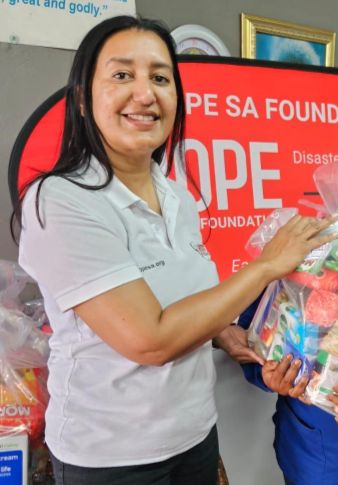
Namritha Sivsanker, founder of Johannesburg-based Hope SA Foundation, says her experience of childhood abuse shaped a lifelong commitment to helping vulnerable women, children and communities, writes Monishka Govender.
For Namritha Sivsanker, helping others is not simply a job.
It is a purpose born from hardship, shaped by compassion and sustained by an unwavering belief that even the smallest act of kindness can restore dignity and hope.
The 52-year-old CEO and founder of Hope SA Foundation, an NPO based in Johannesburg, has spent years reaching vulnerable communities across South Africa, and, when disaster strikes, beyond the country’s borders.
“I do not really see what I do as a job. It has become my life's purpose. There is always someone who needs help, and I feel deeply compelled to respond when I can,” Sivsanker said.
Her organisation has grown significantly since 2020, becoming involved in feeding programmes, disaster relief, humanitarian assistance, school-support initiatives, winter and hygiene drives, and assistance to vulnerable women, children, families and elderly people.
Since 2020, Hope SA has served more than one million meals.
But for Sivsanker, the figure represents far more than a statistic.
“Every meal represents a person. Every blanket represents someone who was cold. Every baby pack represents a mother who needs help. Every school shoe represents a child who can walk into a classroom with a little more dignity. That is what matters to me,” she said.
Namritha Sivsanker, the CEO and founder of Hope SA Foundation.
The roots of Sivsanker's humanitarian work stretches back to her childhood, growing up with an abusive father.
As a young girl, she knew what it meant to feel vulnerable and powerless, she said.
Yet rather than allowing those experiences to define her, she chose to transform them into something positive.
“My experiences could have made me bitter, but instead I chose to turn my pain into purpose,” she said.
That personal history has made her work with vulnerable women and children particularly meaningful.
“There are so many women who have experienced abuse, poverty, trauma and circumstances they never chose for themselves. I want women to know that their circumstances do not have to define their future,” she said.
Sivsanker hopes one day to establish a safe space or shelter where women and children fleeing difficult circumstances can find more than temporary refuge.
“I do not want it to simply be somewhere a woman goes to sleep safely for a few nights. I want it to be a place where she can heal, receive support, learn, gain skills, become educated and eventually become financially independent. I want to help women move from survival to empowerment,” she said.
Hope SA's work has taken the organisation into some of the country's most difficult circumstances.
During the Covid-19 pandemic, the organisation provided food and basic necessities to families who had lost their livelihoods.
It later responded to the unrest in KwaZulu-Natal, as well as disasters including the Boksburg explosion and a tornado.
The organisation also travelled to Turkiye following the devastating earthquake, taking volunteers to assist communities on the ground and providing supplies including sleeping bags and baby necessities.
But some of Sivsanker's most meaningful moments happened much closer to home.
For Sivsanker, humanitarian work is not about being present only when there is public attention.
“One of the things I am proudest of is that Hope SA does not only respond to crises when everyone is watching. We try to show up when the cameras are gone too,” she said.
Hope SA Foundation helping the community.
The work comes with an emotional cost.
Sivsanker has witnessed abuse, hunger, illness and desperation, including children experiencing abuse and people begging for food.
Those experiences, she said, do not simply disappear when she leaves a community.
“When you repeatedly see suffering, abuse, hunger and desperation, you do not simply switch those experiences off when you leave the community. You carry them home,” she said.
She said the emotional trauma of what she has witnessed has at times been overwhelming, particularly because of her own childhood experiences.
“Seeing children being abused and women trapped in difficult situations is particularly painful for me because of my own childhood experience,” she said.
“My faith keeps me going,” she said, recalling the moments when support arrives just when it is needed most, whether through a company donating food, someone providing blankets, a volunteer offering their time or a member of the public making a contribution.
“I see God's grace in those moments,” she said.
Namritha Sivsanker and the Hope SA Foundation during their feeding schemes.
One of the biggest challenges facing Hope SA is funding.
Sivsanker said the demand for assistance often exceeded the organisation's resources.
“If 500 people need food and we only have resources for 300, there are still 200 people who are hungry. That is the reality we face,” she said.
She believes sustainable partnerships between businesses and non-profit organisations could help humanitarian organisations plan for the future rather than continually responding from one project to the next.
“That will allow us to plan ahead rather than constantly wondering whether we will have enough resources for the next project,” she said.
Despite the challenges, Sivsanker remains grateful to the donors, corporates, community organisations, volunteers and members of the public who have supported Hope SA.
Support comes in many forms — money, food, blankets, water, baby supplies, transport and time.
Hope SA Foundation feeding the community.
Sivsanker believes humanitarian assistance should ultimately go beyond meeting an immediate need.
“Feeding someone today is important, but we should also ask what we can do to help that person build a better tomorrow,” she said.
That philosophy is central to her vision for Hope SA.
She wants the organisation to expand its education and skills-development initiatives while continuing its feeding programmes, food assistance, school-support campaigns, winter and hygiene drives, disaster relief and community outreach.
Her greatest ambition remains the establishment of a safe space for women and children, where women escaping abuse can access counselling, education, skills development and opportunities for employment or entrepreneurship.
“I want us to teach women that they are not defined by what happened to them. I want children to grow up knowing that they are worthy of safety, love and opportunity,” she said.
Hope SA Foundation helping different communities.
Sivsanker does not seek recognition for the work she does.
“I don't need recognition. If I can change one person's life, that is enough for me,” she said.
Her definition of success is not measured simply by the number of meals served or projects completed, but by the moment someone begins to believe that they have not been forgotten.
“The most rewarding part is seeing hope return to someone's face,” she said.
Sivsanker's story is a reminder that resilience can take many forms, including turning personal pain into a lifeline for others.
She remembers the little girl who once believed she was meant for something greater.
“I do not want my legacy to be about how many people I helped. I want it to be about how many people found hope again.”
For Sivsanker, that is the true meaning of Hope SA: keeping hope alive, one person, one meal and one act of kindness at a time.
“I believe that the hands that serve are mighty hands. You don't have to be wealthy to make a difference. Give even when you have little, because sometimes the smallest act of kindness can mean everything to someone else,” she said.
“Together, we can give more than food. We can give dignity. We can give opportunities. We can give hope. The hands that serve are mighty. Let us use ours to lift someone else.”


