What a Democrat win means for Canada - Toronto Star
In today's First Up: Bryan Adams' new elbows-up love letter album and the Raptors collapsed in 'epic form' against the Nuggets.
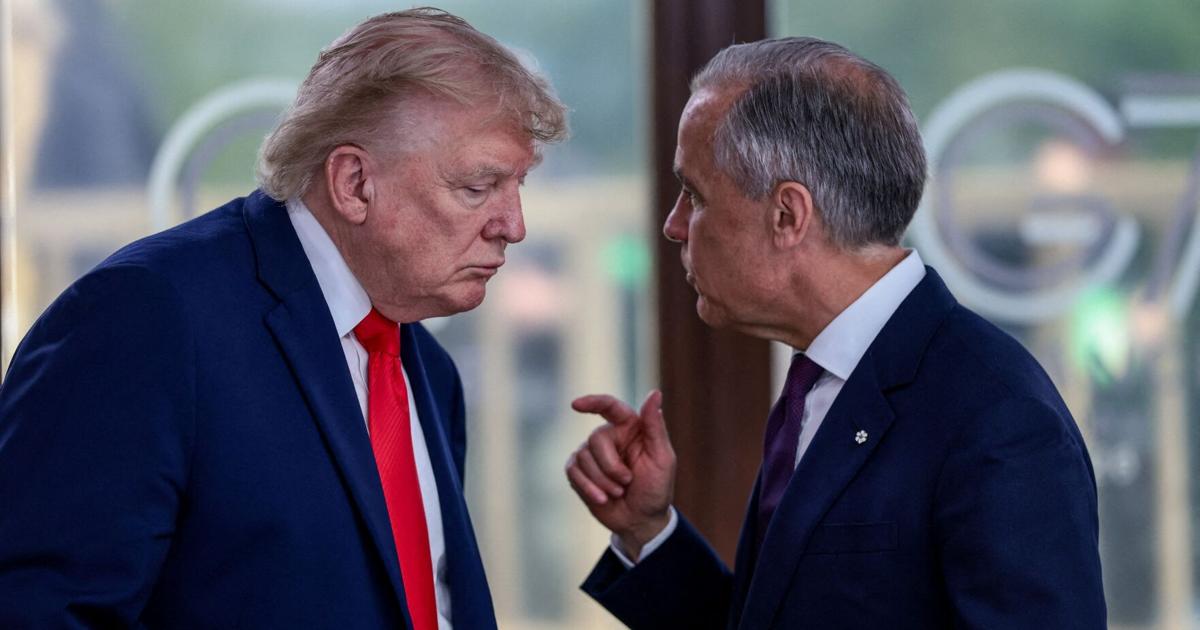
U.S. President Donald Trump speaks with Canadian Prime Minister Mark Carney on June 16, 2026.
Good morning. This is the Thursday, Nov. 5 edition of First Up, the Star’s daily morning digest. Sign up to get it earlier each day, in your inbox.
I don’t know who needs to hear this after we turned our clocks back this week, but if we adopted permanent standard time as other provinces have, we’d all be in the dark late into the morning (8:45 a.m. sunrise at the solstice). I don’t think kids walking to school in the dark is a good change. But some people love the idea. Doug Ford says he’s “all in” on making the change, but only if Quebec and New York state do too.
It’s a budget day tradition that the finance minister should wear a new pair of shoes. But with cost of living being so top of mind, I’m reminded of a Toronto tough-times anthem about not being able to afford new shoes: “Henry needs a new pair of shoes / To get him past these barefoot blues / And he’d walk a mile in his own shoes / If he only had ’em / Come on Henry, up and at ’em.”
If you’re asking what Trump’s thumping defeat in the U.S. midterms means to Canada’s trade hopes, the short answer is, don’t get your hopes up. (For the quick answers to other questions, see The Conversation below.) While experts surveyed by Estella Ren pointed out that the Democrats now in control of Congress can slow Trump down and alter his strategic approach, the U.S. president still retains significant executive authority of the kind he has used to impose tariffs already. And his own impulse has usually been, as one put it, to “add more tariffs and more pressure.”
Ontario Minister of Colleges and Universities Nolan Quinn speaks to reporters during a scrum at Queen’s Park on Oct. 27, 2026.
Supporters of Democratic U.S. Senate candidate Adam Hamilton celebrate during an election-night watch party on November 3, 2026.
There was a lot to take in after the American midterm election results. The first Democrat elected to the Senate from Kansas since the 1930s. The first Latina governor of Texas. The first Black woman governor (in Georgia) and the first Muslim senator (in Michigan) in U.S. history. Just for starters. Richard Warnica and I went over big takeaways; watch here.
Star readers were chewing it all over in our comments section, too. And many had questions. Our audience team and I canvassed the staff covering the election fallout from various angles to try to get answers.
Reader: Hasn’t Trump already been impeached by the Dems twice?
Ed: I personally covered both of Donald Trump’s impeachment trials when I was the Washington bureau chief. I can say they achieved some things: they let everyone who cared know about wrongdoing, and it put it all on the historical record (he has been the defendant in half of all U.S. impeachment trials in history). However, a Trump-obedient Republican-held Senate both times refused to provide the supermajority needed to convict him.
As contributor John Semley, who writes from his Philadelphia home, says, “It didn’t really do much, other than embolden him on the basis that he ‘beat’ the impeachments.” That’s true. And it’s part of why columnist Justin Ling says: “Don’t hold your breath that President Donald Trump, twice impeached and twice acquitted, will be ousted.”
Jerry: If they are unlikely to remove Trump or Vice-President J.D. Vance or Secretary of War Pete Hegseth from office, would beginning impeachment proceedings be a useless distraction?
Ling: Hegseth might be a different story. Even before their catastrophic midterm results, some rebel Republicans were pushing to impeach him.
That’s before the Democrats even take control. Once they do, they’ll need roughly a dozen Republicans to join them to convict — difficult, but not impossible. But it may all be academic. CBS News is reporting that Trump is already asking advisers whether he should fire Hegseth, scapegoating him for their loss.
Lisa: Money didn’t buy this election. Elon Musk dumped almost $450 million into the midterms, and he failed to get the outcome he wanted.
Ed: I think it’s fair to say that in at least a lot of cases. In Texas, where Musk is reported to have spent $250 million to influence the race, governor-elect Gina Hinojosa was outspent 8 to 1 by the Republican incumbent. She won by 7 percentage points.
Chris: Why did Canadian media report on a ‘close race’? Meanwhile U.K. media predicted a Democratic landslide.
Semley: All U.S. political races seem kind of close. As a friend joked, it’s a country where a 52/48 Republican/Democrat voter split can see your state decried as a fascist hellhole. Where a similar split the other way can see that same state held up as some shining bastion of progressive values. Also, people are right not to trust polls, which have failed to prove meaningfully, accurately predictive in the very recent past. Calling every race close, or close-ish, is a way to hedge your bets, both editorially and emotionally.
Rubicon: The great question is whether Americans can break their addiction to the dopamine rush of political hatred long enough to rediscover the value of common purpose.
Ling: If you dare to be inspired, give senator-elect James Talarico’s election night speech a listen. After racking up a stunning double-digit win in Texas, he took to the stage to declare that “a politics of division is no match for a politics of love.”
Talarico managed to cut through the intense polarization to win in deep-red Texas, but I wouldn’t expect that trend to maintain. American politics is run on huge sums of money, increasingly spent by dark money groups who don’t much care for democracy. Social media, where conspiracy theories and obscene vitriol dominated the midterm discourse, is also way too central to American political discourse. Still, there’s a tiny ray of hope that things might start to get better.
Have thoughts, questions or comments on the fallout from the U.S. elections? Share them with the rest of us in the comments section here.
Some comments and answers have been edited for length and clarity.
Bill Hader at “The Cat in the Hat” Toronto fan screening.
“Carney is on the right track in most respects, but sabotaging his efforts at strengthening our economy — while stoking division along the way — will not serve us.” — Frances
Another reader asked: what’s the rush?
“Government timelines can be improved without exclusion, without blunt-force trauma, and without using sovereignty as the impetus (or worse, the excuse).” — Kerwood
Today’s big number is 40. That’s the percentage of Ontario’s commercial waste that is currently shipped to the U.S. Martin Regg Cohn writes about how Ford is latching onto Trump’s tariffs to wean us off our garbage-exporting habits.
Thanks for starting your day with us. If you enjoy First Up, please share it with a friend. And let us know what you think of the changes we’ve made, and what you’d like to see. Email firstup@thestar.ca. I’ll see you back here tomorrow morning.