What a MISSa! Vijay sets a trap, DMK walks into it eyes closed
In a healthy parliamentary democracy, an Opposition party has one primary, unremitting vocation: the relentless cross-examination of the Treasury’s immediate performance. It does not exist to run an archival society, curate historical museums, or litigate ancient grudges.
It exists to ask hard, unsparing questions about today’s balance sheet, tomorrow’s budget, and yesterday’s broken promises.
At 140 days into its tenure, the infant TVK administration under Chief Minister C Joseph Vijay offered a sprawling, tempting target. Here was a rookie government grappling with executive teething troubles, administrative musical chairs inside Namakkal Kavignar Maaligai, populist welfare promises awaiting hard cash, and grand Rule 110 announcements—including a 1,200-crore Secretariat and an Olympic City—that invited forensic fiscal scrutiny.
An alert Opposition should have arrived in Fort St George with ledger books in hand, bowling relentless, toe-crushing yorkers at an untested cabinet.
Instead, the DMK managed a feat of athletic confusion rarely witnessed even in the most chaotic gullies of local cricket. In a single stroke of bizarre political acrobatics, it performed both halves of a catastrophic double fault.
As batsmen, the DMK stepped backward onto its own stumps trying to defend a delivery bowled half a century ago in 1976; as bowlers, it turned around and served up a looping, dicey waist-high full toss, gifting Vijay an effortless, gilded free hit that sizzled into his dazzled gallery.
The Treasury benches, which ought to have been sweating under the arc lights of an unsparing accountability test, looked on in delighted disbelief. The DMK had not merely dropped the match; it had happily knocked down its own wickets, presented the opponent batsman with a bonus ball, and then spent the rest of the afternoon quarrelling with the umpire over the rulebook of 1975-76.
Vijay, meanwhile, is in London, cheering his ‘friend’, actor Ajith, and incidentally scouting investments for Tamil Nadu. The state, meanwhile, is exulting over the bonhomie between the ‘Brad Pitt and Tom Cruise’ of Tinsel Nadu.THE BY POLL VACUUM: WATER TAPS VS JUSTICE SARKARIA
Nowhere has this strategic opposition disorientation been more glaring than on the campaign trail for the upcoming October 6 by-elections in Madurantakam (SC) and Dharapuram (SC).
By-elections are the fundamental audits of ground-level democracy. In the dusty streets of Madurantakam and the textile hinterlands of Dharapuram, political legitimacy is negotiated not through ideological treatises, but through the elemental mechanics of daily survival.
Voters in these reserved constituencies have urgent, flesh-and-blood questions: What happened to local drinking water pipelines? Where are the agricultural feeder canals? Why are rural roads cratered? How will local youth find industrial employment? And what, precisely, has the 140-day-old TVK government delivered beyond theatrical punch dialogues and high-voltage trailer launches?
Instead of seizing these bread-and-butter grievances to corner an inexperienced ruling regime, DMK, the named and challenged enemy, dragged the entire campaign into a historical time-warp.
Step onto the campaign trail today, and the air does not reverberate with civic demands or scrutiny of TVK’s governance. Instead, loudspeakers crackle with indignation over Maintenance of Internal Security Act (MISA) detentions, yellowing affidavits from the Sarkaria Commission, jail logs from Central Prison Madras, and half-century-old judicial findings.
The irony is staggering: the voter asked for drinking water; the Opposition produced Justice Sarkaria. The agrarian labourer inquired about welfare disbursements; the campaign platform served up an impassioned lecture on the excesses of Indira Gandhi’s Emergency. In an electoral arena crying out for an interrogation of the living present, the principal Opposition chose to wage an existential holy war against the ghosts of 1976.
How did a seasoned political machine with seven decades of street-fighting experience allow itself to be so comprehensively derailed? The answer lies in the theatrical timing of the Assembly’s police-grants debate, where Vijay set the bait and the DMK swallowed it whole—hook, line, sinker, and archival folder.
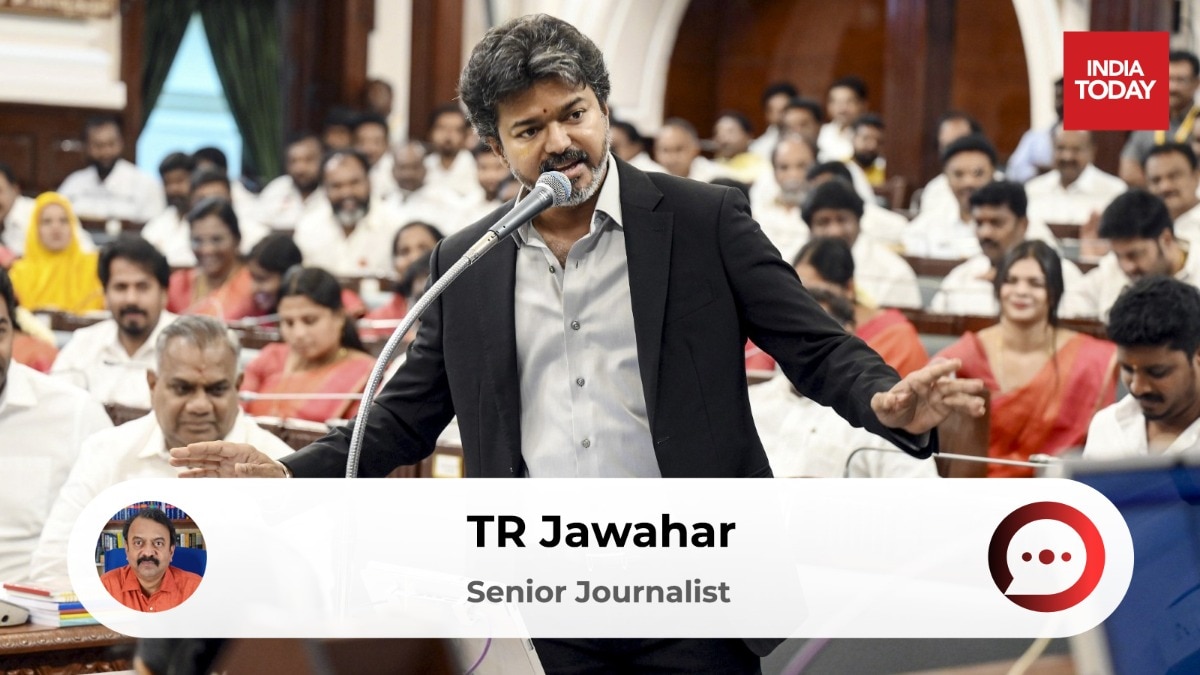
When Vijay stood up in Fort St George, brandished the Sarkaria Commission report borrowed from the Assembly library, and questioned the DMK’s Emergency-era credentials, he was not acting as a scholarly historian delivering a peer-reviewed lecture. He was acting as a shrewd political provocateur who understood the mass pulse. And he knew that invoking Sarkaria and MISA would touch the rawest nerve in DMK’s psychological anatomy.
The bait was obvious, clumsy, and deliberately dangling. A composed, battle-hardened Opposition would have laughed off the theatrical jibe, dismissed it as a novice’s evasion, and dragged the Chief Minister back by his lapels to the unglamorous issues of law and order, custodial safety, and departmental budgets.
Instead, the DMK erupted with apocalyptic fury. The party reacted not like an unshakeable institutional giant, but like an agitated hornet’s nest struck by a stray pebble. In their rush to defend their ancestral honours, DMK leaders allowed the reaction to become ten times larger than the original charge.
By taking the bait, the opposition party committed the cardinal blunder of political warfare: it allowed the adversary to choose the battlefield, the weapons, and the clock. In an instant, Vijay was transformed from an amateur defending a wobbly 140-day administrative record into a serene bystander, casually watching the DMK wage a noisy, exhausting war against its own shadow.THE DECIBEL TRAP: VETERANS' SELF-GOAL
Having abandoned the legislative floor, the DMK promptly escalated the conflict from rebuttal to rancour. What followed on the public square was an extraordinary spectacle of rhetorical self-immolation.
Party stalwarts took to the protest stages with microphones turned up to deafening volumes. Former Union Minister A. Raja and former Minister P. K. Sekarbabu, seasoned gladiators of the high-decibel Dravidian platform, launched into blistering, unfiltered counter-offensives. But in their fury to demolish Vijay’s audacity, their language rapidly deteriorated from political indignation into crude personal abuse and vitriol.
Here is where the DMK fell headlong into the modern media trap.
In an earlier era of political communication, a forty-minute ideological sermon delivered from a wooden stage had room for rhetorical hyperbole. The cadre cheered, the local evening paper printed a selective, sanitized summary, and the fiery excesses evaporated into the humid night air.
Today, that political ecosystem is dead. We live in a vertical video economy governed by the uncompromising cruelty of the smartphone screen. A nuanced, four-paragraph historical context does not travel across digital networks; a venomous, five-second burst travels with the speed of an epidemic.
The reel algorithm does not care about ideological pedigree; it cares about outrage, visceral ridicule, and shareable scandal. Within minutes, the DMK stalwarts’ explosive diatribes were sliced, captioned, set to mocking background scores, and beamed into millions of private handheld screens.
Suddenly, the narrative suffered another disastrous inversion. The political headline of the week was no longer TVK’s administrative drift, nor was it even Vijay’s original Assembly jibe. The headline had become the appalling language of the Opposition.
The target: women. The DMK had walked directly into a decibel trap of its own engineering.
The embarrassment grew so acute that the party was forced into an agonizing, internal damage-control exercise. MP Kanimozhi was compelled to stage a subtle, high-table intervention on social media, quoting the Thirukkural on the paramount virtue of restraint in speech—a gentle, public slap on the wrist aimed squarely at her own party colleagues.
Tactical expressions of regret followed. But in politics, the linguistic chasm between a defiant regret and an honest apology is paper-thin to the partisan, yet glaringly wide to the discerning public.
The spectacle was complete: while the infant TVK government relaxed comfortably in the shade and its leader in a London pavilion, the principal Opposition was furiously applying bandages to self-inflicted wounds, desperately explaining away the indiscipline of its own frontbenchers.THE GEN Z DISCONNECT: WHEN MISA MEETS THE MOBILE PHONE
Beneath this strategy fiasco lies a profound, structural failure of political comprehension. The DMK is trapped in a tragicomic paradox: one half of its apparatus tries desperately to woo Gen Z with slick digital marketing and corporate PR, while the other half berates reels and scolds the youth in archaic, high-decibel Dravidian drivel.
To a 19-year-old voter navigating gig economies, steep college fees, question paper leaks, soaring urban rents, and elusive tech jobs, MISA is not a sacred badge of martyrdom—it is an ancient acronym that sounds vaguely like an entrance exam.
The DMK operates under the comfortable, hereditary delusion that political gratitude is genetically transmissible. It assumes that because a grandfather wept over Annadurai’s prose and a father marched behind Karunanidhi’s rallies, the granddaughter must naturally genuflect before the altar of the mid-seventies of a bygone century.
It does not work that way. Generational reverence cannot be inherited like ancestral property; it must be re-earned in the contemporary currency of the voter. For a generation born in the Y2K cusp, Indira Gandhi’s Emergency is as emotionally distant as the Battle of Plassey or the French Revolution.
The Gen Z voter lives in a fiercely contested information ecosystem where politics does not compete merely with rival parties; it competes with Netflix, Premier League highlights, Instagram influencers, gaming streams, and LinkedIn job alerts. Attention is the rarest, most guarded commodity in the modern republic.
A teenager scrolling through their feed may encounter MISA as a 30-second reel; they may glance at the Sarkaria Commission via a fleeting YouTube Short; they may see the Emergency summarised in a carousel graphic. But knowing that an event occurred five decades ago is fundamentally different from harbouring an emotional loyalty to the veterans of that event.
When young voters look at their political leadership, they are not asking: “Who was imprisoned under harsh detention laws in 1975?” They are asking, with blunt, transactional clarity: “What are you offering my life in 2026?”
They care about artificial intelligence curricula in state universities. They care about coding bootcamps, high-speed public transport, women’s safety on night shifts, the cost of living, clean drinking water, and environmental livability.
Above all, they care about authenticity. They possess an instinctive, highly attuned radar for hypocrisy and condescension.
When party elders take to microphones to deliver scolding, patriarchal lectures on history, Gen Z does not feel educated; they feel patronised. And there is nothing the vertical screen punishes more brutally than an uninvited sermon.THE IDEOLOGICAL ALPHABET VS THE NEW VOCABULARY
The tragedy of the DMK’s messaging is that it insists on confusing relevance with resonance.
The Dravidian movement’s historic achievements—pioneering affirmative action, expanding educational access, institutionalising federalism, and championing social justice—are monumental milestones in India’s democratic evolution. They are living foundations. But they cannot be preserved as mummified heirlooms or brandished as an excuse to avoid modern interrogation.
A party that treats history not as an inspiring foundation, but as a compulsory syllabus to be forced down the throats of an unwilling electorate, will rapidly find itself talking to empty halls.
This is precisely where Vijay enjoys a colossal, natural advantage. He does not possess this advantage because he is a seasoned statesman with a profound philosophy of governance—his 140 days have demonstrated that his political ideology is an untested, populist patchwork. His advantage is that he speaks the grammar of the digital native.
Vijay does not need to commission high-priced consultants to decipher the aesthetics of the vertical screen; he was nurtured in the crucible of mass visual culture. He communicates in concise, punchy, digitally portable sentences. He does not mount a pulpit to lecture his followers; he looks straight into the camera lens with the practiced, conversational intimacy of a performer who knows that his viewers are holding him six inches from their eyes.
Every year adds a big chunk of new voters to the rolls. It does not need a script to know into whose kitty this incremental demographic will fall.
The DMK, by contrast, must translate a massive, eighty-year ideological inheritance into a medium it fundamentally distrusts.
The irony turned farcical when party leadership publicly berated “reel culture,” lamenting that young minds were being trivialized by short-form superficiality—even while its own well-funded IT wings were frantically commissioning PR agencies to churn out stylized reels.
You cannot insult the exact medium through which an entire generation breathes, thinks, and communicates, and then express aggrieved bewilderment when that generation casually scrolls past your fifty-minute harangue.
The fatal habit of the established political class is blaming the audience for not understanding history, instead of blaming itself for not understanding the audience. When an orator speaks and the room walks away, the fault rarely lies with the ears of the listeners.THE GILDED ESCAPE ROUTE: WHAT GOT SWEPT UNDER THE CARPET
While the DMK was furiously occupied in checking jail logs, defending affidavits, and issuing linguistic clarifications for its platform speakers, what became of the actual government of Tamil Nadu?
It enjoyed the most gilded, unearned political escape route ever handed to a rookie administration.
Consider what the TVK was comfortably spared from answering during these two weeks of manufactured historical delirium.
No one was interrogating the fiscal arithmetic behind the lavish Vetri Laptop scheme or asking how many classrooms had actually been refurbished. No one was demanding a status report on the 1,200-crore Secretariat complex announced under Rule 110 or questioning why the Chief Minister’s Office had to initiate bureaucratic musical chairs inside Namakkal Kavignar Maaligai.
No one was pressing the government on the damning findings of the Comptroller and Auditor General’s report on the Smart Cities Mission, which flagged hundreds of crores in unplanned projects and underutilised assets. No one was examining the realistic revenue yield of taxing liquor production or grilling the Treasury benches on the state’s soaring public debt.
All of it—every hard, inconvenient administrative question that an infant 140-day government should have spent sleepless nights answering—was effortlessly swept under the thick rug of the MISA-Sarkaria controversy.
By allowing its historical ego to override its democratic duty, the principal Opposition transformed an open-and-shut prosecution of an untested government into an apologetic symposium on its own past.
It entered the week as the prosecutor holding the chargesheet of 2026; it exited the week as the defendant desperately citing judgments from 1976. In the annals of political strategy, rarely has an Opposition managed to inflict upon itself such an astonishing unforced error.THE FINAL OVER: LOOKING FOR HISTORY, LOSING THE FUTURE
The voters of Madurantakam and Dharapuram cast their ballots on October 6. They will register their verdicts on candidates, local alliances, and immediate community grievances. But the larger political war sweeping across Tamil Nadu will not be settled by the arithmetic of two by-elections, nor will it ever be won in the archives of Fort St George.
A seismic generational transition is underway in the State’s political psychology. The traditional duopoly that defined Tamil politics for half a century was comfortable because both players shared the same archival vocabulary, the same emotional touchstones, and the same script of mutual recrimination.
Vijay’s entry has shattered that comfortable symmetry—not because he has presented a superior vision of statecraft, but because he has exposed how brittle and out-of-touch the old rhetorical machinery has become.
An Opposition party that genuinely aspires to govern cannot afford to live in the rearview mirror. History is a magnificent compass, but it makes an atrocious steering wheel. If the DMK continues to insist on answering 1976 questions in 2026, it will inevitably discover that while its leaders were frantically rummaging through dusty cupboards for old commission reports, the next generation simply switched the channel, muted the volume, and moved on.
The pitch was set; the infant government was visibly wobbly on its administrative feet; the ball was in the Opposition’s hand. Yet, through sheer tactical myopia, the DMK managed to knock down its own bails and gift the Treasury a looping, waist-high full toss.
And Vijay, after the unexpected free hit, left for the land of 'Lords', while the DMK is stranded mid-pitch, shouting to deaf ears and arguing with itself, over a hazy history in a vacant stadium.- Ends(Views expressed in this opinion piece are those of the author)Published By: Ritaban MisraPublished On: Sep 14, 2026 11:36 IST