What China Winning the AI Race Could Look Like - Newsweek
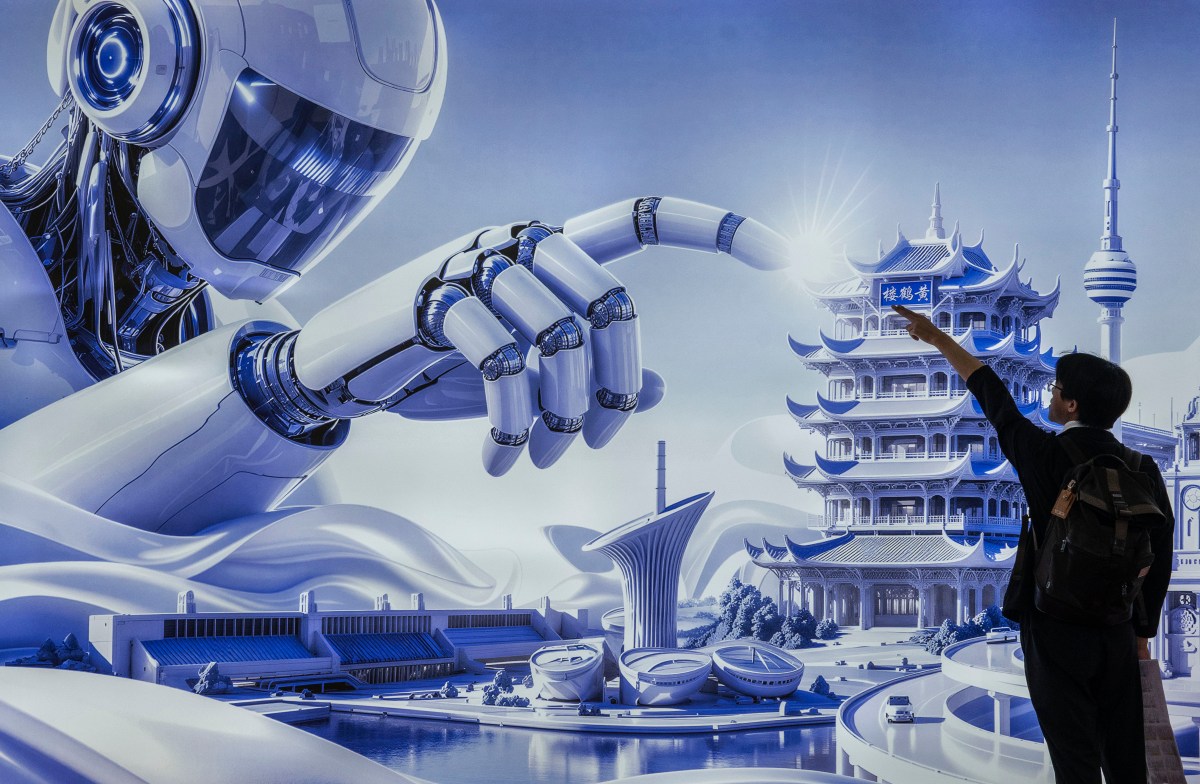
In defending data centers—and now the technology itself—President Donald Trump and his administration have painted China as an adversary eager to exploit any self-imposed handicaps by the U.S., while blaming the nation for choreographing the current domestic backlash against the AI buildout.
This week, Trump criticized wary developers as “conspiracy theorists” peddling a “sick hoax,” and argued that any guardrails on the tech would only serve Beijing’s interests.
This came after executives like Anthropic CEO Dario Amodei and OpenAI CEO Sam Altman warned of potentially apocalyptic consequences if the tech’s advancements outpace its own developers, and called for a slowdown in the frenetic frontier-model push.
“WHOEVER WINS AI, WINS!" Trump posted to Truth Social on Monday, while arguing that the only safeguards needed are a “STRONG AND SMART (High IQ!) PRESIDENT.”
Some officials within China have downplayed the notion that regulation on the tech would only benefit Beijing. Quoted by the BBC, the country’s foreign ministry spokesperson said this week that "narratives of threat, confrontation, and malicious competition serve only to disrupt the process of global AI governance and are not in anyone's interest.”
But to the U.S., the matter is existential, and the battle extends well beyond Silicon Valley or the borders of either nation.
“If the United States loses the AI race and China is the main competitor,” David Sacks, Trump’s former AI “czar,” told CBS News, “then I think we should expect that the U.S. will not be the number one country in the world.”
“America is in a race to achieve global dominance in artificial intelligence,” reads the introduction to the administration’s “AI Action Plan,” published last year, and which identifies countering China’s global influence as among the core motivations for “winning this race.”
The competition has been compared to the Space Race and the Cold War's nuclear arms race, with notions of progress similarly relying on technological milestones like which country can develop the most capable frontier models or do so while expending the fewest resources.
More broadly, however, policymakers in both countries have viewed establishing a "lead" in this race as success in integrating AI across society and industry while reaping the rewards of doing so.
“I think winning means first having the most advanced AI companies, which the U.S. currently does in the case of firms like OpenAI and Anthropic,” said Chris Miller, a professor at Tufts University and author of Chip War: The Fight for the World's Most Critical Technology. The second aspect, he told Newsweek, would be “deploying AI rapidly” and harnessing its economic benefits.
Winning the AI race would therefore involve establishing a commanding and unbridgeable lead when it comes to employing the technology—effectively using homegrown models for scientific, economic and military purposes.
“The more meaningful measure of success will be whether a country can translate technical capabilities into broad economic and social gains,” said David Lin, Senior Director for Future Technology Platforms at the Special Competitive Studies Project (SCSP).
Lin, a former State Department and Central Intelligence Agency (CIA) analyst, told Newsweek this would comprise helping a labor force become more productive, promoting new scientific discoveries, improving public services, and establishing industries which were “previously constrained by technological bottlenecks.”
“Developing frontier models matters," he said, "but so does diffusing AI safely and effectively throughout the economy.”
“There is no day after tomorrow if China wins at this,” Treasury Secretary Scott Bessent said at an event in D.C. last week. “If they were to pull away from us on AI, then nothing else would matter.”
And many of the prophecies about a Chinese AI future—from both officials and the private sector—have been similarly apocalyptic. A white paper from AI researcher and investor Leopold Aschenbrenner, published to much discussion in 2024, warned that the country could use the tech to manufacture “advanced bioweapons…that could target specific ethnic groups, e.g. anybody but Han Chinese.”
Others, however, see the consequences as less extreme, and the Manichean, winner-takes-all framing of the AI race as mistaken.
“I don't think there is a single AI race nor really a fixed finish line,” according to Lin, who considers it unlikely that one nation will be victorious across “every dimension of AI.”
However, he sees a future in which China’s “sprawling manufacturing industrial base” gives it control over “AI infrastructure, autonomous systems, and technical standards across large parts of the world.”
But this technological dominance, he notes, will likely remain “subordinate to the Chinese Communist Party’s priorities of political control and regime security.”
Miller told Newsweek that this would present a particular vulnerability for the U.S. if it came to rely on “Chinese systems with the rules of those systems written in Beijing.”
He pointed to a recent article from China’s State Security Minister Chen Yixin, who said that the motivation for securing and maintaining AI dominance was to ensure that the CCP itself maintains a handle on power.
“I understand why the Chinese Communist Party wants that,” said Miller, “but I think Americans understandably don't want to rely on AI systems with those priorities themselves.”
To Ben Charoenwong, “winning” the race for China may be less to do with the advancements and capabilities of its models—and markers of progress like “solving previously impossible math questions”—than the successful integration of these into its economy.
Charoenwong, a professor of finance at the INSEAD business school campus in Singapore, told Newsweek that China is already ahead along this metric, and will continue using the technology “to drive productivity gains that show up dramatically in GDP growth, more so than in the U.S.”
Lin said that with technological dominance Beijing could secure “considerable economic and geopolitical influence”—able to promote its own version of global governance and cooperation as companies and counties become “become dependent” on its suppliers and practices.
“China would also be better positioned to capture the productivity gains, industrial advantages, and new markets created by AI,” he added.
And Daniel Remler, a senior fellow at the Center for a New American Security (CNAS), said that one of the more threatening outcomes from the perspective of U.S. national security was China leveraging its AI advantages “to establish a technology sphere of influence over other countries and regions that then hardens into political alignment.”
“The result would be a diminishment not just of American power and prosperity but also the capacity of other countries, particularly in Asia, to remain free from CCP coercion without running significant risks, as well as the further strengthening of CCP authoritarian rule over and oppression of the Chinese people,” he told Newsweek.
Lin notes that “unchallenged American dominance” would carry its own set of issues, including the concentration of economic and political power “in a small number of companies.”
“The goal then should not be dominance at any cost,” he told Newsweek. “It should be durable American leadership rooted in innovation, broad adoption, alliances, competition, and safeguards perhaps most importantly, consistent with democratic values.”
China has placed AI at the heart of its national strategy, and has set its sights on global leadership by the end of the decade. But like in the American private sector, some Chinese officials are also expressing wariness over uncontrolled advancements that could soon become uncontrollable.
During a July speech at the 2026 World AI Conference in Beijing, Xi Jinping highlighted the risks of runaway tech.
“We should take seriously the various types of inherent and secondary risks that AI may trigger. We should put in place laws and regulations, technological monitoring, early warning and emergency response systems in order to strengthen the line of security, prevent abuses and malicious use, and ensure that AI is always under human control,” he said, as quoted by the state-run Xinhua news agency.
But the country continues to devote significant resources toward advancements in and integration of AI, and “central planning has allowed China to rapidly develop its sovereign technology and expand its global influence,” according to researchers at the University of Virginia National Security Data and Policy Institute.
And some believe its progress has even been facilitated by Washington’s confused approach to the AI “race.” Early this year, the administration reversed its stance on the export of advanced AI chips to China, even though its “AI Action Plan” calls for restricting chip exports to its “foreign adversaries” and “countries of concern.”
Anthropic’s CEO—whose remarks have helped fuel the recent concerns about AI and the associated race against China—told CBS News the “toughest dilemma” about his calls to put a “speed limit on the rate of AI progress” was the possibility that China would ignore these calls.
A global approach to regulation and guardrails will, he acknowledges, “be very difficult because the incentives to pull ahead and the military advantage that you get from that are so large.
“And honestly, I don’t know if it’s possible, but we should we should try.”
Contact Newsweek editors on this story: John Fitzpatrick and Gray R. Thomas