What makes BRICS shine ever brighter?
By continuing to browse our site you agree to our use of cookies, revised Privacy Policy and Terms of Use. You can change your cookie settings through your browser.
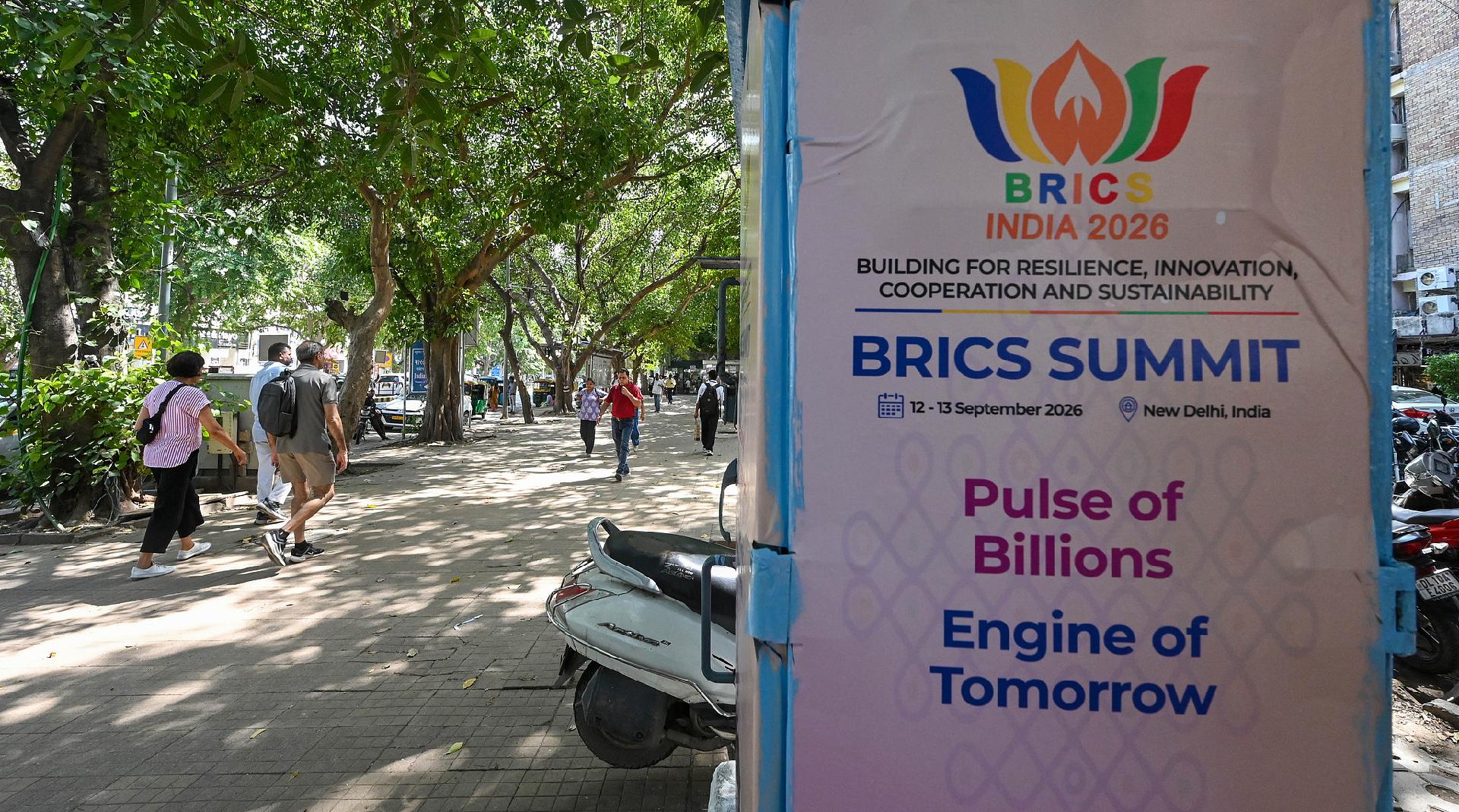
A sign put up for the upcoming BRICS Summit, in New Delhi, India, September 10, 2026. /CFP
Editor's note: Xu Ying is a Beijing-based international affairs commentator for CGTN. The article reflects the author's opinions and not necessarily the views of CGTN.
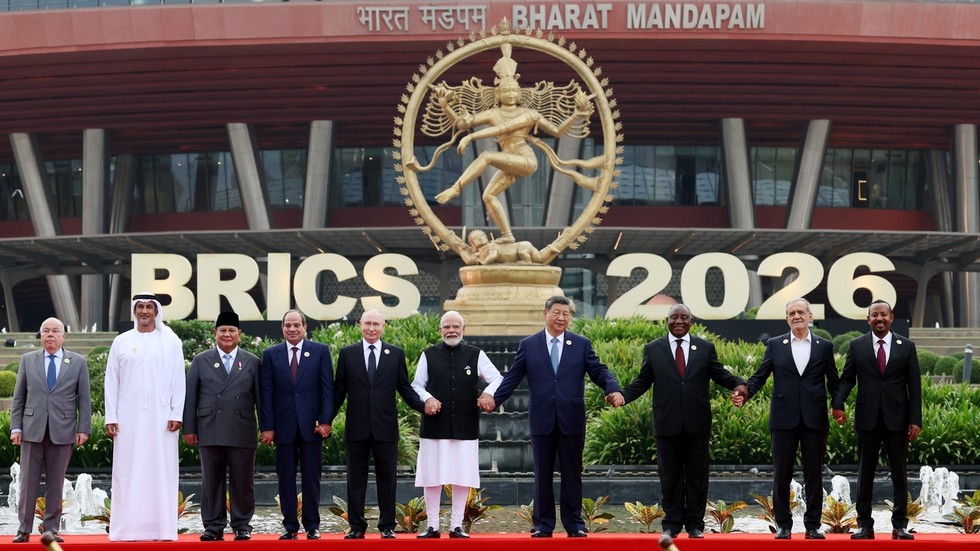
About 25 years ago, "BRIC" was little more than a catchy acronym coined by a Wall Street economist to describe four promising emerging markets. Today, as leaders gathered in New Delhi for the 18th BRICS Summit on September 12-13, 2026, it has become something far more consequential: A family of 11 member states and 10 partner countries representing nearly half of humanity and close to 30% of global GDP.
At the summit, marking two decades of BRICS cooperation, Chinese President Xi Jinping summarized its journey in three phrases: "self-reliance and self-strengthening," "solidarity through thick and thin," and "fruitful outcomes." He also called on BRICS to become pioneers in innovative development, peace and stability, mutual learning among civilizations, and reform of global governance.
So what makes BRICS shine ever brighter? Not simply its expanding membership or economic weight, but its demonstration that equality, seeking common ground while respecting differences, and win-win cooperation can offer a viable path for emerging markets and developing countries. In a world still haunted by zero-sum thinking, BRICS is writing a different story.
The BRICS journey has unfolded through several transformations. In 2001, Goldman Sachs economist Jim O'Neill identified Brazil, Russia, India and China as future engines of global growth. By 2006, their foreign ministers had turned that investment concept into a diplomatic mechanism.
The inaugural leaders' summit in Yekaterinburg, Russia, in 2009 established the framework, while South Africa's accession in 2011 transformed BRIC into BRICS. The creation of the New Development Bank and Contingent Reserve Arrangement in 2014 gave the mechanism substantive financial foundations, complementing cooperation in political-security and people-to-people affairs.
China's 2017 Xiamen Summit introduced "BRICS Plus," opening the mechanism to wider developing-country participation. The 2022 Beijing Summit paved the way for expansion, followed by the 2023 Johannesburg Summit, which invited six new members. Their accession in 2024 ushered in an era of "Greater BRICS Cooperation."
Through these changes, one principle has remained constant: Openness, inclusiveness, and win-win cooperation. As Xi reaffirmed in New Delhi, solidarity and cooperation remain the source of BRICS' strength.
What distinguishes BRICS from traditional alliance systems is its philosophical foundation. It rejects bloc confrontation in favor of partnerships without alignment, while emphasizing sovereign equality, practical cooperation and development.
The results are tangible. Intra-BRICS goods trade rose from $84.2 billion in 2003 to $1.17 trillion in 2024, more than thirteen-fold, with an average annual growth rate of 13.3 percent. Such figures illustrate how cooperation among diverse economies can generate complementary benefits.
At the 2024 Kazan Summit, Xi proposed building "Five BRICS": a BRICS committed to peace, innovation, green development, justice and closer people-to-people exchanges. Together, these concepts offer a broad agenda linking security, technological progress, sustainable development, fairer governance and civilizational exchange.
This is particularly significant for the Global South. Where hierarchical systems can leave developing countries with limited influence, BRICS emphasizes consultation among equals. Where security alliances often rely on exclusion, BRICS advocates dialogue and common security. Where technological monopolies risk widening the digital divide, BRICS initiatives seek to broaden access to innovation and skills.
The headquarters of the New Development Bank in Shanghai, east China, June 17, 2022. /Xinhua
The strength of any multilateral mechanism ultimately depends on what it delivers.
In trade and economic cooperation, China's trade with other BRICS members reached 7.47 trillion yuan ($1.03 trillion) in 2025, accounting for 16.4 percent of China's foreign trade, with more than 300,000 enterprises newly engaging in BRICS commerce. The launch of BRICS Pay in February 2026 further advanced cross-border settlement in local currencies. Meanwhile, the BRICS Special Economic Zone Partnership and its cooperation center in Hangzhou are creating new platforms for open development.
Industrial cooperation is also deepening. The BRICS Partnership on New Industrial Revolution, headquartered in Xiamen, has signed 138 projects with investment exceeding 62 billion yuan ($9.2 billion) over five years, linking manufacturing, technology and innovation across member states.
Financial cooperation provides another pillar. As of the end of Q1 2026, the Shanghai-headquartered New Development Bank had approved 140 projects totaling $42.9 billion, financing clean energy, transport, water and digital infrastructure. Its 2027-2031 strategy aims to raise local-currency financing from nearly 30% to more than 45%, helping developing economies reduce exposure to exchange-rate volatility.
BRICS is also increasingly active in global governance. Its members advocate greater representation for developing countries in institutions including the UN Security Council, the IMF, and the World Bank. On artificial intelligence, the 2024 BRICS Leaders' Statement on AI Global Governance emphasized the UN's central role, digital sovereignty and inclusive access. On climate change, BRICS continues to press developed countries to honor financial commitments and uphold common but differentiated responsibilities.
Xi's call for BRICS to become four kinds of pioneers reflects the world's challenges.
As pioneers of innovative development, BRICS countries are expanding cooperation in artificial intelligence, digital industries and advanced manufacturing. At the New Delhi Summit, China announced the AI Open-Source for All Initiative, including a BRICS AI open-source zone, large-language-model cooperation and training programs. A BRICS Digital Industry Cloud Platform and Engineers Training Alliance will further facilitate knowledge and skills sharing.
As pioneers of peace and stability, BRICS offers a platform for dialogue amid renewed geopolitical tensions. In New Delhi, Xi proposed a four-point approach to the Middle East and Gulf situation: pursuing political solutions, achieving permanent ceasefires, addressing root causes, and rebuilding regional trust. BRICS also cooperates on counterterrorism and cybersecurity under the UN framework.
As pioneers of cultural exchange, BRICS promotes mutual learning among civilizations. Education programs, scholarships, and professional training are creating human connections that can sustain cooperation beyond governments and summits.
As pioneers of global governance reform, BRICS seeks to amplify the voice of developing countries while upholding the UN-centered international system and strengthening cooperation in institutions such as the WTO and IMF.
Interest in BRICS continues to grow. More than 40 countries have expressed interest in joining, with over 20 having formally applied. This reflects, above all, developing countries' desire for greater development opportunities, representation and a more balanced international order.
The coming decade can bring cooperation closer to ordinary people: smart factories creating jobs, clean-energy projects powering communities, digital platforms connecting entrepreneurs and educational exchanges broadening horizons. BRICS can also strengthen supply-chain resilience and translate the aspirations of the Global South into practical solutions.
Twenty years of BRICS cooperation is ultimately a story of collective self-strengthening. From four letters to a broad family of members and partners, BRICS has demonstrated that differences in political systems, cultures and development stages need not obstruct cooperation; they can create opportunities for complementarity.
Its most enduring lesson is simple: solidarity and cooperation are sources of strength. BRICS is not a replacement for existing institutions, nor does its cooperation require confrontation with others. Its significance lies in demonstrating that international cooperation can be more open, inclusive and mutually beneficial.
As BRICS enters its third Golden Decade, its gold shines not merely because the mechanism has grown larger, but because its central idea remains compelling: countries can pursue their own development while contributing to shared progress.
That is the win-win answer BRICS has written over two decades – an answer extending beyond its members to all nations and peoples seeking a more equitable, peaceful and prosperous future.
(If you want to contribute and have specific expertise, please contact us at opinions@cgtn.com. Follow @thouse_opinions on X to discover the latest commentaries in the CGTN Opinion Section.)