
What makes Hinduism in Bengal distinctive? A history of Shaktism, Tantra and Bhakti - The Indian Express
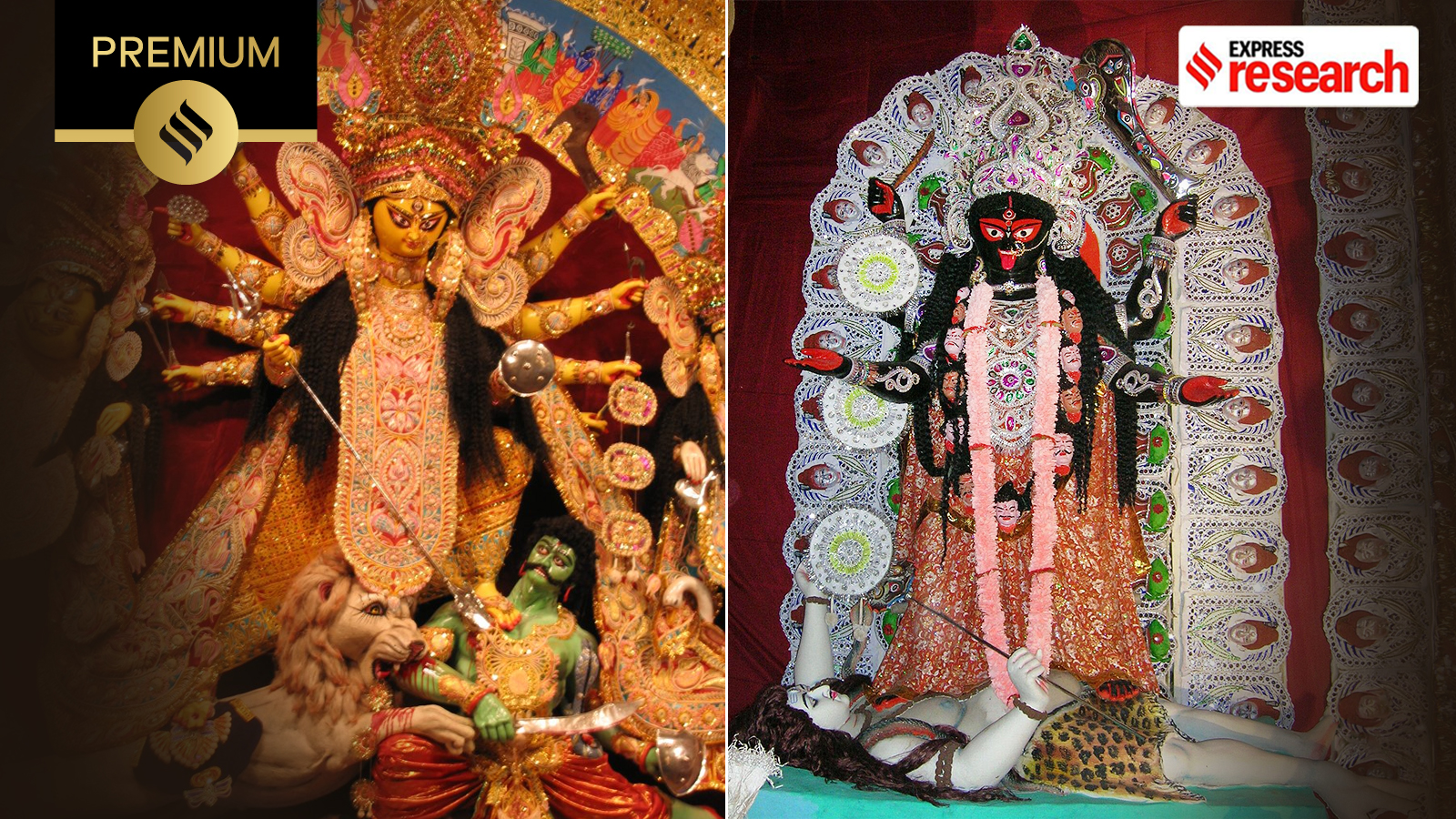
What makes Hinduism in Bengal distinctive? The question has acquired new urgency ahead of this year’s Durga Puja, amid debates over meat-eating during the festival and new rules prohibiting DJs and liquor. At the heart of these controversies lies a larger question: why do some practices that are discouraged or prohibited in some Hindu traditions remain an integral part of religious and cultural life in Bengal?
Part of the answer lies in the historical prominence of Shaktism, or the Shakta tradition. Centred on the worship of the divine feminine, Shaktism developed a distinctive regional expression in eastern India, shaped in part by Tantricism and its interaction with Gaudiya Vaishnavism. Together, these influences shaped the particular forms of goddess worship that took root in Bengal and its surrounding areas.
The tradition of goddess worship has existed in the Indian subcontinent for several centuries before Vedic Brahmanism emerged. Female figurines found at Indus Civilisation sites have been interpreted as representations of mother goddesses, though their religious significance remains debated. Goddess worship is particularly long-lived and deeply rooted in Bengal and the surrounding regions, including parts of present-day Bihar, Assam and Odisha. The deities were known by different names and associated with a range of attributes and functions, most importantly the protection of the family or village that worshipped them.
“In Bankura district, for instance, the village of Chhandar was associated with the goddess known as Jangalasini Devi, Lakhershole village with Kamakhya Devi, Naricha village with the deity Sarvamangal Devi, Ajodhya village with the deity known as Kaluburi and Raipur village with Ambika Devi,” writes historian Kumkum Chatterjee in her research paper, Goddess Encounters: Mughals, Monsters and the Goddess in Bengal (2013).
There were also goddesses associated with disease and other social fears. Ola Bibi, for instance, is worshipped to ward off cholera, while goddess Manasa is worshipped for protection from snakebites.
Kunal Chakraborty, a retired professor of Ancient History at JNU, whose research focuses on the social history of religion, notes that Bengal’s association with goddess worship is due to the late entry of Brahmanism in the region. In his book, Religious Processes: The Puranas and the Making of a Regional Tradition (2001), he argues that “Bengal remained outside the sphere of Brahmanical influence for a long time, and large-scale Brahmana migration to Bengal did not begin before the Gupta period (mid-4th century to 6th century CE).”
He further notes that even when Brahmanism eventually seeped into Bengal, the goddess tradition was already so firmly established that it demanded recognition from the Brahmanas. “The newcomers, who had to adjust with the prevailing tradition adopted these goddesses with suitable modifications and transformed them into Brahmanical divinities by means of a carefully constructed Sakta theology,” he writes.
Thereafter, Brahmanists adopted folk goddesses like Manasa and Shashti by incorporating them into the Sanskrit Brahmanical Puranas composed in eastern India from the eighth or ninth centuries till about the 13th or 14th century. At the same time, there were attempts to give them Brahmanical genealogies and identities. For instance, the 15th-century Manasa Mangal Kavya identified Manasa as Shiva’s daughter. The Mangal Kavyas were a group of Bengali religious texts composed between the 13th and 18th centuries that carried narratives about indigenous deities of rural Bengal.
Durga, in the manner in which she is celebrated in Bengal today, is first described in the ‘Devi Mahatmya’ in the Markandeya Purana, where she is shown as the destroyer of the demon Mahishasura. Scholar of religion Thomas B. Coburn, in a translation of the Devi Mahatmya, describes the goddess as emerging from the combined radiance of the gods. She is depicted as a formidable warrior, armed with weapons and mounted on a lion, who subsequently defeats Mahishasura.
June McDaniel, a scholar of religious studies, in her book, Offering Flowers, Feeding Skulls: Popular Goddess Worship in West Bengal (2004), writes, “Durga grew to this lofty status over time.” She was incorporated through the village deities existing in Bengal. As an agricultural goddess, for instance, she was worshipped as Vana Durga, or goddess of the forest.
The predominance of the Shakta tradition continued well into the 20th century and beyond. In her book, McDaniel cites Professor Narendra Nath Bhattacharya, an expert on the Shakta tradition, who estimates that nearly 90 per cent of West Bengal’s population is Shakta to some degree.
The Shakta tradition in Bengal evolved along its own trajectory, shaped in part by Tantricism, which emerged around the 6th and 7th centuries.
David B Gray, a scholar of religious studies, in his research paper, Tantra and Tantric Traditions of Hinduism and Buddhism (2016), writes that Hindu Tantric traditions emerged in the subcontinent from the mid-first millennium CE.
The Tantric tradition, he writes, emerged at a time when Vedic Hinduism was undergoing a series of transformations. “This period saw the rise of both the Tantric and the Bhakti devotional movements. While the latter drew from the tendency toward monotheism seen in late Vedic literature, Tantricism developed from Vedic ritual traditions as well as from the yogic and meditative traditions that developed both within ancient Hinduism as well as in rival Buddhist and Jain traditions.”
In an interview with indianexpress.com, Madhu Khanna, scholar of Tantric studies, says, “The tantras rectified and replaced the major gaps and limitations found in orthodox Brahmanical religiosity. For instance, the orthodox Brahmanical tradition, for centuries, upheld caste inequality, gender subordination, repressive asceticism of the body and the denial of the senses. The Tantric masters changed these precepts.”
The tantras, she says, gave prominence to women. “The Tantric pro-gender codes state that women have the authority to become priestesses and gurus, initiate disciples, run their own respective ashramas and hold positions of power in the religious sphere.”
She also notes that while the Vedic religion had very strict notions of purity and impurity, the tantras believed that only one’s ‘bhavana’ (emotion) made something impure. “Tantricism made a rupture and created a Hinduism that was extremely pluralistic, while also being holistic.”
Bengal and its surrounding areas, she notes, emerged as an unrivalled centre of Tantricism. Among the reasons for the proliferation of tantra in the region is the rule of the Pala kings between 780 and 1174 CE, under whose patronage Bengal and Bihar were among the most renowned centres of the cultivation of Tantric culture. For instance, Vikramshila University, in present-day Bhagalpur, Bihar, was established by the Pala king Dharmapala in the 8th century CE, and it became a premier centre for Tantric Buddhism and occult studies.
Under the Sena dynasty that followed, the religious beliefs, values, and sacred practices of Shakta Tantra were codified in the Bengali vernacular.
“Tantra took root in Bengal through the goddess culture,” says Madhu. She argues that the goddess worshippers of the region were also great critics of the Brahmanical tradition, thereby making it easier for Tantricism to thrive.
Tantricism had a significant impact on how Hinduism was practised in the region, going so far as to influence the mantras and mudras practised during worship. Madhu points out that the mantra chanted during the worship of goddess Durga, Om Aim Hreem Klim Chamundayai Vicche, is tantric in its nature.
By the 15th century, the Bhakti movement, which originated in South India, had spread to Bengal, where it developed a distinct expression in the form of Krishna-centred Gaudiya Vaishnavism. The tradition gained particular prominence in the region through the teachings of Chaitanya Mahaprabhu in the late 15th and early 16th centuries.
Over time, the Gaudiya Vaishnava movement interacted with the goddess traditions of Bengal and was, in turn, influenced by them. Vaishnava Bhakti brought an emphasis on an intimate and emotional relationship with the deity, while Shakta and tantric ideas also informed Bengali Vaishnava traditions. “Interestingly, among Gaudiya Vaishnavas, there is a greater emphasis on the worship of Radha than on Krishna himself,” McDaniel told indianexpress.com.
In her book, McDaniel mentions the 18th-century Bhakti poet Ramaprasad Sen, whose poetry often transformed the esoteric and powerful goddesses of the Shakta tradition to appear as beautiful and loving. “Devotees worship the goddess with great intensity as Kali Ma (who is sometimes frightening on the outside, but inwardly loving and compassionate), Tara Ma (who gives knowledge and liberation), and many others,” she writes.
The devotional approach towards goddess Kali, or what is known as Kali Bhakti, was further popularised by the 19th-century saint Ramakrishna Paramahamsa of Dakhineshwar.
The intense emotional relationship with the goddess, superseding fearful obedience, reflects the influence of Gaudiya Vaishnavism. “Goddess Kali would appear to be different from all other goddesses in her form. She is black, four-armed, carrying a sword in one hand and a severed head dripping with blood in the other. Her appearance is frightening,” says Madhu, “but ask a Bengali, and they see Kali as maa, embodying the real essence of the benign mother.”
Goddess Durga perhaps best represents the convergence of these three historical religious strands in Bengal. She is the fierce slayer of demons, but also the divine mother, Durga Maa. At the same time, she is Bengal’s beloved daughter, whose annual homecoming is awaited throughout the year and celebrated with a fervour that extends beyond conventional religious boundaries.
Adrija Roychowdhury leads the research section at Indianexpress.com. She writes long features on his... Read More


