What Putin’s Election Victory Means for Next Phase of Ukraine War - Newsweek
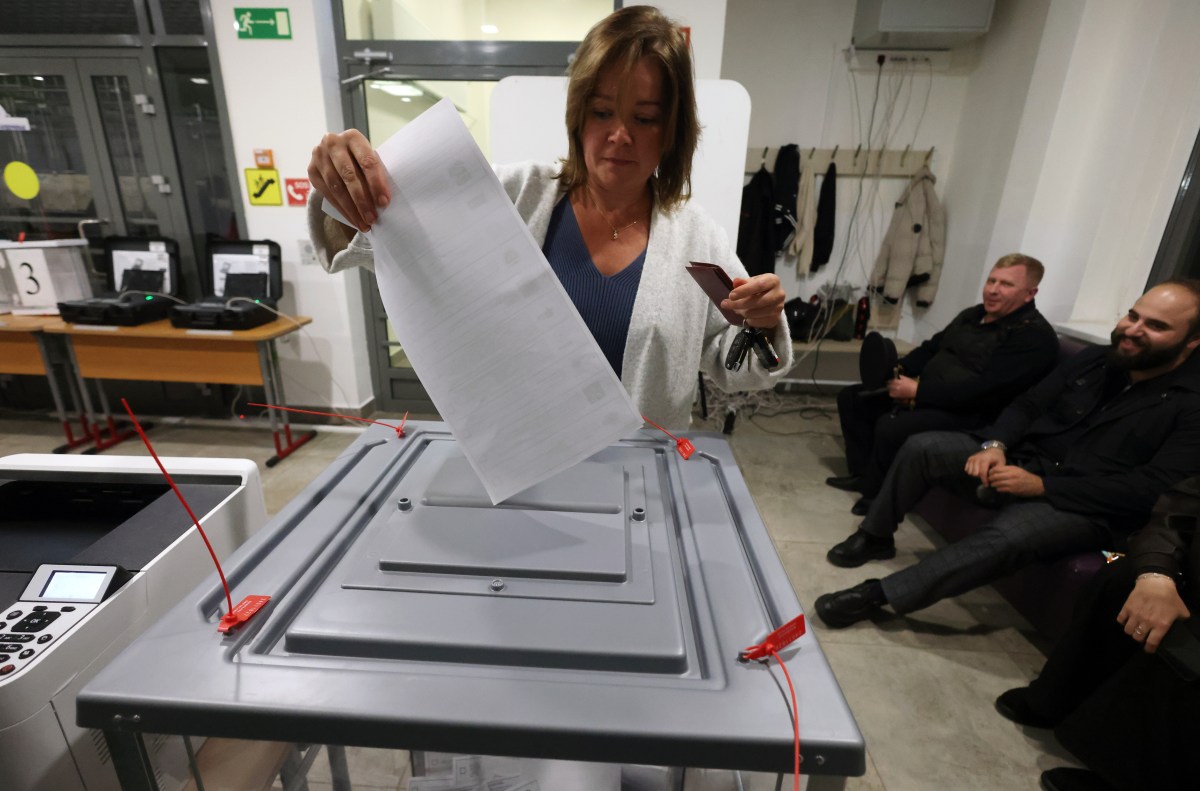
The United Russia party has won a record number of parliamentary seats after a controlled election that President Vladimir Putin is likely to use as a mandate to continue his aggression in Ukraine, a Russian economist has told Newsweek, as speculation grows over whether the election will precede a military draft.
Russia's Central Election Commission (CEC) said on Monday that the ruling United Russia party linked to Putin would get 355 seats in the 450-seat State Duma. This would beat its previous record from 2016 of 343 seats, after getting almost 58 percent of the party-list vote and dominating single-member districts.
Reports of ballot stuffing, malfunctioning voting machines and a turnout analysts said was inflated marked the three-day election that took place amid stubborn inflation, new U.S. sanctions and a wartime economy that Russians are feeling. Newsweek has contacted the CEC for comment.
Sergei Guriev, who served as rector at Moscow's New Economic School between 2004 and 2013 and was an informal adviser to former President Dmitry Medvedev, told Newsweek on Monday that Putin would point to the ballot as showing that Russians can handle the economic pinch as he doubles down on his war aims of Ukraine's capitulation.
"Putin already said that the war is not free; it is costly," said Guriev, the dean of London Business School and a prominent Kremlin critic. "He will use this result as confirmation that Russians are happy to tighten their belts."
There has been speculation over whether the election will be followed by a mobilization of hundreds of thousands of troops, as warned by Kyiv, to replenish Moscow's losses in Ukraine, which number up to 1,000 a day, according to Kyiv and Western estimates.
The Kremlin has denied any imminent draft. But following a botched partial mobilization in September 2022, it has built digital infrastructure to ease the calling up of troops and tightening potential escape routes.
Bloomberg reported last week that Russian officials are trying to move assets abroad and encouraging friends and relatives to leave Russia, fearful that their high status would not save them from the front line.
Guriev said that given Russia's growing budget deficit and record military spending, it would be cheaper for Putin to draft soldiers by force, and this is a risk he may soon have to weigh up.
"There is a political cost to the mobilization and then there is economic cost in hiring a mercenary army," Guriev said, adding that Putin "needs to compare the political cost, and he may actually interpret this vote as saying actually Russians are OK [with a draft]."
This may not be the case, "but he may be misinformed" about the true level of support he has, Guriev continued.
Yabloko, the anti-war party that was initially allowed to run, was excluded from running by Russia's Supreme Court because of alleged violations of election campaigning rules, sparking accusations of the election being neither free nor fair.
United Russia gained 8 percentage points more of the vote than in 2021, and the official turnout reached almost 60 percent, the highest for parliamentary elections since 2003.
Russia analyst Farida Rustamova said on Telegram that this turnout was "completely unrealistic" given the nonexistent election campaign, with parties not engaging in serious campaigning.
She said that five years into the war, the Kremlin wants a parliament "as controllable as possible, in case of any unforeseen developments—such as the war ending or, conversely, escalating."
United Russia is set to enter the Duma along with four other parties, according to the results—which are expected to be finalized this week. The second biggest party in the 450-seat lower house, according to projections, will be the Communist Party with 40 seats. The other parties, which form the country's systemic opposition, are the nationalist Liberal Democratic Party with 25 seats, New People with 20 seats and A Just Russia with four seats.
Russian Foreign Minister Sergey Lavrov said on Sunday that the results would confirm Russian political parties' and voters' support for Putin's foreign policy. Medvedev, who now serves as deputy chairperson of the Russian Security Council, said United Russia would continue to support Putin's foreign policy objectives and efforts to achieve victory over Russia's "enemies."
Tatiana Stanovaya, a Russian political scientist and founder of the R.Politik analysis firm, said Putin would interpret the results as a validation of support for the war, even though there is a growing demand for it to end, which the election carefully masked.
But there are no signs that this anti-war sentiment is finding an outlet, with no surge in support for the Greens—a left-wing party that might have captured Yabloko's voters, Stanovaya added in a Telegram post.
Guriev said the economic impact of the war is becoming a political liability for Putin, with some officials issuing dire financial forecasts. German Gref, the head of Sberbank, Russia's largest bank, has warned of stagnation.
Another key figure, Andrei Klepach, the chief economist at the Russian state development bank VEB, was fired in August after saying Russia was falling behind the economies of China and the U.S.
Meanwhile, repeated Ukrainian drone strikes on e-retailers Wildberries and Ozon and miles-long petrol station queues have brought the war into Russia in a way the Kremlin would have wanted to avoid.
"Russians are asking a lot of questions about this, and of course the objective of Ukrainians now is to deliver this message that this is not just a distant war," Guriev said.
"That of course reduces support for the war, and that eventually creates openings for people around Putin to be more concerned about the war and less afraid to speak publicly about this" he added.
When a key official speaks publicly about the economic cost of the war, it means that this person cannot talk to Putin directly, "or they gave up talking to Putin because they see that he doesn't want to listen," Guriev continued.
Increased criticism of the war by Russian officials could also precede a jockeying for position to be on the right side of history if they predict the end of Putin's rule, he said, but it is not known for sure.
Guriev added, "This is, as Churchill would say, 'like bulldogs fighting under a rug.'"
Contact Newsweek editors on this story: Matthew Robinson and Shakeema Edwards.