What schools will do amid intense heat during El Niño - Rappler
Already have Rappler+? Sign in to listen to groundbreaking journalism.
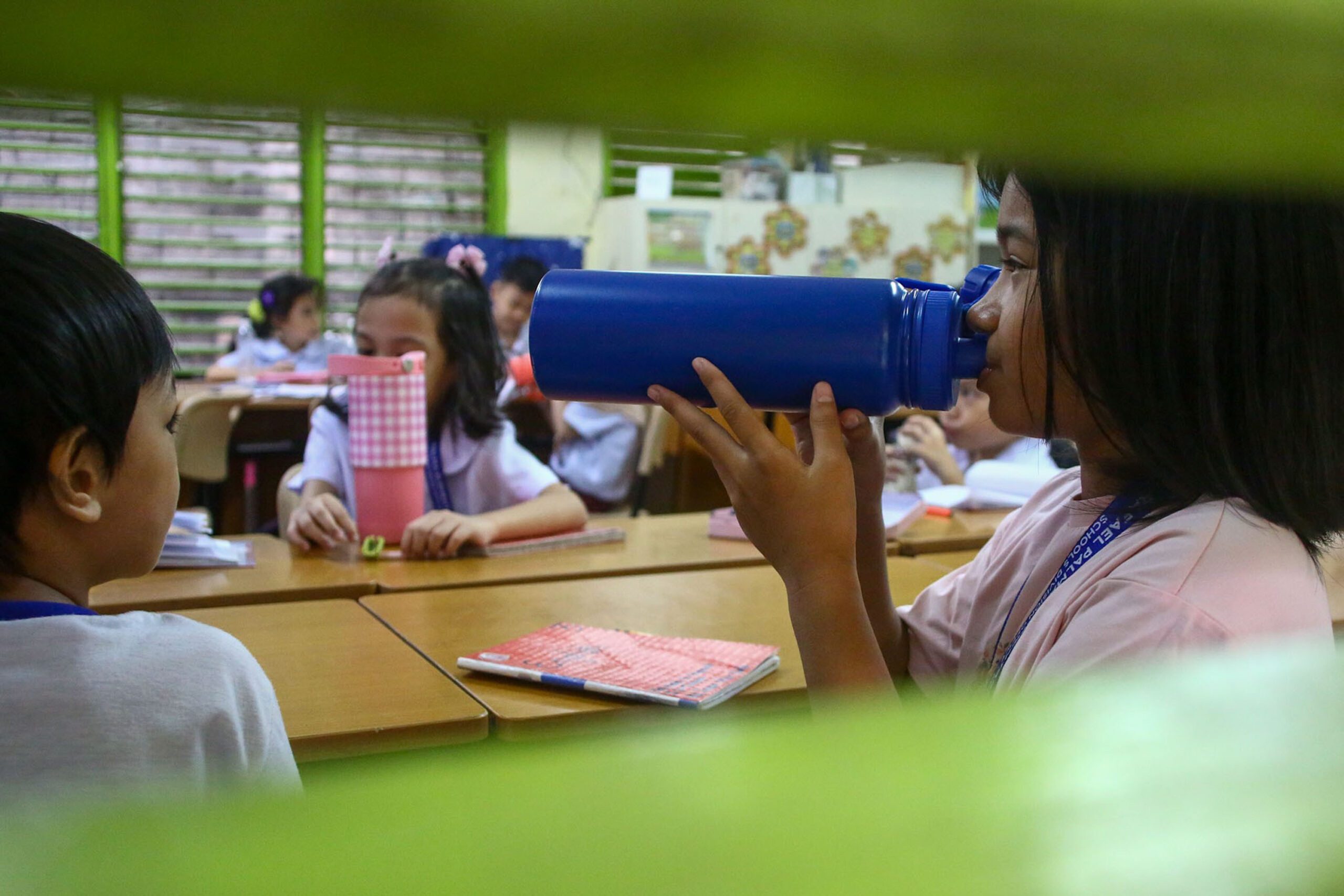
HYDRATION. A student at Rafael Palma Elementary School in Manila drinks from her tumbler on October 8, 2026.
This is AI-generated. Read the article for full context. Report any errors.
MANILA, Philippines – The education sector will not be spared when El Niño worsens in the coming months. Across the country, temperatures are expected to be warmer than usual, which would pose another threat to students’ learning.
Education Secretary Sonny Angara previously said government protocols would ensure that El Niño’s effects are mitigated in public schools.
The Department of Education (DepEd) released its Memorandum No. 64 on Monday, October 26, which laid out preparations for the impact of the weather phenomenon. Here are the important details:
In an interview with Rappler on Friday, October 23, Education Undersecretary Malcolm Garma said the DepEd is concerned that lost school days may increase due to high heat index levels. The heat index, or the temperature that the human body perceives, is measured using the air temperature and the relative humidity in a place at a given time.
Garma noted that the DepEd’s existing class suspension guidelines, issued back in June, already spell out learning continuity plans for schools.
According to the guidelines, under Level 1-Hayo, face-to-face classes continue during manageable conditions. Schools can set scheduled water breaks, shift outdoor activities to early morning or shaded areas, and allow students to wear comfortable clothing or Physical Education attire.
At Level 2-Hinay, schools may lessen face-to-face class hours to adopt modified class days with structured home-based or hybrid learning. Under the guidelines, modified schedules may be 6 am to 10 am for the morning shift, and 2 pm to 6 pm for the afternoon.
When the heat index is between 33°C and 41°C or there is loss of water supply, face-to-face classes are suspended under Level 3-Hinga. Such a heat index level can cause heat cramps or heat exhaustion. Learning packets, short activities, and broadcast resources may be used to reduce academic demands.
Once the heat index reaches 42°C and above, academic activities, both face-to-face and home-based learning, are suspended at Level 4-Hinto. Schools will focus on safety checks and psychosocial support referrals.
Garma said self-learning modules, activity sheets, and other materials needed for alternative learning will be prepositioned before the peak months of intense heat.
In case actual conditions turn out to be worse than projected, Garma said school heads can adjust class schedules or recommend granular suspensions of face-to-face classes. But he added that the situation must be properly assessed.
Under the guidelines, the DepEd said, calibrated thermometers with hygrometers must be installed in classrooms to monitor actual temperature and humidity levels.
“Hindi naman ‘yung school head ay basta-basta na lang siyang magpapauwi o magsu-suspend. So kailangan mai-vet ito ng [schools] division office…or [they should] even coordinate with the local government unit. Para sa gano’n, talagang hindi naman maabuso din ‘yung pagsususpende ng klase,” the DepEd official said.
(The school head cannot just decide to send students home or suspend classes. This must be vetted by the schools division office or they should even coordinate with the local government unit. This is to prevent abuse of class suspensions.)
“While we are looking after…the welfare of our learners, we also have to ensure that learning continues. At alam naman natin na pinakamainam pa din na learning delivery natin ay kung school-based ito or face-to-face (And we know that the best learning delivery is school-based or face-to-face),” he added.
As learning is expected to be disrupted, the DepEd will be identifying essential learning standards and skills in literacy, numeracy, and other key subjects. The guidelines advise schools that mastery of these essentials will be prioritized over rigid curriculum coverage.
Amid El Niño, schools are also told to strengthen the integration of disaster risk reduction and climate change adaptation.
Youth for Environment in School Organizations-led activities and other co-curricular activities must also be used to provide practical lessons on heat safety, water conservation, and other El Niño-related concepts.
Garma said the DepEd has ordered schools to make hydration facilities and equipment, such as safe drinking stations and water dispensers, accessible to learners and personnel.
The DepEd also told schools to repair water leaks immediately and coordinate closely with local water concessionaires for rationing contingencies.
Social Welfare Secretary Rex Gatchalian earlier raised the possibility of deploying community water depots to public schools. These depots are rainwater catchment equipment with built-in filtration systems to provide potable water during shortages. Garma said the DepEd welcomes such proposals.
Regarding health, Garma said school clinics will be ready to address medical concerns like heat stroke or dehydration. Additional support from local government units (LGUs) and the Department of Health will also be tapped for emergency response.
With El Niño also threatening agriculture and food supply, schools division offices and schools were directed to develop contingency menus for the school-based feeding program, partner with LGUs and cooperatives for local food sourcing, and maintain buffer stocks of shelf-stable commodities.
The DepEd directed schools to conduct integrated school-level risk assessments covering water supply reliability, classroom thermal safety, electricity resilience, and fire hazard prevention.
Schools are prohibited from charging or requiring parents to buy cooling equipment, connectivity, or specialized attire as a condition for alternative learning modalities.
Public schools can use their funding for maintenance and other operating expenses to buy additional ventilators like electric fans. They can also coordinate with local school boards to access the special education fund or tap disaster preparedness and response program allocations.
But Garma said the DepEd’s long-term solution is structural intervention.
“For old classrooms, we cannot change their designs; we can only do mitigation. But for those classrooms under construction and for future ones, we’ll make sure that there will be structural intervention such as high ceilings, insulated ceilings, and wide airflow,” he said in Filipino.
Garma also said the DepEd is exploring the possibility of institutionalizing the use of solar power in schools to reduce electricity costs and possibly provide air-conditioning. – Rappler.com