What the Crimean bridge attack means for Russia
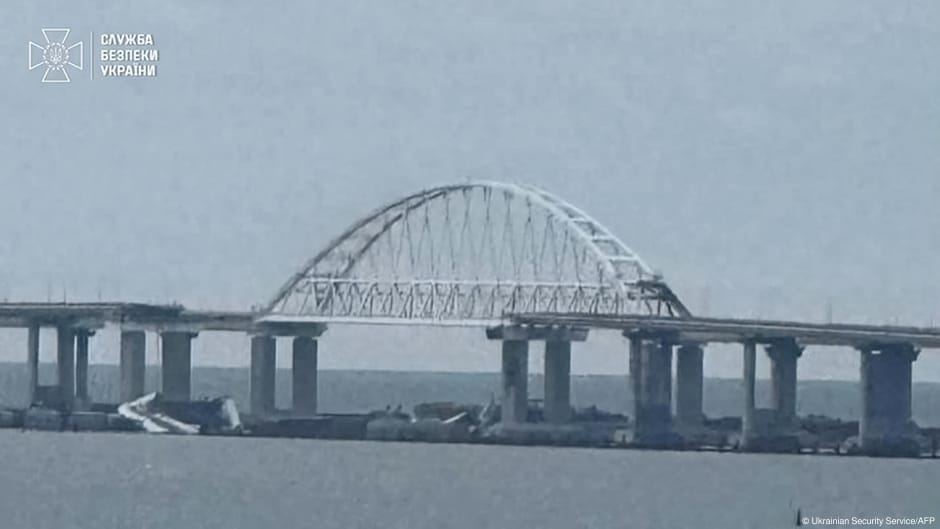
Debris from the destroyed bridge arch is obstructing the main shipping route linking the Black Sea and the Sea of AzovImage: Ukrainian Security Service/AFPAdvertisementIt had been a year and a half since Ukraine last attacked the 19-kilometer-long Kerch Bridge connecting Russian-annexed Crimea with Russia's Krasnodar region.
Now, Ukraine has struck again. The attack during the night of November 17 caused the highway section of the bridge to collapse into the sea. As a result, shipping traffic between the Black Sea and the Sea of Azov has also been disrupted.
Russia's ministry of transport announced a "temporary suspension" of road and rail traffic on the bridge, though later, rail services were resumed. Russian authorities have launched a criminal investigation into what they are calling a "terrorist attack." It was only after this announcement that the Security Service of Ukraine (SBU) confirmed the attack.
The Kerch Strait bridge is considered one of Russian President Vladimir Putin's most prestigious projects. Its construction began after Russia's 2014 annexation of the Ukrainian Crimea peninsula, an act considered illegal under international law. The Kerch Bridge was completed four years later.
It has been targeted by Ukraine on several occasions since Russia's 2022 full-scale invasion. The most well-known strike occurred in October 2022, when an explosives-laden truck detonated on the bridge, causing extensive damage and several months of traffic restrictions. The most recent attack took place in June 2025, when the SBU reported that an underwater support structure was blown up.
The latest Ukrainian operation lasted about a month, and consisted of seven distinct phases. "First, the SBU and armed forces systematically neutralized the enemy's air defense system. After that, the direct attack on the bridge began," says the SBU Telegram channel.
Some Russian military bloggers claim that the attack was carried out with the support of Ukraine's Western allies, or at least using their equipment and weapons.
Ukraine has not confirmed this. It has instead pointed out that various Ukrainian-made weapons were used in the attack, ranging from a variety of drones, to FP-5 Flamingo and R-360 Neptun missiles. British daily The Times has cited Ukrainian military sources, saying that Ukraine attacked the bridge without the support of SpaceX's satellite network system Starlink. There has been no confirmation of this so far.
Ukrainian President Volodymyr Zelenskyy, meanwhile, described the strike as a response to Russian attacks: "Russia is attacking our infrastructure every day, particularly bridges in Zaporizhzhia, Dnipro, Kyiv, and the Odesa region." He said "we are rebuilding our infrastructure, but we also remind Russia that the war always returns to where it began."
After the attack, pictures and videos of the bridge were shared on social media. The Krimskij Veter Telegram channel has highlighted damage to the railroad link and questioned why Russian authorities have opted to resume train services.
The Kerch Strait shipping channel is also completely blocked by debris. "This brings road traffic to a standstill, but also shipping between the Black Sea and the Sea of Azov," the channel writes.
Indeed, the Kerch Strait navigational channel is merely 120 meters wide, writes Mychajlo Hontschar of the Ukrainian Center for Global Studies "Strategy XXI" on Facebook. "The strait is shallow, only three to five meters deep."
As early as the 19th century, the seabed was dredged to allow heavier ships to pass from the Black Sea to the Sea of Azov and vice versa. "Now, Vladimir Putin's bridge-building efforts have brought shipping to an indefinite standstill," Hontschar said.
Not only will river-sea vessels no longer be able to leave the waters of the Sea of Azov, the Don, and the Volga, but boats and small ships from the Black Sea fleet and the Caspian flotilla based in Novorossiysk will also be unable to do so.
Many pro-Kremlin Telegram channels have been quick to claim that the bridge does not play an important role in the Russian army's logistics or in supplying Crimea.
The Dva Mayora (Two Majors) channel quotes the "Deputy President of the Republic of Crimea," Olga Kurlayeva, who described the bridge as a "purely civilian structure."
Ukrainian military experts interviewed by DW, on the other hand, point to the systematic disruption of Russian logistics. These efforts also included regular attacks on the R-80 highway leading through Russian-occupied territories of the Donetsk, Zaporizhzhia, and Kherson regions.
Russia cannot replace the Kerch Bridge with any other land connection, says Oleksandr Kovalenko, a Ukrainian military expert with the Information Resistance Group that seeks to counter disinformation. He expects the damaged bridge will cause supply problems for the Russian armed forces: "If there is a resource shortage during attacks or in defense, then either the attacks or the defense will fail."
That is why he does not rule out a decline in attacks from occupied Crimea on the rest of Ukraine. "There are many launch pads for kamikaze drones in Crimea — in the Hvardijsk area, at Cape Chauda and in Balaklava," Kovalenko told DW. "From there, many drones are launched toward Odesa, Mykolaiv, and the right bank of the Dnipro River in the Kherson region. They also fly over Crimea en route toward Ukraine. Then there are attacks using Iskander-M ballistic missiles, as well as Zircon and Oniks missiles, guided missiles, and glide bombs. And while they don't originate in Crimea, they are brought over via the Kerch Bridge."
Kovalenko says the bridge strike has dealt a serious blow to Vladimir Putin's standing. It comes at a sensitive time as Putin is about to meet Chinese President Xi Jinping and US President Donald Trump in Shenzhen, China.
Memes and witty comments about the bridge abound on X. Meanwhile, the Russian president's spokesperson Dmitry Peskov has promised to rebuild the bridge and assured that it will be "even better than before."
Andrii Korezkyj of the Kyiv University of Transportation, however, says this is not likely to happen anytime soon. "All in all, I would estimate that it would take between one and a half and three years [to rebuild]," Korezkyj told DW, adding, "I don't think they'll let the Russians build another [bridge] arch like that near the Ukrainian border without interference."
Pro-Russian commentators, known as Z-bloggers, agree with this view. "Unlike in 2022 and 2023, the Ukrainian armed forces are now able to launch strikes against floating cranes and repair teams."
"Even installing a pre-assembled arch under these conditions would constitute a challenging task," writes the pro-Kremlin Rybar Telegram channel.
This article was translated from German.