What to know about Trump's meeting with Xi in China
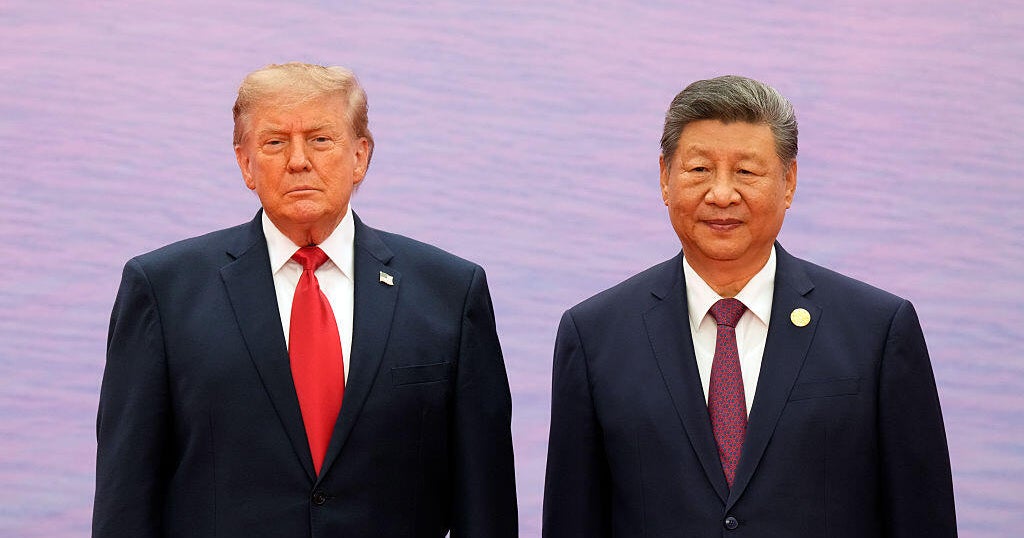
Washington — President Trump is holding a high-stakes meeting with Chinese President Xi Jinping on Thursday, against the backdrop of a widening scandal over advanced U.S. chips reaching China and internal divisions within Mr. Trump's Cabinet about how to address it.
The bilateral meeting is taking place in Shenzhen, China, on the sidelines of the Asia-Pacific Economic Cooperation summit, known as APEC. Mr. Trump embraced Xi when he arrived in Shenzhen on Wednesday.
It's the third time the two world leaders are meeting face to face this year. The last time they met was in September, when Mr. Trump hosted Xi for a three-day summit at the White House. Mr. Trump is hosting Xi again for the G20 Leaders' Summit at Trump National Doral in Miami in December.
The Trump-Xi meeting will be followed by a meeting of Mr. Trump, Xi and Russian President Vladimir Putin.
Here's what Mr. Trump and Xi are likely to discuss.
Mr. Trump told reporters as he left for Asia that he may bring up Alice Huang, the former Megaspeed executive and suspected Chinese spy who had an affair with former Nvidia CEO Jensen Huang. The Justice Department has been investigating Singapore-based Megaspeed for diverting semiconductor chips to China.
The president has cast doubts on assessments that Alice Huang is a Chinese intelligence asset.
"I don't know that she is a spy," he said. "Usually, what happens with that is that any woman coming to the country, that's a beautiful woman that comes from China, they say she's a spy. I don't know that she was a spy at all. I mean, I really don't."
Chris McGuire, a senior fellow for China and emerging technologies at the Council on Foreign Relations, said the scandal is much bigger than Jensen Huang and his alleged affairs.
"It's really kind of unfolded into a much bigger, longer-term scandal that involves the question of how many chips did China get, how porous were export controls, and how did the Commerce Department enforce them?" McGuire said on a phone briefing with reporters Wednesday. "Which I think is a much more important, longer-term strategic question for the United States, for the U.S.-China relationship than anything involving Jensen Huang's personal affairs."
Shortly before the president left for Asia, the Trump administration announced new interim trade rules that will restrict Chinese AI companies from accessing advanced U.S. chips remotely.
The move comes after Treasury Secretary Scott Bessent accused Commerce Secretary Howard Lutnick of slow-walking restrictions on Megaspeed, revealing a rift between Bessent and Lutnick. Bessent told CNBC that Mr. Trump had indicated that China should not have access to the chips, but suggested that Lutnick was resisting. The president didn't take sides in the Bessent-Lutnick debate, telling reporters before he left for Asia that the men have "two different views" where "one wants to be friendly with China, and one wants to have a blowup with China."
"One view is you don't want to insult China," Mr. Trump said Monday. "We have a very good relationship with China, and you don't want to insult them. And the other view is just go, you know, down and dirty and do what you have to do. Both can say either is wrong or right."
Ultimately, the Treasury Department and National Security Council, not the Commerce Department under Lutnick, wrote the new interim rule cutting off Chinese companies from remotely accessing the most advanced AI chips in data centers abroad, though the Commerce Department issued the rule.
"This is a very significant action that really cuts off a lot of the avenues that China is using to get AI computing power," McGuire said. "There was a digital forensic study that was done recently that showed that every single advanced Chinese model is actually trained with the most advanced American chips, so even though these chips have been banned to China, the controls have not been effective. They've probably had some impact but not that much."
The actions taken on Monday, however, will have a "really significant" effect on China's access to computing power, which "could materially widen the lead" between the U.S. and China on AI, McGuire said.
Mr. Trump has shown no signs of wanting to slow the United States' AI advancement in the race against China. After a September summit between Mr. Trump and Xi, the U.S. and Chinese governments pledged to set up a communication channel to share information when AI goes off the rails.
But talking about wayward AI incidents after the fact isn't nearly enough, said Alvin Wang Graylin, a senior fellow on technology with the Asia Society Policy Institute and a digital fellow with the Stanford Institute for Human-Centered AI.
Graylin will be interested to see if Mr. Trump and Xi can work past the negative news cycle, like the Jensen Huang scandal, to take more steps on AI safety collaboration by bringing together more technical experts for working-level discussions.
"I hope that we go beyond just having surface level discussion, and we start to actually create some enduring institutions around safety," Graylin said.
Before leaving for Asia, Mr. Trump was asked if he'll bring up Taiwan in his meeting with Xi.
"I'm sure he'll raise it," the president responded. "I won't have to raise it."
David Sacks, a senior fellow for Asia studies at the Council on Foreign Relations — not the former White House AI czar David Sacks — said he thinks that's right.
"I think that it's very clear that every time Xi sees Trump, they do a little check-in on Taiwan, and Xi Jinping raises his concerns on Taiwan and his expectations of how President Trump will handle Taiwan and cross-strait dynamics," Sacks told reporters on the Council on Foreign Relations call.
A $14 billion arms package to Taiwan is still pending on the president's desk, Sacks said. Earlier this year, the Navy said the arms sale had been put on "pause" to make sure the U.S. military had enough munitions for the Iran war. Sacks said there will be "more pressure from Congress in the coming months to move that arms package forward."
"And so, if President Trump is determined to resist that, you know he will need, you know — Xi Jinping will hope to kind of stiffen his spine and say, 'You're on the right track, and if you approve this arms package, you're going to send cross-strait relations reeling.'"
Lyle Goldstein, the director of Defense Priorities Asia, told CBS News he is actually optimistic about a Trump-Putin-Xi meeting. Goldstein said he doesn't think any "major results" will come out of the sit-down, but the discussions might bear fruit in a future U.S.-China-Russia meeting.
"I actually think it could allow for some, not for breakthroughs, but for some movement on major issues," Goldstein said. "And this is the first time ever that you have this trilateral format for Russia, China, and the U.S. So I would like to see this continue."
Mr. Trump said he has a range of topics to discuss with both Xi and Putin when they meet, including denuclearization.
"We're going to talk about denuclearization," Mr. Trump said. "Tough subject, because it's very hard for any of us to say we'll get rid of our nukes, right? Especially since you do have other countries."
They'll also discuss Iran, the U.S. president said. On Tuesday, Mr. Trump said Iran would have a major price to pay if it detonates a so-called dirty bomb, after CNN reported U.S. intelligence indicates Iran may be developing plans to set off such a device in the nation's capital.
The White House previously said Ukraine would not be a topic of discussion in the Trump-Xi-Putin meeting, since no Ukrainian representatives will be present. But on Monday, Mr. Trump said Ukraine will be a topic for the three leaders.
"We'll talk about my favorite subject, Ukraine," he told reporters.