What Trump, Putin and Xi want from their historic meeting - ABC News & Headlines – Australian Broadcasting Corporation
The Chinese foreign ministry says the meeting of Donald Trump, Xi Jinping and Vladimir Putin will cover topics of "groundbreaking significance". (Reuters)
The world's three most powerful nuclear leaders are preparing to make history by meeting for the first time.
The historic summit between Donald Trump, Xi Jinping and Vladimir Putin will take place on the sidelines of the Asia-Pacific Economic Cooperation (APEC) forum in China's southern city of Shenzhen.
But analysts are sceptical anything concrete will come from the highly anticipated talks.
So what might a meeting between these men achieve? And why hold a summit if a firm result is not expected?
China and Russia have not confirmed any talking points for the summit but have expressed lofty aspirations for "in-depth exchanges" that would be symbolic and significant.
America has a clear goal of forming a new arms agreement with Russia and China.
Russia currently has the world's largest arsenal of nuclear warheads, followed closely by the United States, with China's rapidly expanding cache sitting significantly behind.
The agreement between America and Russia capping strategic nuclear arsenals, called the New Strategic Arms Reduction Treaty (New START), lapsed in February this year.
Former US president George Bush and former Soviet president Mikhail Gorbachev exchange pens after signing the START treaty on July 31, 1991. (Reuters: Mal Langsdon)
The United Nations has urged both sides to agree to a new framework without delay, but Mr Trump has been reluctant to sign a new agreement unless it also included China.
A White House spokeswoman said Mr Trump would use the meeting to discuss a reduction of nuclear weapons in the world.
"This proliferation, President Trump believes, is very dangerous," said White House representative Olivia Wales.
However, experts told the ABC they do not expect much to be decided on nuclear arsenals.
China has historically railed against being part of the agreement and views its arsenal as significantly less than Russia's and America's.
When asked whether Beijing would discuss the idea, Foreign Ministry spokeswoman Mao Ning said "the three presidents will have an in-depth exchange of views on safeguarding world peace and enabling strategic stability in major-country relations" but would not provide specific details.
Russia, too, has been vague on what it would like to discuss in the summit, with Kremlin foreign policy aide Yury Ushakov instead pointing to the "significance and symbolism of this meeting".
"It has been agreed that [this meeting] should be structured in the spirit of the mutual understanding and alliance between our three countries during World War II, with an emphasis on our countries' cooperation in the establishment of the United Nations," he told reporters.
The wars in Iran and Ukraine may also be on the agenda.
There have been concerns Mr Trump could use the meeting to discuss an end to the conflict in Ukraine without Kyiv in the room.
The US president has indicated Ukraine may be on the agenda. (AP: Mark Schiefelbein)
When speaking to reporters about the meeting earlier this week, the US president said he was ready to discuss his "favourite subject, Ukraine", which the Kremlin also supports.
It could be an uncomfortable moment for China, which has claimed neutrality in the war despite its close ties with Russia.
NATO allies have accused Beijing of providing material support for the war with the export of dual-use goods, though China has consistently maintained it is not supplying Moscow.
It is unclear what role the superpower would play in potentially bringing the war to an end.
China's assistance in the US and Israeli-led war in Iran may be a little more clearer, with Mr Trump potentially turning to Beijing, an ally of Tehran, to help end that conflict or to pressure Iran to fully reopen the Strait of Hormuz.
Beijing is the main buyer of Iran's oil and its largest trading partner, and it also wants to see an end to the conflict.
But it is unlikely to want to embroil itself in a protracted conflict and has previously avoided wading into ceasefire negotiations.
Despite low expectations for any key deliverables from this summit, each leader is coming into this with their own goals and ambitions.
China has so far resisted calls to engage in non-proliferation talks. (Pool via Reuters: Kent Nishimura)
"This summit … demonstrates the multi-polarity of international politics today," said Wi Xinbo, director at the Center for American Studies at Fudan University.
"This means that there is no longer a unipolar world, and the US has to respect and recognise the role and importance of China and Russia in international affairs."
Mr Xi, who has spent years building his image and position as a serious geopolitical and diplomatic powerbroker, hopes to emerge as the only person able to bring together these three countries together for a historic moment.
For Mr Trump, coming off bruising midterm elections, he will want to portray strength alongside other strongmen.
"Mr Trump gains a bit in being able to have a platform to demonstrate some deal-making, maybe advancing some talks on Ukraine, possibly nuclear arms control," said Han Shen Lin, China managing director for The Asia Group.
"But his pay-off depends more on actually producing a tangible result, which is [a] pretty high [ask]."
But some analysts suggest the biggest winner from the sit-down will be Russia, with Mr Putin to be recognised as a major diplomatic player, not a pariah, on the world stage.
The most likely reason Vladimir Putin got a seat at the table is Russia's nuclear agenda. (Sputnik/Kristina Solovyova via Reuters)
"He will have achieved his return to the top table in global diplomacy without making any significant concessions on Ukraine or elsewhere," wrote Ryan Hass from the Brookings Institute.
A joint press conference or communique after the meeting is not expected, so readouts released by each country will be pored over for what happened behind closed doors.
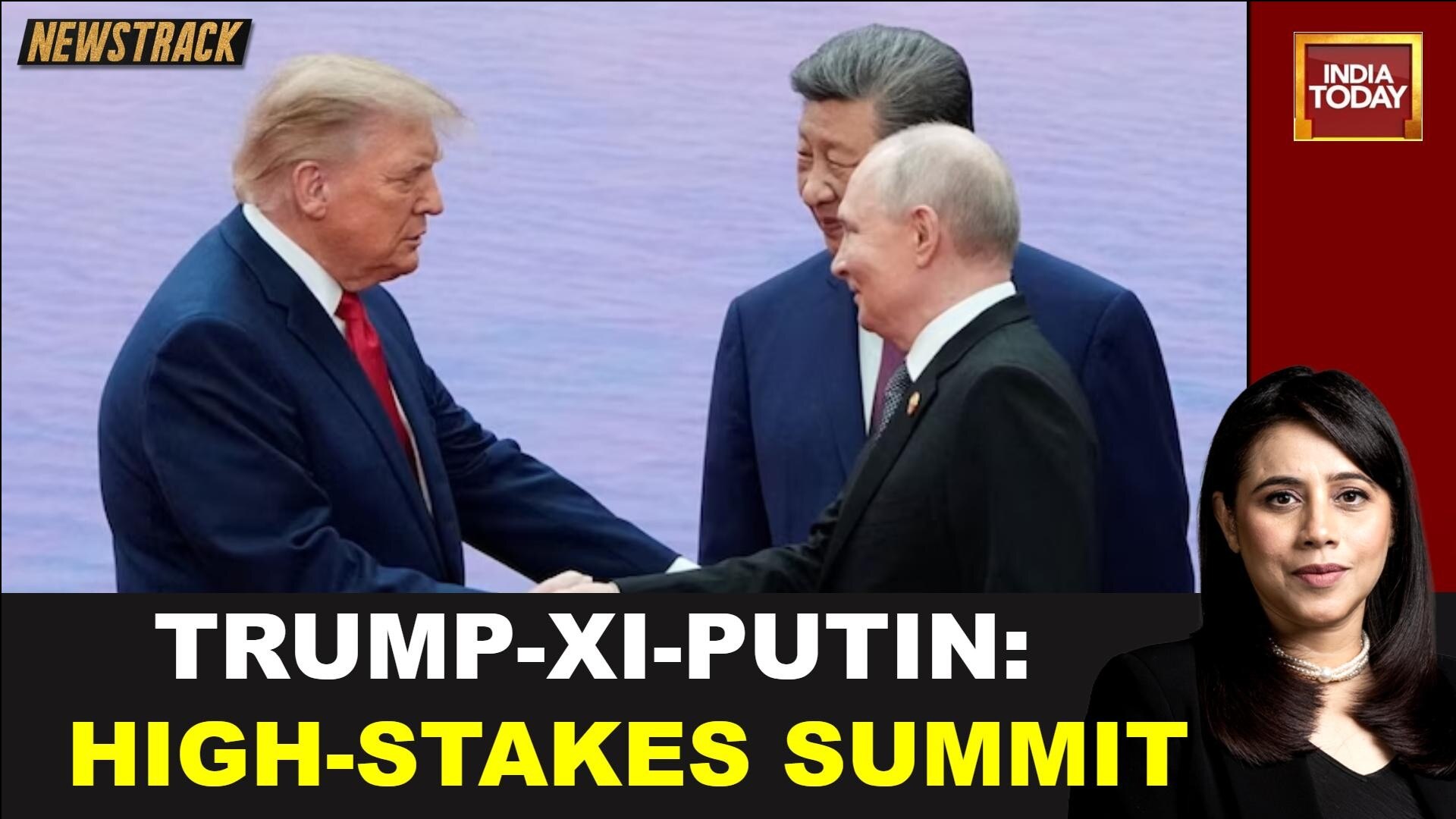
Either way, a photo of the three most powerful nuclear powers in the world, talking together for the first time, will be one for the history books.