When Israelis flew 4,000 km to rescue 100 hijack hostages. Netanyahu lost a brother
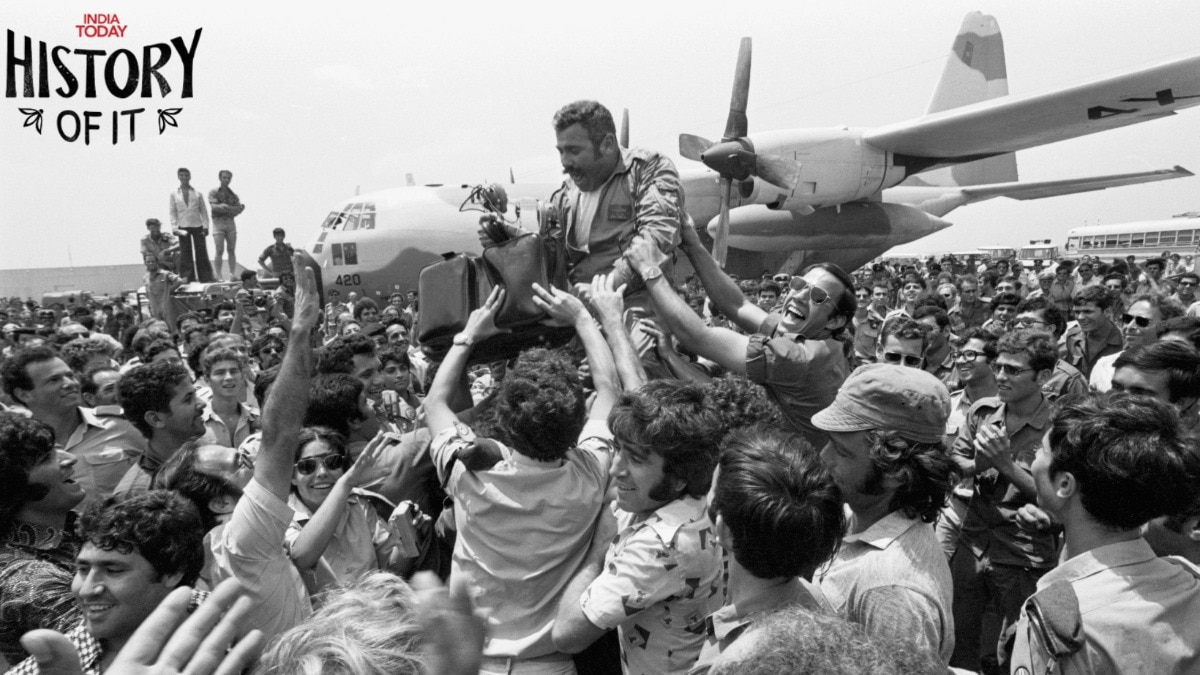
"Like somebody amputated your arms and legs, and you're never going to be whole again," said Benjamin Netanyahu, describing the loss of his elder brother Yonatan 'Yoni' Netanyahu, the only Israeli commando killed during one of the most audacious hostage-rescue operations in aviation history. "It changed my life and steered it to its present course," Netanyahu told UK-based newspaper The Guardian in 2016, four decades after Israel's Entebbe raid of 1979.
When Yonatan Netanyahu was killed, Benjamin Netanyahu was 26 and living in the US. As news reached him in the US that his 30-year-old brother, leading Israeli commandos in the Entebbe hostage rescue, had been killed, Benjamin Netanyahu drove for seven agonising hours from Boston to Ithaca to tell his parents himself. His father initially smiled on seeing him, but then saw his face and understood, letting out what Netanyahu recalled as "a terrible cry like a wounded animal".
More than 100 hostages (predominantly Israeli and Jewish passengers) were rescued by the Israeli commandos. The passengers were on Air France Flight 139, which was hijacked by four Palestinian and German terrorists shortly after it left Athens on June 27, 1976.
The flight, travelling from Tel Aviv to Paris via Athens, was first forced to Benghazi in Libya and then to Entebbe airport near Kampala, the Ugandan capital. There, more gunmen joined the hijackers and forces of Ugandan President Idi Amin supported the hostage-takers.
The hijackers held the passengers and the flight crew at Entebbe for nearly a week and demanded the release of 53 prisoners held in Israel and several other countries. While non-Israeli and non-Jewish passengers were released, more than 100 people (mostly Israelis and Jews), along with the Air France crew and some others, remained captive.
Responding to the situation, Israel prepared for a high-risk evacuation response. On the night of July 3-4, four C-130 Hercules aircraft carrying Israeli commandos flew roughly 4,000 km to Uganda, landed at Entebbe, stormed the terminal and brought the hostages out in a daring overnight rescue. Yoni Netanyahu, commander of Israel's elite Sayeret Matkal assault force, was the only Israeli soldier killed in the daring operation. Later, the mission was renamed Operation Yonatan in his memory.
Fifty years later, Israel on Wednesday faced a major aviation scare as a flight with 174, mostly Israelis, headed from Dubai for Tel Aviv.
The Omani co-pilot of the flydubai flight attacked Indian Captain Smit Machchhar mid-air and, according to Israeli officials, apparently attempted to crash the aircraft. The plane plunged more than 14,000 feet before control was regained. Netanyahu, now Israel's prime minister, claimed the co-pilot had undergone "radical Islamist indoctrination".
Despite being attacked and wounded, Smit Machchhar managed to unlock the cockpit door, allowing passengers to overpower the attacker before two off-duty pilots who happened to be travelling on the same flight, landed the aircraft with over 170 onboard, safely in Saudi Arabia's Tabuk.
Netanyahu said the intervention had prevented what could have become a "9/11" type catastrophe. Yonatan Netanyahu, born in 1946, was the eldest of three brothers, followed by Benjamin Netanyahu and Iddo Netanyahu in 1952. (Image: Israel PMO)
Yes, the two incidents are fundamentally different. And, the flydubai incident on September 30 was not a conventional hijacking like Air France Flight 139 was. Investigators from multiple Middle Eastern nations are yet to establish the attacker's motive. But the flydubai incident has inevitably recalled Israel's long and bloody experience with threats to civilian aviation, of which the rescue in Entebbe was one of the most defining missions. It also changed the life of Netanyahu, now Israel's prime minister, and is confronting another threat in the skies.
Here's the story of the 1976 hijacking and the Entebbe rescue from the time when terrorists taking over aircraft was too common. Airport security looked little like it does today. This story has a mix of Palestinian and German terrorists, Idi Amin's Uganda, a black Mercedes used as a disguise, four Israeli Hercules aircraft flying through the night and an Israeli rescue plan so improbable that surprise was one of its greatest weapons.WHEN HIJACKING A PASSENGER PLANE WAS TOO COMMON
To understand the Entebbe rescue mission, let's have a look at how commercial aviation operated in the late 1960s and early 1970s. Aircraft hijackings were so frequent that, according to American aviation historian Janet Bednarek, at their peak one occurred somewhere in the world on average about once every five days. In 1969 alone, there were 87 hijackings worldwide. Between 1968 and 1974, US airlines suffered 130 hijackings, according to Bednarek's 2002 piece in the Smithsonian Magazine.
Initially, many hijackers wanted money, asylum or simply to be flown somewhere else. But Palestinian militant groups hijacked planes to make them visible instruments of political pressure on the Jewish nation. In July 1968, members of the Popular Front for the Liberation of Palestine (PFLP) hijacked an El Al flight travelling from Rome to Tel Aviv. In September 1970, the PFLP seized several aircraft in the Dawson's Field hijackings (in Jordan). In 1970, PFLP hijackers blew up three empty passenger planes at Dawson's Field.
It was in this age of "skyjacking" that Air France Flight 139 took off from Athens on June 27, 1976. The old terminal building of Entebbe International Airport, where the 1976 hostages were held, seen from the air. (Image: LTC David Konop/US Army Africa) HOW DID AIR FRANCE FLIGHT 139 END UP 4,000 KM AWAY IN UGANDA
Flight 139 had originated in Tel Aviv and stopped at Athens on its way to Paris. Four hijackers boarded during the stop at Athens. Two were Palestinians associated with the PFLP's external operations and two were Germans, Wilfried Bose and Brigitte Kuhlmann, associated with the Revolutionary Cells, a West German far-left militant group active in the 1970s and 1980s. Soon after the Airbus A300 took off for Paris, the gunmen seized control.
Captain Michel Bacos later recalled that the hijacking took place only minutes after the departure. "The hijacking was carried out four minutes after the plane took off from Athens towards Paris," Bacos told Israeli newspaper Yedioth Ahronothin in an interview four decades later.
Bose entered the cockpit armed. "Every time I tried to look in a different direction, he pressed the barrel of his gun against my neck," Bacos recalled.
The aircraft was diverted to Benghazi (in Libya), where it remained for hours and refuelled. It then headed south towards Uganda.
At Entebbe on the banks of Lake Victoria, the hostages were moved into the airport's old terminal. More militants joined the original hijackers. Ugandan soldiers guarded the site, and the "Butcher of Uganda", Idi Amin, repeatedly appeared before the captives while publicly portraying himself as a mediator.
The terrorists demanded the release of 53 prisoners, 40 of them held by Israel and the others in West Germany, France, Switzerland and Kenya. They threatened to begin killing hostages if their demands were not met. Then came one of the most disturbing moments of the ordeal.
The captives were divided, with Israelis and some people identified as Jewish separated from most of the other passengers. Because two of the hijackers were German, the selection inevitably carried echoes of the Holocaust for some hostages. Accounts differ over precisely how the selection was conducted, but contemporary reporting confirms that Israeli passengers were separated while groups of other captives were released.
Four days after the hijacking, by July 1, most non-Israeli captives had been freed, leaving more than 100 hostages at Entebbe. Their deadline given by the hijackers was fast approaching. Sayeret Matkal commandos with the Mercedes used to deceive Ugandan forces during the Entebbe rescue operation in July 1976. (Image: IDF) HOW ISRAEL PLANNED A RESCUE 4,000 KM FROM HOME
Israel initially had no easy military option, with the hostages held nearly 4,000 km away in a foreign airport guarded by hijackers and Ugandan forces. Israel needed to fly a sizeable force across international airspace, land without alerting the hijackers and the Ugandans, find the correct terminal, kill the hostage-takers before they could execute their captives and then get everyone out.
Fuel was a major challenge. The Israeli aircraft needed enough range to fly thousands of kilometres, carry out the rescue and get the hostages out of Uganda. But Israel had an advantage. It knew Entebbe.
Israel and Uganda had once maintained close relations, and an Israeli construction company had built the old terminal, where the terrorists kept the Israeli and Jewish captives. Plans of the building could therefore be obtained. Israeli intelligence gathered information about the airport. The military planners worked through different rescue possibilities. The final plan was built around a surprise.
Four C-130 Hercules transporters would fly to Uganda. Commandos would land at Entebbe and race towards the terminal before the hijackers understood what was happening. The rescue plan also relied on an audacious deception trick.
A black Mercedes and Land Rovers were loaded aboard an aircraft. Once on the ground, Israeli troops would drive towards the terminal in vehicles intended to resemble Idi Amin's motorcade. The hope was that Ugandan guards would hesitate long enough for the Israelis to get close.
On July 3, Israeli Prime Minister Yitzhak Rabin's government considered the plan. The Knesset's account records that Chief of Staff Mordechai 'Motta' Gur told Rabin there were "very good chances of implementation". Rabin's Cabinet approved the operation unanimously.
"Let the troops take off," Rabin told Gur. Among those troops was Lieutenant Colonel Yonatan Netanyahu. Yoni was 30, an experienced officer and commander in Sayeret Matkal, Israel's elite special-operations unit. He would lead the assault and was tasked with reaching the hostages.
The aircraft flew for hours towards Uganda, maintaining a low profile. An Israeli pilot later recalled flying in tight formation and under radar for more than seven hours. Then, shortly before midnight, the Israelis landed at Entebbe. An image of the old Entebbe terminal in 1994, with bullet holes from the 1976 Israeli rescue raid still visible and a US Air Force C-130 Hercules parked outside. (Image: SRA Andy Dunaway) HOW THE BLACK MERCEDES RUSE TURNED INTO A GUN BATTLE IN UGANDA
As the Hercules came to a halt on the Entebbe runway, its rear cargo ramp opened and Israeli commandos, along with the black Mercedes and Land Rovers meant to disguise their approach, emerged into the night. Lieutenant Colonel Yonatan Netanyahu's assault force began moving towards the old terminal. They were trying to preserve the illusion that this was an official Ugandan convoy of President Idi Amin. But the deception did not last all the way.
According to the IDF's account, an Israeli soldier fired at an armed Ugandan soldier near the vehicles. The surprise element was now slipping away. The Israeli commandos accelerated towards the terminal. Inside, the hostages heard gunfire.
Captain Bacos of the Air France flight recalled everyone dropping to the floor as shooting started around them. The threat that the hijackers could kill the captives before rescuers reached them had hung over the entire confinement. Soon, Israeli commandos stormed the building and killed the terrorists. Reinforcements from subsequent Hercules aircraft fought Ugandan forces in and around the airport. Israeli troops also destroyed Ugandan military aircraft (including fighter jets) on the tarmac, reducing the possibility of any pursuit.
More than 100 hostages were evacuated. But not everyone survived.
Three hostages were killed during the operation. Dora Bloch, an elderly hostage who had earlier been taken from Entebbe to a Kampala hospital after falling ill, was not among those rescued and was killed by the Ugandan forces.
Yoni Netanyahu was shot during the fighting outside the terminal and was evacuated by his men. But he died of the wounds. He was the only Israeli commando killed in the Entebbe operation. An Entebbe hostage is carried on a stretcher by Israeli soldiers after the rescued passengers arrived in Tel Aviv in July 1976. (Image: AFP) HOW ISRAEL BROUGHT ENTEBBE HOSTAGES HOME
The aircraft that had secretly carried Israeli soldiers into Uganda now ferried the freed hostages out of the country. The Israeli operation on the ground lasted roughly an hour, according to Israeli documents declassified for its 50th anniversary in 2026. More than 100 Israeli and Jewish captives had been rescued from a hostile airport thousands of kilometres from Israel. When they returned, the freed hostages received an emotional welcome in Israel.
The Entebbe rescue has inspired several films, including the 1977 TV film Raid on Entebbe and the 2018 feature film 7 Days in Entebbe.
For the Netanyahu family, however, the rescue operation brought devastating news. Benjamin Netanyahu has repeatedly described his elder brother's death as a turning point in his life. At a Knesset commemoration marking 30 years since the Entebbe raid, he said the loss of a brother whose life had been cut short was a "traumatic event" that "diverted the course of my life to its current direction."
Two decades after the Entebbe raid, in 1996, Benjamin Netanyahu became Israel's prime minister for the first time at the age of 46.
The operation has now acquired a mythical status in Israel and is a key case study in long-range hostage rescue. But its legacy isn't uncontested. Uganda's sovereignty was violated even as Amin's regime facilitated the hijacking and helped the terrorists. African governments criticised the Israeli action, even as the rescue was celebrated in the Jewish state.
Now, fifty years later, Israel confronted another mid-air scare and has vowed to unearth the truth. For Israel, the Entebbe raid was a big triumph. For Netanyahu, it's personal too. It was an Israeli rescue team that saved more than 100 lives but cost him his brother.- Ends
Sushim Mukul is a keen observer, with interest in polity, geopolitics, culture and heritage.