When TN Seshan tried to become EC's sole boss and went to SC. Court said no
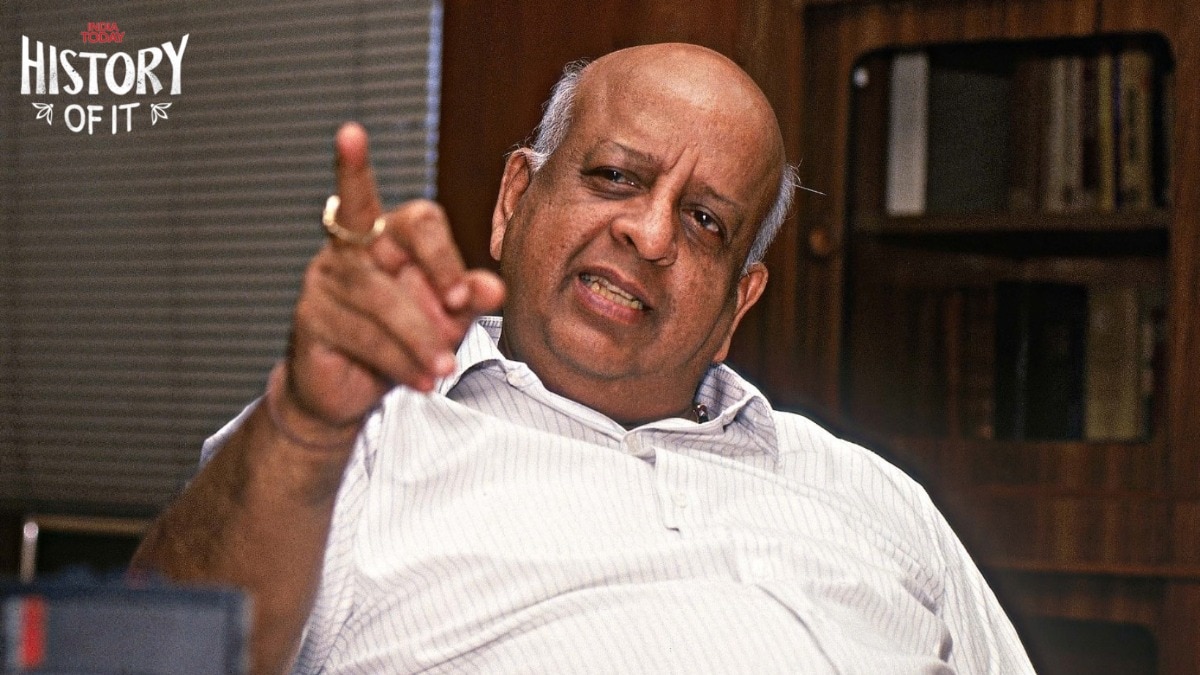
"The spirit of this order wasn't that we are never to be shown a paper, never to be brought to a meeting, never to be spoken to... The Chief Election Commissioner (CEC), however, acted as if we don't exist."
That was Election Commissioner MS Gill in July 1995, describing to India Today Magazine what it was like to work alongside CEC TN Seshan. Gill and fellow Election Commissioner GVG Krishnamurthy had been appointed almost two years earlier, but according to him, Seshan had barely acknowledged their role in the Election Commission of India (ECI).
Gill's response came at the height of an extraordinary legal and institutional battle over who really called the shots in the ECI. Seshan believed the CEC occupied a pre-eminent position. He challenged the new system introduced by the Congress-led government of PM PV Narasimha Rao, which gave two other commissioners equal decision-making powers. As the tussle got intense, Seshan took the fight all the way to the Supreme Court, where a five-judge Constitution Bench ruled against him in 1995. It upheld the multi-member ECI and majority decision-making as the rule. Even then, Seshan wasn't done. He filed a review petition. But the Supreme Court dismissed it too, saying it saw "no reason to review".
This was the same TN Seshan who had transformed the public image of the ECI by aggressively enforcing election rules. During the 1993 Assembly elections, his intervention helped produce a sharp reduction in violence and re-polling in Uttar Pradesh (UP) compared with 1991. He also took on governors, ministers and powerful politicians over alleged violations. His style was summed up by a returning officer in UP, who told India Today Magazine, "This time there was no escape route for us, we were at the mercy of a merciless person."
But, on the other hand, the power Seshan wielded also raised the question of whether the man credited with making the ECI powerful could himself exercise overriding power within the autonomous body.
The nearly three-decade-old tussle and subsequent legal battle from the 1990s make for an interesting read amid the fresh controversy over allegations that CEC Gyanesh Kumar has been taking key decisions without keeping the other two Election Commissioners in the loop, and by overruling them.
An investigative report published by The Indian Express said that Election Commissioners Sukhbir Singh Sandhu and Vivek Joshi had recorded objections at least 14 times over a period of 10 months to decisions and orders they said were taken without their knowledge, including issues concerning the Special Intensive Review (SIR) of electoral rolls, the changes to Form 6, and the access to the EC's IT systems. The EC subsequently said that differing observations were a normal part of institutional deliberations and that the final decisions of the full Commission over the past year had been unanimous.
The political temperature has risen. The Opposition INDIA bloc parties are now preparing to seek Kumar's impeachment. The Opposition had made a similar move earlier too.
The present circumstances don't match the case of Seshan, but the reports in The Indian Express have put the internal balance of power in India's poll panel under scrutiny.
Three decades ago, Seshan's battle with his two fellow commissioners put that balance of power in the EC to a big test. And much of the system under which a CEC today cannot overrule two fellow commissioners was settled after Seshan himself went to the Supreme Court. We'll tell about that later in detail. But first, let's go back to the beginning.WAS THE ELECTION COMMISSION ALWAYS A THREE-MEMBER BODY?
The answer is no. Article 324 of the Constitution provides for an Election Commission consisting of the CEC and "such number of other Election Commissioners, if any," as the President might fix.
When the ECI was set up in 1950, it began as a single-member body, with the CEC at its helm. Indian Civil Service (ICS) officer Sukumar Sen was the first to hold the post. The ECI remained a single-member body for nearly four decades, until 1989, when the Centre, led by PM Rajiv Gandhi, appointed former Indian Administrative Service (IAS) officer SS Dhanoa and former Intelligence Bureau officer VS Seigell as Election Commissioners alongside then-CEC RVS Peri Sastri.
The move came right before the 1989 Lok Sabha elections, which the Congress lost.
The experiment was short-lived. Their posts were abolished in January 1990 by the new National Front government of PM VP Singh.
The ECI returned to being a one-member body. The arrangement continued when TN Seshan took over as CEC in December 1990, after VP Singh's government fell and PM Chandra Shekhar's fragile government came in. Seshan would remain in office until December 1996. Back then, the CEC's post was perceived as a low-profile constitutional office. Seshan turned it into one of the most visible institutions in the country.
By the 1993 state Assembly elections (in UP, MP, Rajasthan, Delhi and HP), India Today Magazine reported, officials knew exactly who was in command. Seshan had instructed officials to independently record, screen and verify complaints. He made district magistrates, police officers and hundreds of election observers very conscious of accountability to the Commission. In UP, the magazine reported, re-polls fell from 873 booths in 1991 to 255 in the 1993 Assembly election, while reported deaths connected with poll violence fell from 36 to two.
Soon came the Centre's decision that challenged his dominance from within the ECI.advertisementWHY DID PM RAO ADD TWO ELECTION COMMISSIONERS?On October 1, 1993, the PV Narasimha Rao government restored the multi-member ECI by appointing former IAS officer MS Gill and former IRS GVG Krishnamurthy as Election Commissioners.
As we noted earlier, the Constitution permitted expansion. But Seshan saw it differently.
India Today Magazine's July 1995 report recorded that Seshan consistently maintained that Gill and Krishnamurthy had been appointed to hamper his functioning. The magazine called the Centre's 1993 decision an effort to "clip his wings".
Seshan went to the Supreme Court challenging the constitutional validity of the appointments and provisions governing the functioning of the expanded ECI. It was the fight to ensure a hierarchy inside the constitutional poll body.
Seshan argued, among other things, that the CEC occupied a constitutionally superior position. His side argued that the CEC could not be treated like other commissioners, and demanded greater constitutional powers. He also challenged majority rule within the ECI.
Initially, Seshan had got considerable room to operate within the ECI.
In November 1993, the Supreme Court's interim arrangement vested overall control in the CEC while requiring him to "work harmoniously" with the other commissioners. The constitutional questions were eventually sent to a Constitution Bench. Harmony in the ECI was, however, elusive.advertisementDID SESHAN SIDELINE THE OTHER TWO COMMISSIONERS?Gill certainly believed so. In his July 1995 interview with India Today Magazine, he said he had visited Seshan's house and Nirvachan Sadan (ECI headquarters) several times in October and November 1993 because he was "trying to make it work".
"Because I feel mature people should be talking to each other," Gill said. But, according to Gill, they were not shown papers, brought into meetings or properly consulted.
The confrontation became public and stark in June 1995. When Seshan was leaving for a month's holiday in the United States, he issued an order authorising Deputy Election Commissioner DS Bagga to hold "the current charge of work in the Election Commission". He did not hand charge to Gill or Krishnamurthy.
The two commissioners protested that Seshan had bypassed constitutionally appointed Election Commissioners to entrust work to an official subordinate to them. Constitutional expert AG Noorani told India Today Magazine that the order sought to bypass "the offices created by the Constitution — the other election commissioners". Senior advocate Soli Sorabjee said the proper course would have been to consult the commissioners and work out arrangements with them.
All these episodes brought the bigger legal question and the dispute into focus. Were Gill and Krishnamurthy equal partners in the ECI, or did Seshan as CEC have the final say? The question was soon in the Supreme Court.WHAT DID SESHAN ARGUE IN SUPREME COURT?
At the centre of Seshan's case was the question of constitutional distinction between the posts of the CEC and Election Commissioners.
As we saw, Article 324 expressly calls the CEC the chairman when the Commission has multiple members. The CEC also enjoyed stronger constitutional protection against removal. Seshan's lawyers argued that reducing his decision-making position to parity with the other commissioners undermined the special status accorded by the Constitution.
By Seshan's side, there was historical ammunition too. The earlier 1991 SS Dhanoa judgment had discussed differences between the constitutional position of the CEC and other commissioners. Seshan's side also relied on Constituent Assembly debates concerning the CEC's directing and supervisory role.
But the Constitution Bench was not persuaded that those differences meant the CEC's view must prevail when the Commission took decisions.WHY DID THE SUPREME COURT SAY NO TO SESHAN?
In July 1995, a five-judge Constitution Bench headed by Chief Justice AM Ahmadi unanimously upheld the validity of the multi-member Election Commission arrangement.
The constitutional scheme, the Court held, allowed the ECI to be either a single-member or multi-member body. The Court said that if a multi-member ECI could not work, there would be little point in the Constitution allowing the appointment of other Commissioners.
More importantly for Seshan, being chairman did not give the CEC overriding decision-making authority over the others, the court held.
India Today Magazine's August 15, 1995 report, noted what the verdict meant in practice. Seshan would have to treat Gill and Krishnamurthy as equals in decision-making, consult them, and could even be overruled if the two agreed against him.
The ruling was welcomed in some quarters and criticised in others. Seshan, who belonged to the latter camp, still refused to concede.
He returned from the US and, seeking to re-establish his superiority, went knocking on the Court's doors. He sought review of the judgment and proposed rules under which he alone would decide whether a Commission meeting should be convened, when it would be held, and what would appear on its agenda.
The Court declined to entertain the petition.
More than a year later, Seshan retired as CEC in December 1996, and entered politics. Seshan contested the 1999 Lok Sabha election from Gandhinagar on a Congress ticket and lost to BJP veteran LK Advani by 1.8 lakh votes. Gill also joined the Congress and was elected to the Rajya Sabha from Punjab in 2004. He served two Rajya Sabha terms until 2016 and also served as a Union minister, including that for Youth Affairs and Sports.
Today, the Election Commission itself describes all Election Commissioners as having an equal say in decision-making. The three-member arrangement introduced in 1993 has continued ever since, and its alleged breach is precisely what has triggered the latest controversy over CEC Gyanesh Kumar's conduct and functioning.- Ends
Sushim Mukul is a keen observer, with interest in polity, geopolitics, culture and heritage.