Who are the retired justices tapped to advise impeachment court on voting threshold? - Rappler
Already have Rappler+? Sign in to listen to groundbreaking journalism.
This is AI-generated. Read the article for full context. Report any errors.
On Day 23 of Vice President Sara Duterte’s impeachment trial, Senator-judge Erwin Tulfo posed a looming question that could ultimately determine how the Senate impeachment court will deliver its verdict.
Tulfo asked, should the voting basis for Duterte’s acquittal or conviction remain at 24 amid the prolonged absence of some senator-judges?
“When I raised that question, I was not asking for the court to lower the 16-vote threshold. I was asking if we should count the votes of the four senator-judges who were not partaking in the trial,” Tulfo told reporters in a mix of English and Filipino on Friday, September 11.
At the start of the trial in July, impeachment court presiding officer Francis “Chiz” Escudero set the conviction threshold for Duterte to 16 amid legal interpretations that the two-thirds conviction threshold of the Constitution can mean only 14, as only 21 out of 24 senators can participate in the trial.
But Tulfo’s question at the September 8 trial prompted the court to revisit the ruling and seek the opinion of amici curiae or “friends of the court” in deciding the issue.
The impeachment court set the presentation of the views of the legal experts on September 16. It will be followed by oral arguments between the defense and prosecution, as well as the impeachment court vote the following week, on September 23.
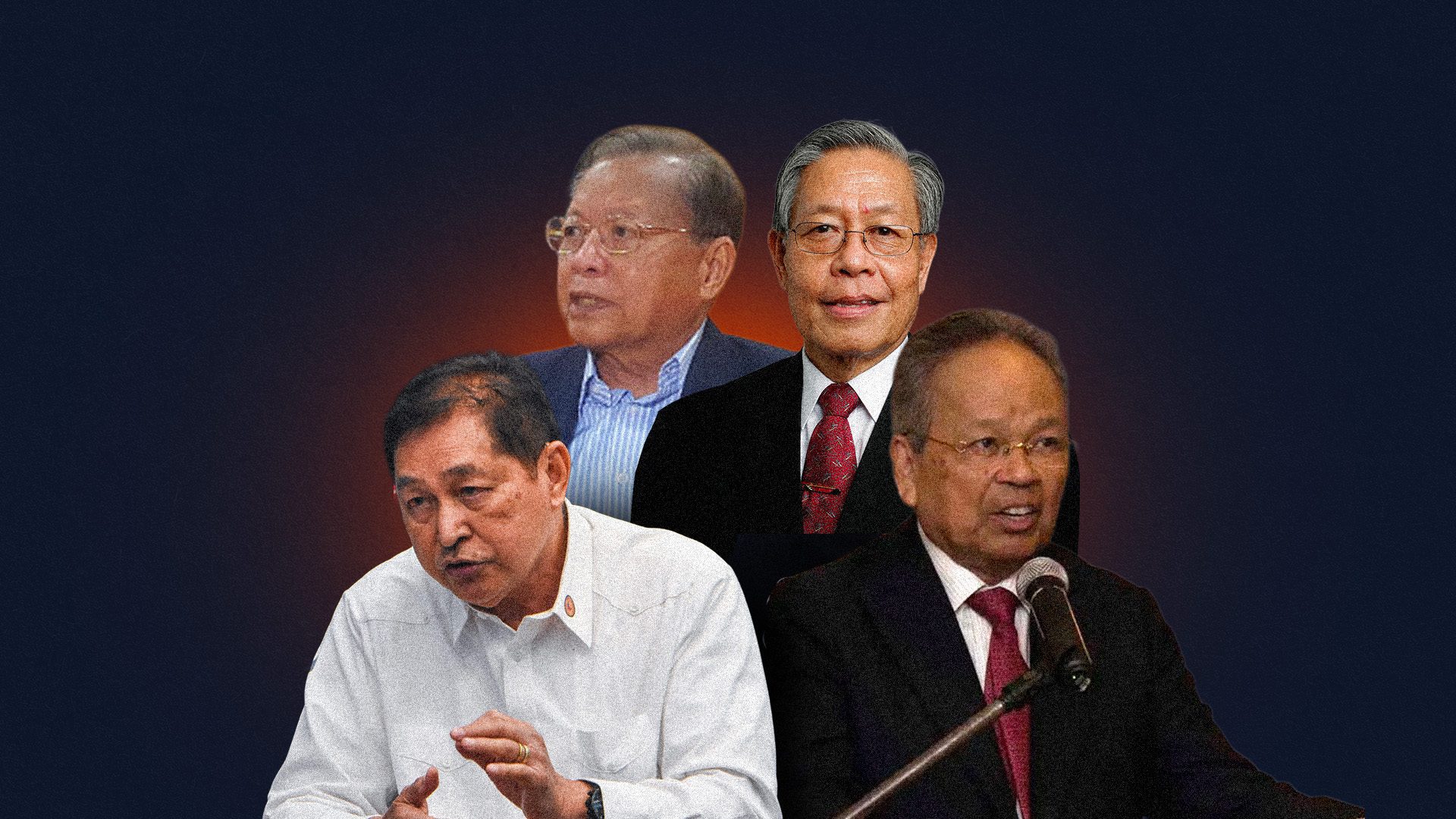
The impeachment court has tapped four retired Supreme Court (SC) justices to share their opinions on the matter and help the impeachment court examine the constitutional question: former chief justices Artemio V. Panganiban, Reynato S. Puno and Hilario G. Davide Jr.; and former associate justice Adolfo S. Azcuna.
Panganiban, Puno, and Azcuna will share their opinion before the impeachment court on September 16, while Davide will submit a legal memorandum instead of appearing in person.
Who exactly are these four legal luminaries and why were they chosen to weigh in on the crucial issue?
Retired chief justice Artemio V. Panganiban served as the 21st Supreme Court chief justice from 2005 to 2006, after serving as an associate justice for more than a decade.
During his tenure, he penned around 1,200 full-length decisions and separate opinions, including La Bugal v. Ramos, which upheld the constitutionality of the Philippine Mining Act. He is currently an opinion columnist for Philippine Daily Inquirer and works as a consultant for various organizations.
Retired chief justice Reynato S. Puno served as the country’s top magistrate from December 2007 to May 2010. He was Supreme Court associate justice from 1993 to 2007.
Under Puno’s leadership, the Supreme Court adopted the writ of amparo, a judicial remedy intended to protect the constitutional rights to life, liberty, and security. He was also one of the legal minds instrumental for the drafting of the interim Constitution under the Cory Aquino administration or the Freedom Constitution.
In 2018, then-president Rodrigo Duterte appointed Puno as the chairperson of the Consultative Committee to Review the 1987 Constitution.
Retired associate justice Adolf Azcuna, who served as Supreme Court magistrate from 2002 to 2009, is best remembered for championing the writ of amparo, a remedy that serves to protect constitutional rights perceived to be in danger.
Azcuna was a delegate to both the Constitutional Convention in 1971 and the 1986 Constitutional Commission that drafted the 1987 Constitution. He was the presidential legal counsel during the Cory Aquino administration, and had served as chancellor of the Philippine Judicial Academy from 2009 to 2021.
Retired chief justice Hilario G. Davide Jr. was Supreme Court associate justice since 1991 before service as top magistrate from 1998 to 2005. In 2000, Davide presided over the impeachment trial of then-president Joseph Estrada.
Davide was a delegate to the 1986 Constitutional Commission that helped shaped the 1987 Constitution. He served the Cory Aquino administration as Commission on Elections commissioner.
Impeachment court spokesperson Reginald Tongol explained in an online media briefing that the amici curiae were chosen based on their credentials, and were also among those recommended by both the defense and prosecution.
“One of the things that the presiding officer considered is their credentials…. Technically, two of them were framers of the 1987 Constitution and two others were SC chief justices,” he added.
The 1987 Constitution states that no person may be convicted in an impeachment trial without the concurrence of two-thirds of all members of the Senate. But with some senator-judges missing the trial, the dispute lies on whether “all the members of the Senate” should refer to the entire 24-member chamber or only those senator-judges who are legally able to participate in the final vote. – Rappler.com