Who’s who at the EU-Canada summit

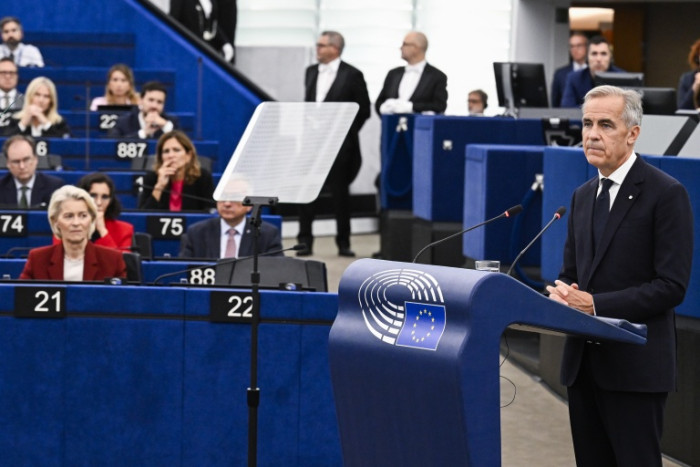
Brussels and Ottawa want to deepen their partnership at an Oct. 29-30 summit in Montreal, where Canadian Prime Minister Mark Carney’s push for a middle-powers alliance will meet European Commission President Ursula von der Leyen’s bid for geopolitical influence.
The outcome may fall short of von der Leyen’s bold offer to make Canada an associate EU member, particularly as EU countries remain divided on the idea. But the push reflects a shared desire to reduce dependence on the U.S. and secure supply chains, with the two sides aiming for closer cooperation on energy, critical minerals, artificial intelligence, computing and financial services.
In a draft declaration, Canada and the EU also envisage “mutually favorable treatment” if they align their economic security policies — a nod to maintaining a united front amid the challenges posed by China.
Carney laid out his vision for the world’s “middle powers” in an era-defining speech at the World Economic Forum in Davos at the start of the year. He argued that they must combine their influence in a world of great-power rivalry, saying: “If we’re not at the table, we’re on the menu.”
But Brussels is wary of describing itself as a middle power. “Individual EU countries may be middle powers, but the EU is not,” said a senior EU official, arguing the bloc’s economic might is on par with that of the U.S. or China. The distinction hints at a different vision for the partnership: Canada may be looking to build a coalition of middle powers, while the EU sees itself as a superpower in its own right.
Who’s driving this push for closer ties — and who will decide what comes next? Here are the key players on either side of the Atlantic:
António Costa, the leaders’ chair. The European Council president represents the EU’s 27 countries at the summit alongside Commission President Ursula von der Leyen. The former Portuguese prime minister will be central to getting leaders behind the partnership’s political direction.
Ursula von der Leyen, the associate-membership booster. The Commission president opened the door to Canada becoming the EU’s first associate member during her State of the European Union address last month. She has pitched an alliance spanning economic security, technology, energy and defense.
Anna-Maria Boura, the EU’s pen holder. Costa’s chief foreign policy adviser, Boura is coordinating preparations for the summit and drafting the joint declaration, collecting positions and finding language that can secure agreement among the 27 EU countries.
Simon Mordue, von der Leyen’s chief diplomatic adviser. Mordue covers foreign policy, including Ukraine, and coordinates the Commission’s external relations work. He is working with Boura on drafts of the joint statement as Brussels and Ottawa negotiate the wording.
Kaja Kallas, the foreign policy voice. The EU’s foreign policy chief is among the commissioners traveling to Canada. Her brief will cover Ukraine and the wider international agenda, including how closer ties between Ottawa and Brussels could strengthen support for Kyiv.
Maroš Šefčovič, the trade dealmaker. The veteran Slovak commissioner is the EU’s point person on trade. He and Canada’s trade minister, Maninder Sidhu, launched negotiations this year on a digital trade agreement to complement CETA, the free-trade deal between the EU and Canada. He will also be watching the difficult question of how closely the two sides should align their economic security policies, including toward China.
Joost Korte, the partnership coordinator. As the Commission’s special envoy for the EU-Canada partnership, Korte helps bring the institutions together and turn political priorities into summit deliverables. He’ll be one to watch as the two sides begin defining what associate membership could mean in practice.
Mark Carney, the dealmaking Europhile. Canada’s crisis-managing prime minister is on a mission to reduce his country’s longstanding dependence on American customers, military strength and industrial might. He needs to show Canadians tangible results from the Montreal summit.
Marc-André Blanchard, the office boss. Carney’s chief of staff has deep roots in politics, business and diplomacy. He served on former Prime Minister Justin Trudeau’s transition team before heading up Canada’s mission at the U.N. — and served a stint as a pension fund executive in Quebec. He keeps the trains running on time.
Scott Gilmore, the globetrotting setup man. A longtime friend of Carney, Gilmore has been with the prime minister since he entered politics in 2025. Gilmore has traveled the world, laying the groundwork for trade and investment deals. He’s now principal secretary — and is typically in the room when it matters most.
John Hannaford, the Europe whisperer. As the prime minister’s personal representative in Europe, Hannaford works the relationship from both sides of the Atlantic. His last job was clerk of the Privy Council — the head of Canada’s public service. He knows better than most how Canada’s bureaucracy ticks.
Jonathan Wilkinson, the official envoy. Until recently, the former cabinet minister was Canada’s ambassador-designate in Brussels. He presented his credentials ahead of the summit and is Carney’s on-the-ground eyes and ears as the two sides forge a closer partnership.
Jennifer May, the China expert. Formerly Canada’s China envoy, May returned to Ottawa this spring for a new role as Carney’s foreign and defense policy adviser. Her knowledge and contacts in Chinese politics and business — and fluency in the language — make her indispensable in Carney’s inner circle.
Zoya Sheftalovich reported from Brussels and Nick Taylor-Vaisey from Ottawa.