Why 68% of GenZ voted for Vijay? TVK decodes Tamil Nadu political trend
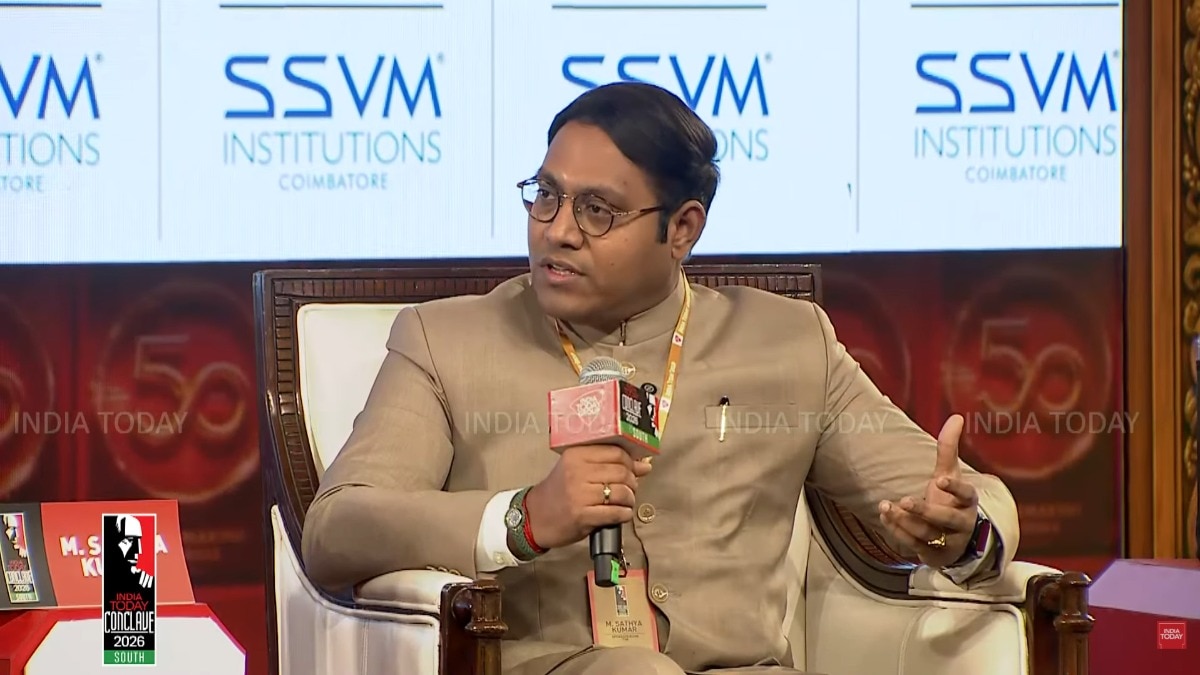
A strong Gen Z vote for Joseph Vijay's Tamilaga Vettri Kazhagam (TVK) played a key role in altering Tamil Nadu's political trend and challenging the state's Dravidian giants. Estimates show 68 per cent of Gen Z voters backed the party in the last assembly election. TVK spokesperson M Sathya Kumar attributed this support of the younger generation to Vijay's focus on jobs, better governance and issues that resonate with young voters.
Speaking at the India Today Conclave South, Kumar said TVK's messaging resonated with a generation seeking "truthful conversations", integrity and values in political leaders.
"My leader, Thalapathy Vijay, always addressed Gen Z when he started the political party. Indeed, Gen Z required truthful conversations and integrity, and they look at values in a leader," Kumar said.
According to Kumar, the party’s appeal among young voters went beyond political rhetoric and focused on what he called the "functional space of activity" , how effectively governments and their departments deliver services and address people's concerns.
"What they are looking at is the functional space of activity. What we promised was towards Gen Z's requirements," he said at a panel discussion on cracking the Gen Z Code, which was also attended by CJP South India In-Charge Vijay Reddy Mallangi, BJP's Anil K Antony and Congress's KS Shabareenathan.
Kumar identified employment as one of the key concerns of young voters, along with better governance and more efficient government departments.
"Today, they need jobs, they want good governance architecture and functional-level government departments. That was what they were asking for, and that was the language my leader spoke," he said.
He also attributed TVK’s appeal among young voters to Vijay’s ability to communicate directly with them. Kumar said Vijay’s speeches and public statements regularly generate significant engagement on social media, particularly among younger voters.
"All Gen Z in Tamil Nadu, the moment my leader speaks, the entire social media celebrates him," Kumar said. He said Vijay had connected with younger voters by communicating political ideas in a language they could easily understand.
"He is able to communicate with ease and convey the vision of Gen Z and identify what they want," Kumar said.
Kumar further claimed that the political preferences of Gen Z voters extended beyond their own generation, influencing the views and choices of their parents and older family members.
He linked the trend to Vijay’s focus on issues young voters consider important, particularly employment, governance and the functioning of government departments.
"That's the reason our political party won with so many votes," Kumar said.GENZ GOES WITH WHOM?
As Gen Z emerges as an increasingly influential electoral constituency, the young political leaders offered sharply different explanations for what is driving young voters.
BJP's Anil K Antony said the political engagement of younger voters was not a new phenomenon but part of a broader transition that had been underway for years. He said the BJP had witnessed strong support from younger voters and argued that the party's organisational changes reflected an effort to connect with a younger generation.
He also cited the BJP's recent electoral performance as evidence of its continued appeal among younger voters.
"In the last five-six major elections, we had our best-ever elections. If Gen Z had not voted, how did we win?" Antony said.
Addressing the concerns of young Indians, Antony said the country was performing better than several global trends, particularly in high-technology sectors. He pointed to the growth of startups and employment opportunities for young people, saying the BJP would continue to work with the younger generation.
"We will ensure that we work with the young generation," he said.
According to him, the political changes involving young voters should be understood not merely as generational shifts but as a broader process of reform and transformation.
Congress's KS Shabareenathan, however, argued that several issues affecting young people remained insufficiently addressed, including graduate unemployment.
"There are many issues Gen Z is facing. No BJP is addressing them. The graduate unemployed..." he said.
Shabareenathan said young voters were increasingly looking for political leaders who demonstrated honesty and integrity and connected with the issues they faced. Referring to Kerala, he said the voting behaviour of young people showed that they were willing to support leaders and political positions that resonated with their concerns.
"If you look at what happened in Kerala, over 100 seats, a lot of people voted. They believe in leaders who are honest, have integrity, and the issues Rahul Gandhi is raising are resonating," he said.
CJP South India In-Charge Vijay Reddy Mallangi, meanwhile, linked the growing political participation of young voters to wider public issues they are facing, including the concerns over the electoral process. Referring to the protests at Jantar Mantar, Mallangi said the mobilisation was the result of sustained efforts and could be replicated in other parts of the country.
"What happened in Jantar Mantar was the result of efforts," Mallangi said, referring to the protests. He also said a similar mobilisation in Mumbai could emerge, adding that it could begin on a smaller scale but potentially develop further.
"What is being put to test is the credibility of the Election Commission," Mallangi said.
Mallangi said the larger issue at stake was the credibility of the electoral process and the Election Commission, arguing that the conduct of elections had become an important concern for politically engaged sections of the younger generation.- Ends