Why ABVP's DUSU sweep gives BJP a boost after Gen Z protests
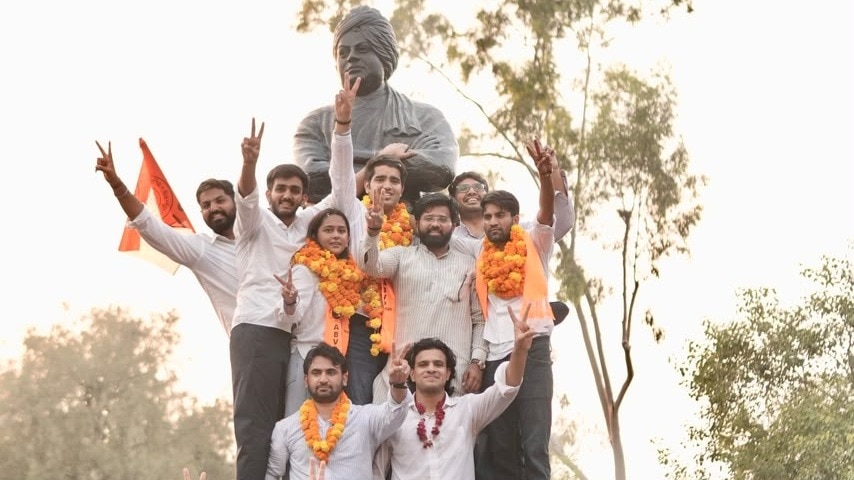
On the day Rahul Gandhi took his “Chhatron Ki Goonj” student outreach campaign to Indore, the Congress-affiliated NSUI drew a blank in the Delhi University Students’ Union election, while the BJP-affiliated ABVP won three of the four central posts.
The outcome carries added significance as it comes nearly two months after youth-led protests over the NEET paper leak forced then Education Minister Dharmendra Pradhan to resign and put the BJP under pressure over its handling of education and youth concerns.
ABVP’s Yash Dabas won the president’s post, Riya Chhawdi was elected secretary and Lakshya Raj Singh secured the joint secretary’s position. Independent candidate Deepanshu Shokeen won the vice-president’s post.
The victory also comes as the BJP steps up its Gen Z outreach, with Union ministers revamping their social media content to connect with younger audiences. The DUSU result gives that effort a timely political boost.
Union Minister Kiren Rijiju said the DUSU election was significant because Delhi University attracts students from across India.
“The ‘Youth Ki Goonj’ narrative has been soundly rejected, and the students have spoken loud and clear. In a way, the DUSU election serves as a referendum that reflects the true voice of the youth,” he said.
Defence Minister Rajnath Singh described the result as a sign of young people’s faith in the BJP’s “Nation First” policy. He said the ABVP would continue working for student interests, national service and nation-building.
Union Minister Hardeep Singh Puri linked the victory to PM Modi’s leadership. “Today’s magnificent showing is a reflection of the confidence that the youth of the country have in the policies and leadership of PM Modi,” Puri said.
The reactions show that the BJP sees the outcome as more than a campus victory. After facing criticism over student concerns, it can now point to an election in which its student organisation defeated the Congress’s principal campus arm.WHY THE RESULT MATTERS
BJP sources described Delhi University as a “mini-India”, citing the presence of students from different states, regions and social backgrounds.
They also highlighted the ABVP’s performance in North Campus, home to institutions such as Shri Ram College of Commerce, Hindu College, Hansraj College, Kirori Mal College, Ramjas College and the Faculty of Law.
The NSUI has historically been the ABVP’s main rival in Delhi University and has controlled the students’ union in the past.
Its failure to secure a central post allows the BJP to argue that anger over examinations and employment has not produced a shift towards the Congress, at least on the Delhi University campus.BJP STEPS UP GEN Z OUTREACH
The BJP and the Modi government began recalibrating their youth outreach after the protests. Their digital strategy shifted towards creator-style short videos, informal Instagram Reels and unscripted content.
BJP leaders also adopted a more conversational tone and online vocabulary to connect with Gen Z, marking a shift from conventional political messaging.
The government assessed Union ministers’ performance on Instagram, X and Facebook between May 1 and August 15, based on their posts, engagement, likes and follower counts. PM Modi topped the assessment.
It also planned a nationwide “One Day One University” campaign, under which Union ministers would visit campuses, interact with students, hear their concerns and explain government schemes.THE BOTTOMLINE
Delhi University remains an ABVP stronghold, and one campus election cannot represent Gen Z nationwide.
But the three-post victory gives the BJP a visible result from its youth outreach and a direct counter to Rahul Gandhi’s “Chhatron Ki Goonj” campaign.- EndsPublished By: Aprameya RaoPublished On: Sep 19, 2026 19:58 IST