Why didn't you resign? CEC in crosshairs, but the two ECs can't escape blame
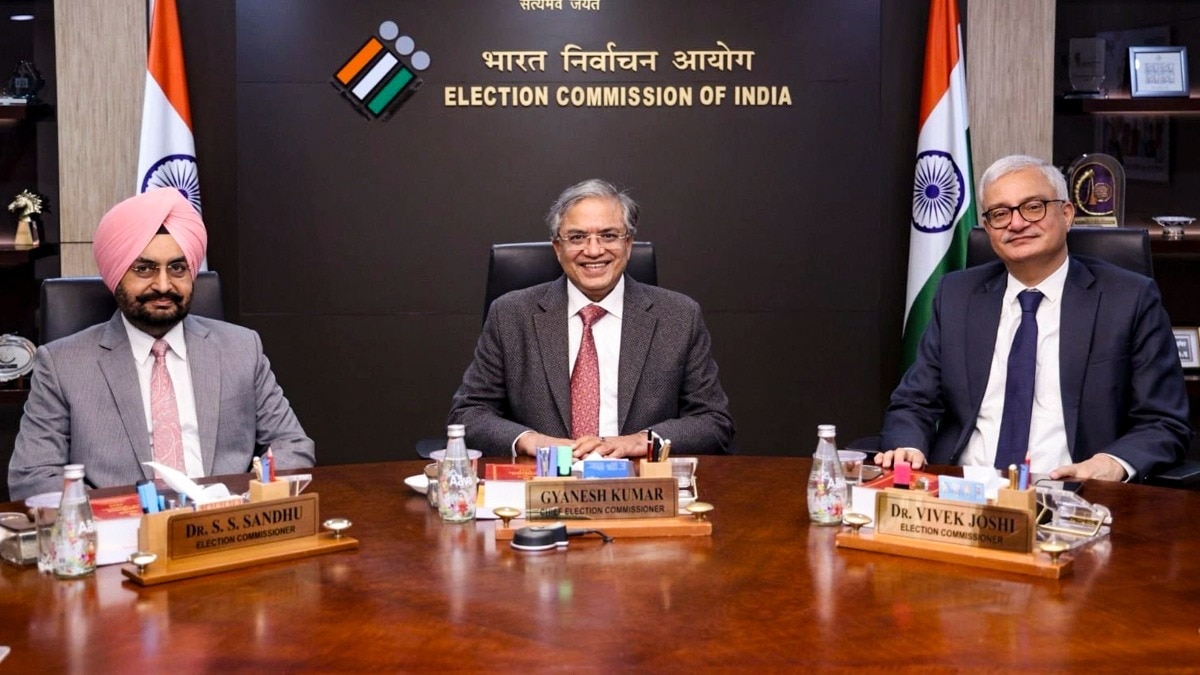
Chief Election Commissioner (CEC) Gyanesh Kumar is rightfully under scrutiny. The uproar against the CEC is over the questions raised regarding dissent by two Election Commissioners (ECs). But if their dissent was repeatedly ignored, why did the two ECs continue to participate in joint decisions and press conferences, approach the Cabinet Secretary instead of the President, and ultimately stay on in their jobs?
The Indian Express newspaper's investigation into the functioning of the Election Commission of India (ECI) on Wednesday (September 23) revealed a pattern of objections recorded by two ECs, Sukhbir Singh Sandhu and Vivek Joshi, on issues involving electoral rolls, Form 6, access to voter data and the functioning of the poll body's IT systems. Overall, it cast questions about the way CEC Gyanesh Kumar went ahead with the Special Intensive Revision (SIR).
According to the report, the two commissioners raised objections at least "14 times over 10 months — once four times in a single day" — including concerns that statutory powers of electoral registration officers (EROs) were being curtailed by centralised control of the electoral-roll database.
These are not minor administrative disagreements. They concern the machinery through which citizens register as voters and through which electoral rolls are prepared and maintained. If the CEC allowed decisions to be taken by bypassing the Commission, ignored a valid majority or permitted statutory powers to be diluted, those questions demand answers.
For the record, the chief election commissioner and the two election commissioners are equals. The chief in the CEC doesn't make him more powerful than the ECs.
On the back of the report that exposed the dissents by the two ECs, the scrutiny on CEC Gyanesh Kumar is justified. But at the same time, it is also important to question if the two ECs did everything in their capacity to highlight their objections.
In the report by The Indian Express itself, there are elements that raise questions that need to be answered by the ECs.
If they believed the functioning of the Commission had become so problematic that their objections were repeatedly ignored, why did they continue to participate in the institution's public defence? Why did they not insist on a formal meeting of the full Commission when they had disagreements? Why did they write to the Cabinet Secretary when the Election Commission is an independent constitutional body? Did they write to the President, who approves their appointment?
Ultimately, if the ECs believed their concerns had reached a point where the institution was no longer functioning as it should, why didn't they tender their resignation? These questions do not diminish the scrutiny on Gyanesh Kumar. They actually complete it.CEC GYANESH KUMAR SHOULD ANSWER THE QUESTIONS
The starting point must be clear. CEC Gyanesh Kumar cannot escape scrutiny simply because the two ECs also face questions.
The Indian Express reported that Sandhu and Joshi repeatedly recorded objections over the functioning of the Commission. One of the most significant disputes concerned the gradual centralisation of the electoral-roll database and the functioning of the ECI's IT architecture.
There was also a controversy over Form 6, the statutory form used by new voters to register themselves.
Joshi recorded on May 16, 2026, that the proposed changes to Form 6 could not be made through an SIR order because the form was prescribed under the Registration of Electors Rules, 1960. He suggested that the matter be sent to the government for the necessary rule changes. Sandhu concurred with him on May 19.
Yet, according to The Indian Express, the disputed changes subsequently appeared on the ECI's online portal ECINet. On August 13, Sandhu again recorded that the changes were "unauthorised or illegal" and called for them to be removed.
If two of the three commissioners had taken this position, the obvious question is what happened next.
Was their view rejected? Was there a formal Commission decision? Was there a majority? Was the matter discussed by all three? And if the CEC disagreed, on what legal basis?
These are questions that Gyanesh Kumar and the ECI should answer.
The issue is particularly important because Article 324 establishes the Election Commission as an independent constitutional authority. The 2023 law governing the CEC and ECs also provides for decision-making by the multi-member Commission, with a majority prevailing where unanimity is not possible.
So the question is not simply whether Sandhu and Joshi disagreed with Gyanesh Kumar. It is actually whether their disagreement was dealt with in accordance with the law. Also, it isn't known if the two utilised the legal powers available to them to the full extent.WHY HOLD JOINT PRESS BRIEFINGS AND MEETINGS EVEN AFTER DISSENT?
This is where the other half of the story begins, which is not widely spoken. If the two ECs believed that their concerns were being systematically ignored, their conduct deserves scrutiny.
Take the press conferences. Leader of the Opposition in the Lok Sabha, Rahul Gandhi, held his first press conference alleging "vote chori" on August 7, 2025. Ten days later, on August 17, Gyanesh Kumar addressed the media to respond to those allegations and defend the Election Commission's position.
Sandhu and Joshi were present alongside him.
This is significant in light of the subsequent disclosures about their concerns over the electoral roll process. Their presence does not prove that they agreed with every statement made by the CEC. Nor does participation in a press conference mean that every internal disagreement disappears. But it does raise a reasonable institutional question.
If they already believed that serious problems existed in the functioning of the Commission, what was the position they were collectively presenting to the public?
The question became even more relevant in 2026. After ECINet was launched on January 22, and as concerns over the centralisation of electoral-roll data were being recorded, the three commissioners continued to appear together publicly.
They held joint appearances in March, including a press briefing on March 10 and the election schedule announcement on March 15.
A multi-member constitutional body can disagree internally while presenting an institutional position externally. But if the disagreements were fundamental, the public is entitled to know how that consensus was reached. And that is why the minutes, notes and records of the Commission's meetings matter. If the disagreements were fundamental, why did the two present a unified stand on behalf of the ECI?advertisementIF THE TWO ECs HAVE MAJORITY, WHY NO CLARITY IN PUBLIC?Political analyst Rajat Sethi raised perhaps the most important institutional question during a discussion on India Today TV.
He said the crucial issue was whether the two ECs had jointly opposed particular decisions, thereby constituting a majority against the CEC, or whether they had raised objections on separate matters while the final decision still had majority support.
"If the two commissioners are on one side on a decision, they could have called the full-fledged meeting of the Election Commission on their own," Sethi said while speaking to India Today TV's Consulting Editor Rajdeep Sardesai.
The distinction made by Seth is critical. The existence of dissenting notes does not automatically mean that the decision taken by the Commission was illegal.
Under the statutory framework, the ECI is a multi-member body and decisions can be taken by the majority when there is no unanimity.
Therefore, the question here is whether Sandhu and Joshi together constitute a majority against the decision that was eventually taken?
If yes, how was that majority dealt with? If not, what was the final decision, and who supported it? These details are, however, not in the public domain.
The Indian Express also in its report said that on September 21, they sent a questionnaire to the ECI on the issues flagged by the two election commissioners asking what was done to address their concerns. There was no response.
It also added that both the ECs were also sent emails on the same day, for clarity. Both emails were followed up by phone calls twice. There was no response from the ECs.WHY SHOULD THE ECs APPROACH THE CABINET SECRETARY?
The second major question concerns the July 29 letters by the Election Commissioners.
According to The Indian Express, after Senior Deputy Election Commissioner Maneesh Garg changed the work allocation within the Commission's administration division on July 28, Sandhu and Joshi separately wrote to Cabinet Secretary TV Somanathan the following day.
They wrote in the letter that the move was a violation and sought appropriate action. The concern raised by the ECs was not trivial. The disputed work allocation affected the oversight structure of the IT division, exactly the area over which they had already raised concerns.
But the decision to approach the Cabinet Secretary raises a constitutional question. Political expert Yogendra Yadav during the India Today TV debate questioned this.
"Is the Cabinet Secretary the boss of the Election Commission of India?" Yadav asked.
The argument is not that the Cabinet Secretary cannot be approached under any circumstances. But why should members of an independent body approach a government executive over a grievance with their fellow commissioner?
The CEC and Election Commissioners are appointed by the President. The Election Commission derives its constitutional authority from Article 324 and is not administratively subordinate to the Cabinet Secretary.
As Yadav argued, if the two commissioners believed that the internal institutional mechanism had failed, the constitutional route would have been to approach the President. That makes their choice of the Cabinet Secretary a legitimate question.AT LAST COMES THE MOST POWERFUL FORM OF DISSENT
Now it's time for the hardest question. Why didn't the two ECs resign?
Resignation is not required merely because an Election Commissioner disagrees with the CEC. Dissent is an accepted part of institutional decision-making.
But resignation becomes a different question when an office-holder believes that the institution has fundamentally stopped functioning in accordance with the law.
If Sandhu and Joshi believed that their objections were being ignored repeatedly, that statutory powers were being curtailed, that electoral-roll systems were being centralised without adequate oversight and that their authority was being bypassed, what was the limit of their institutional tolerance?
Yogendra Yadav's argument is essentially that recording dissent cannot be the end of accountability.
Rajat Sethi, too, questioned the conduct of the two commissioners.
When the July 28 work-allocation order was issued, the ECs acted together. They wrote separately to the Cabinet Secretary and then jointly overturned the order.
That demonstrates that they were capable of exercising collective institutional authority. So why was that approach not used earlier in the disputes recorded by The Indian Express?
And if they believed that even such mechanisms had failed, why remain in office? None of this means CEC Gyansh Kumar should escape scrutiny.
The revelations concerning Form 6, electoral-roll access, the IT system and the alleged centralisation of the database make scrutiny of Gyanesh Kumar necessary. If the CEC disregarded a valid majority, permitted statutory procedures to be bypassed or allowed decisions to be taken without the Commission's approval, the public deserves a clear explanation. But why should only the CEC face scrutiny? The other two too shouldn't escape being questioned.- Ends