Why Peter Bruce's Criticism of the Cape Union Mart Boycott Falls Short - IOL
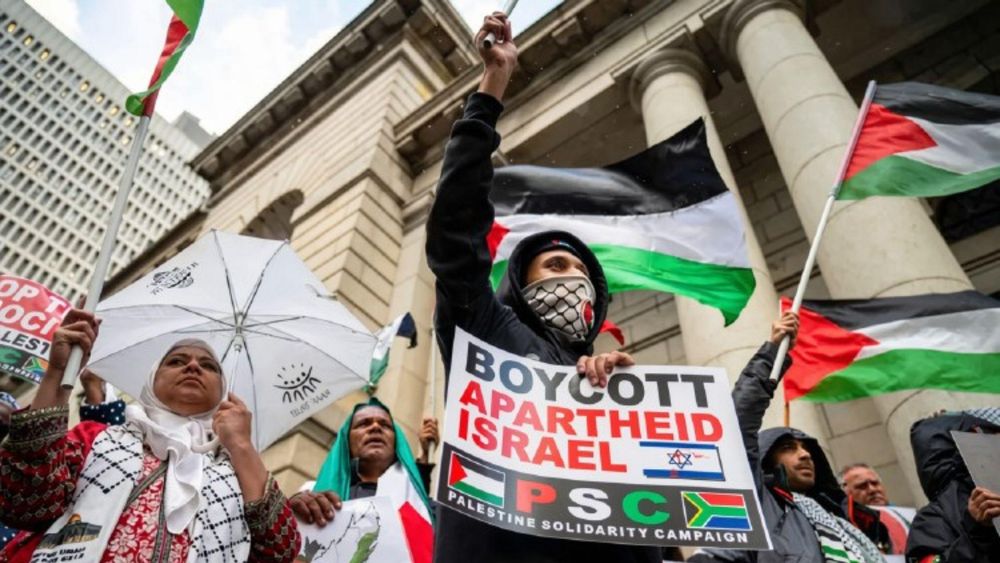
A group of protesters of supported by the Palestine Solidarity Campaign demonstrate outside the Western Cape High Court. Ziyad Motala argues that Peter Bruce misstates the Cape Union Mart court case and conflates Philip Krawitz’s Jewish identity with his public affiliations to Israel and Zionist organisations.
Peter Bruce’s column, “Picking the wrong Jewish target for anti-Israel anger”, performs a curious feat. It lectures pro-Palestinian protesters about recklessness, lies and the obligations that accompany free speech while itself beginning with several elementary inaccuracies about the very case on which the lecture rests. Bruce describes Philip Krawitz as the “owner” of Cape Union Mart, yet the Western Cape High Court judgment records something rather more precise: Krawitz is the company’s executive chairperson and “is not a shareholder.”
Bruce then tells readers that Krawitz endured the protests until “earlier this year, when he went to court,” although the application was in fact launched on June 19, 2025. He later refers to “the judge” who sided with Krawitz, when the case was decided by a full bench of three judges, Cloete J writing with Nziweni J and Barendse J concurring. These may appear small errors, but they become rather less small in a column whose central theme is that other people should exercise greater care before making accusations.
Nor did the protesters “lose comprehensively” in quite the way Bruce suggests. They certainly lost important parts of the case: the Court held that they had not established that Krawitz or Cape Union Mart funded the Israeli Defence Force or military operations in Gaza, and it granted substantial interdictory relief. But the Court itself considered the relief sought excessively broad, describing even an amended formulation as “too broad for comfort”, fashioning its own order, awarding no costs and observing that Krawitz had “probably stoked the proverbial fire” through some of his own public remarks. More importantly, the judgment did not outlaw the boycott campaign or prohibit protest outside Cape Union Mart stores. The final order expressly contemplates continued protest, subject to the Gatherings Act and the prohibition on blocking access. Protesters who returned after the judgment were therefore not defying the Court merely by returning; they were exercising a right the judgment itself leaves intact.
Bruce next offers what amounts to a character reference for Krawitz. Cape Union Mart is patriotic, employs thousands of South Africans, and Krawitz supports charities, bursaries, the Cape Town Philharmonic Orchestra and an all-black production of Aida. These may all be admirable things, but they are also largely irrelevant to the issue before us. Philanthropy is not a voucher redeemable against political criticism, and a businessman does not acquire insulation from boycott because he funds worthy causes. During apartheid, a corporate executive might have supported hospitals, orchestras, bursaries and black education while simultaneously supporting a political order that others regarded as morally indefensible. The charitable ledger would not settle the politics.
The real leap comes when Bruce asks how such a civic-minded businessman became the object of protest and supplies this answer: “It’s because Krawitz is a Jew.” That is an extraordinarily serious accusation, and yet it is asserted rather than demonstrated. The public record supplies an obvious alternative explanation. Krawitz has held senior positions in organisations intimately connected with Israel and Zionism, and the judgment records his chairmanship of Keren Hayesod South Africa and his involvement in Keren Hayesod and the Jewish Agency for Israel. Keren Hayesod itself describes his long-term leadership and “unswerving devotion to Israel”. None of this proves that he funded the IDF, and the Court was entitled to find that the protesters failed to establish that proposition. But it makes Bruce’s categorical assertion that Krawitz was targeted because he is Jewish, rather than because of his public Israel-related and Zionist commitments, exceedingly difficult to sustain.
Krawitz’s Jewish identity is one thing; his public political and institutional commitments concerning Israel and Zionism are another. The Constitutional Court recognised the importance of this distinction in SAHRC v Masuku. Criticism of Zionism may, depending upon context, operate as a proxy for antisemitism, but it does not follow that criticism of Zionism is necessarily criticism of Jews, still less that political action directed at a prominent Zionist is necessarily directed against him because he is Jewish. Bruce’s own title illustrates the problem: “Picking the wrong Jewish target.” Why is “Jewish” the relevant category? When he asks whether protesters would have treated Raymond Ackerman or Adrian Gore similarly, one is entitled to ask why those men are the comparators at all. If Krawitz was targeted because of his highly public involvement with Israel-related and Zionist organisations, the proper comparator would be a businessman of any religion with comparable affiliations and public commitments. Bruce makes Jewishness the organising category and then faults others for allegedly doing the same.
He compounds the problem when he acknowledges that some South African Jews support Israel’s conduct in Gaza and others do not, and then says he would “wager” that Krawitz belongs to the latter group. Wager? Having reprimanded protesters for inadequately grounded assertions, Bruce apparently permits himself speculation when it assists his own case. Krawitz’s attachment to Israel does not prove that he supports every action of Netanyahu’s government, and it would be wrong to invent such a position for him. But Bruce cannot simply invent the opposite proposition either and then use his conjecture as evidence of the protesters’ irrationality. What is established is enough for legitimate political controversy: Krawitz has publicly associated himself with Israel and organisations devoted to it, and citizens are entitled to draw political conclusions from those choices.
Bruce then tells us: “There’s nothing wrong with supporting Israel’s right to exist. It should never be in doubt.” Many international lawyers would regard the familiar invocation of a state’s “right to exist” as a profoundly confused, even stupid, formulation. International law does not ordinarily confer upon states a metaphysical right to exist eternally in whatever ideological or constitutional form they assume. On the conventional account of statehood reflected in Article 1 of the Montevideo Convention, the familiar criteria are a permanent population, defined territory, government and the capacity to enter into relations with other states. States exist as legal and political realities; peoples possess rights, including the right of self-determination. That is quite different from saying that a particular racial, religious or ideological constitutional order has a perpetual entitlement to preserve itself.
Apartheid South Africa illustrates the distinction rather neatly. South Africa indisputably existed as a state, possessing territory, population, government and international legal personality, but it did not possess some sacred “right to exist” as an apartheid state. Those who demanded the abolition of apartheid were not demanding that white South Africans disappear or be expelled from the country; they were demanding the destruction of a political order organised around racial supremacy and its replacement by one founded on equal citizenship. The protesters are entitled to make an analogous political argument about Israel. They may regard its Zionist constitutional conception as ethno-racial, racist and increasingly fascistic, and demand its transformation into a state based on equal citizenship. Bruce may regard that characterisation as outrageous and may defend Zionism as national self-determination, but he cannot settle that profound political dispute by invoking the incantation that Israel has “a right to exist”. I wonder whether he would have said in 1985: “There’s nothing wrong with supporting apartheid South Africa’s right to exist. It should never be in doubt.” Applied consistently, that logic would have transformed South Africa’s existence as a state into an entitlement to preserve the very racial order that its opponents were struggling to dismantle.
Bruce is equally dismissive when he says South Africa “cried genocide.” South Africa did not “cry” anything. It invoked the Genocide Convention and, supported by a detailed evidentiary record, instituted formal proceedings against Israel before the International Court of Justice. The ICJ has not yet determined the genocide allegation on the merits, and intellectual honesty requires saying so, but it has issued binding provisional measures in proceedings under the Convention, including measures directed at preventing prohibited acts and addressing catastrophic humanitarian conditions in Gaza. Describing this merely as South Africa having “cried genocide” substitutes columnist’s disdain for a rather more serious legal reality.
Nor is South Africa standing alone making some eccentric accusation into the wind. Amnesty International concluded after an extensive investigation that Israel has committed genocide against Palestinians in Gaza. The United Nations Independent International Commission of Inquiry on the Occupied Palestinian Territory, including East Jerusalem, and Israel concluded that Israeli authorities and security forces had committed genocidal acts and possessed the requisite intent, and it has subsequently maintained its conclusion that genocide is continuing. The International Association of Genocide Scholars, a leading international scholarly association devoted to genocide studies, adopted a resolution declaring that Israel’s policies and actions in Gaza meet the legal definition of genocide under Article II of the Genocide Convention. The UN Special Rapporteur Francesca Albanese likewise concluded in her Anatomy of a Genocide report that there were reasonable grounds to believe that the threshold indicating genocide had been met.
The list does not end there. B’Tselem and Physicians for Human Rights Israel, two prominent Israeli human-rights organisations, have also concluded that Israel’s conduct in Gaza amounts to genocide. Bruce’s description of South Africa as having “cried genocide” reduces proceedings before the world’s principal judicial organ, findings by a UN commission of inquiry, conclusions by Amnesty International and prominent Israeli human-rights organisations, the considered view of a leading international association of genocide scholars to something resembling an emotional outburst. Bruce is entitled to take an ideological position, align himself with Israel and reject the genocide allegation. He is not entitled, if he wishes to be taken seriously, to pretend that South Africa simply invented it.
Bruce himself acknowledges the enormity of what has happened. He says the Israeli government “basically went berserk,” acknowledges the enormous Palestinian death toll and calls Netanyahu an “out-and-out thug.” Yet an odd asymmetry follows from his own account. Israel may have gone berserk, Netanyahu may be a thug, and Palestinian children may be slaughtered, but South Africans attempting to impose economic and reputational consequences upon someone publicly identified with Israel somehow become the principal objects of his indignation. He then dismisses the significance of local protests because Israel’s diplomatic isolation has, he says, had “very little to do” with activists picketing Krawitz. Of course, one Cape Town picket did not rearrange global diplomacy, but that is hardly the test of whether political protest has legitimacy.
If Bruce studied the South African anti-apartheid struggle he would learn that boycotts operate cumulatively. The anti-apartheid movement consisted of innumerable local acts: students demanding divestment, consumers refusing South African products, dockworkers declining cargo, musicians refusing performances, churches divesting funds and protesters picketing businesses. No individual demonstrator had to establish that his particular placard changed Swedish, Irish or American foreign policy before the protest acquired legitimacy. Political pressure works through aggregation, symbolism and moral delegitimation. Bruce’s reasoning would have rendered boycott politics pointless precisely because no individual boycott can prove that it alone produced the eventual political result.
Then comes one of the column’s strangest suggestions. Bruce speculates that government would have intervened had protesters targeted Ackerman or Gore, and certainly if they targeted Ford, Amazon or another major American investor. What exactly is the democratic principle being proposed here? Should government use its levers to discourage a lawful political boycott when its target employs enough people, and is there some numerical threshold at which freedom of protest yields to payroll size? If 3,000 employees are insufficient, would 10,000 secure constitutional tranquillity, or perhaps 50,000? If government used informal state pressure to drive citizens away from peaceful protest because an economically powerful corporation disliked their message, that would hardly demonstrate the health of South African democracy. It would provide a reason to worry about it.
Bruce also contrasts what people say on social media with speech “in the real world.” Constitutional law recognises no Twitter exception under which robust political accusations are permissible online while pavements become zones of genteel discourse. Defamation law follows a speaker into both places, and so does freedom of expression. South African law has repeatedly recognised that political speech is often harsh. In Mthembi-Mahanyele v Mail & Guardian, the Supreme Court of Appeal recognised that politicians and public figures retain reputational rights but must be more resilient to the “slings and arrows” of public controversy. In The Citizen v McBride, the Constitutional Court made the point even more starkly: protected comment may be extreme, unjust, unbalanced, exaggerated and prejudiced, provided its factual foundation and other legal requirements are established. The opinion itself need not satisfy a judge’s conception of fairness.
That distinction is central to the Cape Union Mart controversy. If a protester asserts as a literal fact that Krawitz personally transferred a specified sum to the IDF, the allegation must be proved, and if it cannot be proved a court may act. But “support,” “association” and “complicity” are not synonymous with a bank transfer; they may also express political and moral judgment. Someone may regard another person as politically complicit in a project without proving that he bought a rifle, financed a battalion or wrote a cheque to a government. Bruce never seriously confronts that distinction. Instead, his column bundles together Jewishness, Zionism, Israel, Netanyahu, corporate reputation and charitable giving into one reassuring story: a decent Jewish businessman confronted by a “baying pack.” The zoological metaphor is revealing. Once political protesters are reduced to a pack of noisy animals, their arguments need no longer be answered; they can simply be dismissed as noise. It is an oddly contemptuous posture for a columnist who ends by congratulating South Africa on being a “real democracy.”
And then comes Bruce’s final flourish. The protesters, he says, may continue provided they obey the Court’s strictures because “they are lucky to live in a real democracy.” South Africans exercising constitutional freedoms of expression, assembly and political protest are not recipients of Peter Bruce’s indulgence; they are exercising rights. There is, however, a delicious irony in his closing thought, because Peter Bruce is lucky to live in a real democracy too. It permits him to call Krawitz an owner when the judgment records that he is not a shareholder; to move a 2025 court application into 2026; to reduce a three-judge full bench to “the judge”; to wager about Krawitz’s views on Gaza without evidence; to speculate about what government would have done for Ackerman, Gore, Ford or Amazon; and, most strikingly, to attribute an entire political boycott to the fact that Krawitz is Jewish without actually demonstrating it.
And that is entirely as it should be. The Constitution protects Bruce’s right to advance arguments that others may regard as inaccurate, speculative, tendentious or profoundly mistaken, just as it protects the people on the pavement who disagree with him. Neither side needs the permission of the other to participate in public debate, and neither exercises constitutional freedom by sufferance. That is not the protesters’ good fortune. It is their constitutional right. And, Peter, that is what living in a real democracy actually means.
* This piece was first submitted to Mike Siluma, head of the Sunday Times op-ed section, and to Makhudu Sefara, the newspaper’s Editor-in-Chief. Newspapers are, of course, entitled to exercise complete editorial discretion over what they publish. What is less defensible is the absence of even a basic acknowledgment. As with several of my previous submissions dealing with Israel, this piece was met with silence.
Ziyad Motala is a Professor of Law at Howard University School of Law. Motala argues that Peter Bruce misstates the Cape Union Mart court case and conflates Philip Krawitz’s Jewish identity with his public affiliations to Israel and Zionist organisations.
** Ziyad Motala is a Professor of Law at Howard University School of Law.
** The views expressed do not necessarily reflect the views of IOL.