Why Shimla monkey menace poses questions beyond human-wildlife conflict - The Indian Express
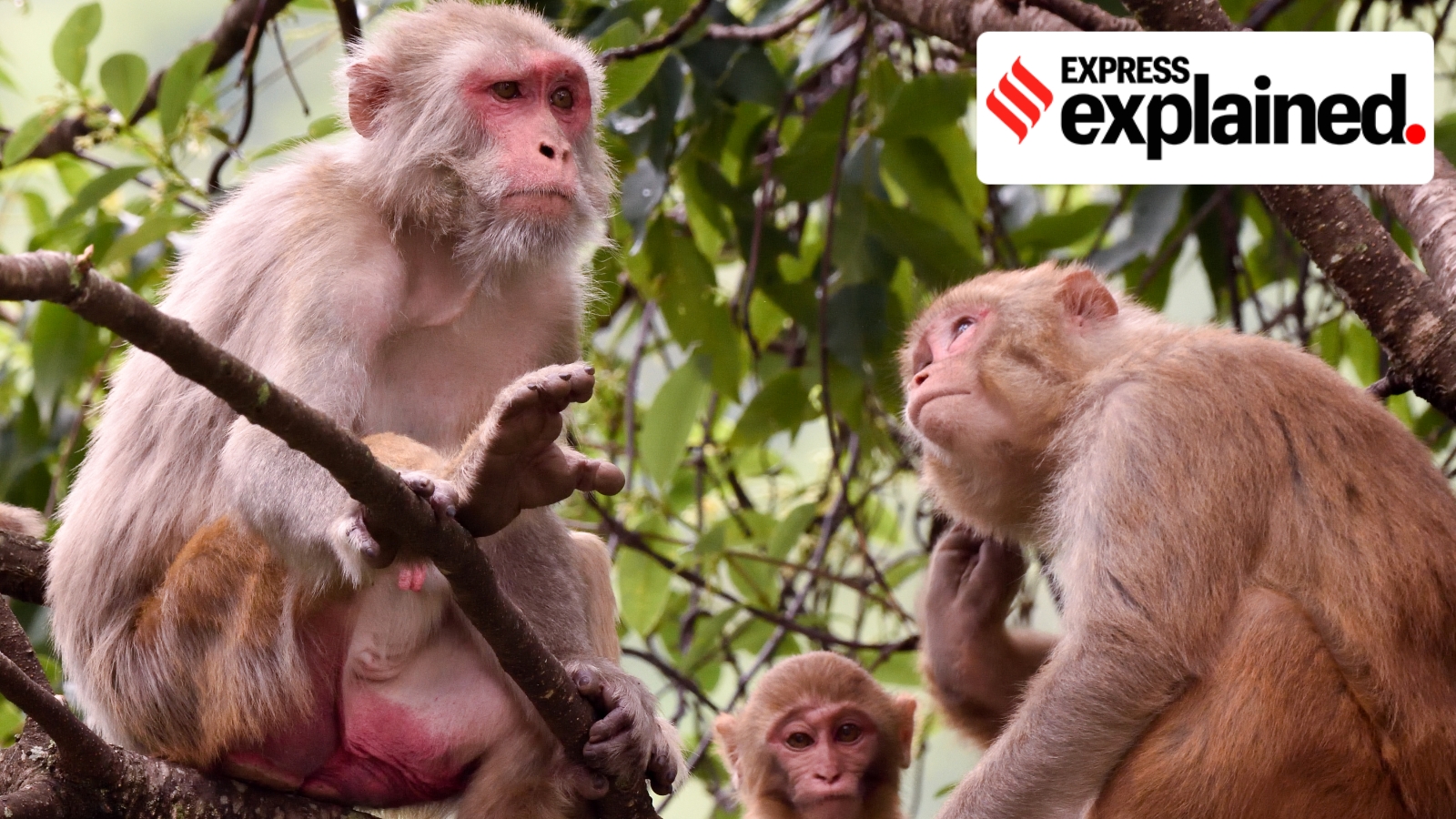
The death of 63-year-old Satya Devi Chauhan in Shimla this month brought the unresolved question of human-wildlife conflict to the forefront once again. Chauhan, a widow, suffered grievous injuries, including spinal damage, after being attacked by a pack of rhesus macaques on the roof of her house on August 30. She was on ventilator support at the city’s Indira Gandhi Medical College & Hospital, before she passed away on September 5.
The incident has brought the legal and administrative position of rhesus macaques, also called rhesus monkeys, into focus. The Wild Life (Protection) Act, 1972, listed the rhesus macaque as a protected species under Part I of Schedule II, but the Wild Life (Protection) Amendment Act, 2022, removed it. We explain what the 2022 amendment changed on the ground, and the questions over conservation and compensation.
The practical consequence has been a shift in institutional responsibility. Chief Wildlife Warden of Himachal Pradesh, Alok Prem Nagar, told The Indian Express, “Practically, the state forest departments are now no more responsible for looking after the monkey menace. A monkey is now like a stray animal, which falls under the purview of civic bodies including urban local bodies (ULBs), that is, municipal corporations, nagar panchayats, etc.”
A senior Indian Forest Service (IFoS) officer, who is among others representing Himachal Pradesh before a Parliamentary Consultative Committee (PCC) of the Union Ministry of Environment, Forest and Climate Change (MoEFCC) on this issue, told The Indian Express, “MoEFCC constituted a PCC to address many issues pertaining to the human-wildlife conflict. The foremost issue was the changed scenario after excluding the monkeys from the list of protected animals. States like Himachal Pradesh, Uttarakhand have been facing similar problems after the changed scenario.”
“Urban local bodies like Shimla Municipal Corporation are not fully competent to tackle the monkey menace independently so far. There are many reasons. First, the lack of funds. Second, absence of expertise and trained manpower to capture monkeys, and sterilising the captured monkeys,” the officer said.
According to the IFoS officer, state forest departments earlier used to receive funds to control the monkey menace from the Compensatory Afforestation Fund Management and Planning Authority, a national-level statutory body functioning under the MoEFCC. Now, with the rhesus monkey no longer a protected animal, the officer added, ULBs across India are yet to receive any consolidated or dedicated funds towards this end from the Central government.
Shimla Municipal Commissioner, Sachin Kanwal, acknowledged the problem. He said, “Indeed, we lack the expertise, but we are in the process of training our manpower on how to capture the monkeys. Whenever a situation arises, we take the assistance of the concerned forest department. The issue of monkey menace has also been taken up with the Central government simultaneously.”
Deputy Conservator of Forests (Wildlife), Shahnawaz Ahmad Bhat, who coordinates with the Shimla Municipal Corporation on this issue, said, “It doesn’t mean that on ground, the forest and wildlife department has completely shunted its responsibilities from the complaints pertaining to the monkey menace. We do intervene, but largely in and around the forest areas. Whenever Municipal Corporation officials approach us seeking our assistance for capturing a monkey and sterilising it, we do provide our assistance. But in such cases, we charge money from the urban local bodies.” The cost of each monkey sterilisation is Rs 700.
As per officials of the Shimla Municipal Corporation, the city records 50-55 cases of monkey attack every month. The figures and dates of such incidents were being collected from all government and private hospitals in Shimla.
According to the Himachal Pradesh Forest Department, the estimated rhesus macaque population fell from 3,17,512 in 2004 to 2,26,086 in 2013, and then further to 2,07,614 in 2015 and 1,36,443 in 2019-20. The department attributes much of this decline to sustained sterilisation and related interventions. The state began its organised sterilisation programme in 2006. By March 2024, 1,86,448 monkeys had been sterilised through the state’s centres.
Wildlife expert and tiger conservationist Shaminder Boparai captured the central dilemma: “Opinions are divided on the issue that monkeys should be treated like vermin or a protected animal, irrespective of the fact that their (monkey) population increases rapidly and at a fast pace.”
In the context of Himachal Pradesh, where the recorded forest area is around 68%, some larger questions arise: Why does a monkey, a wild/protected animal until some years ago, come out of the forest? Or did humans venture deep into the forests, occupying their territories?
“The public feeding of wild animals, including monkeys, are forcing animals to come out of the forest in search of easy food. The decline in the population of predators is also another reason why the population of monkeys is increasing,” Boparai said.
On Monday (September 14), Shimla Nagrik Sabha, an NGO which focuses on civic issues, held a protest outside the office of the Shimla Municipal Commissioner demanding a compensation of Rs 5 lakh for Chauhan. The NGO also demanded stricter action against those found feeding monkeys in Shimla.
The change in legal status, however, has also affected compensation. Under Himachal Pradesh’s wildlife compensation policy cited by officials, severe monkey-attack injuries attract a compensation of Rs 75,000, permanent disability Rs 1 lakh, and death Rs 4 lakh. Since rhesus macaque is no longer covered by the Act, officials indicated that Chauhan’s family is unlikely to qualify under this framework.
Saurabh Parashar is an Assistant Editor at The Indian Express, primarily responsible for the publication’s coverage of Himachal Pradesh. He is a seasoned journalist with over 17 years of experience in print media, specializing in crime, legal affairs, and investigative reporting. Professional Background Education: He holds a Master’s degree in Mass Communication from Guru Jambheshwar University of Science & Technology (Hisar) and a Law degree from Himachal Pradesh University (HPU), Shimla. This legal background significantly informs his reporting on complex judicial and administrative matters. Career Path: Before joining The Indian Express in 2017, he spent 12 years with The Times of India. Core Beats: His primary focus is the socio-political landscape of the hill state, with a specific emphasis on the environment, forest conservation, drug menace (specifically "Chitta"), affairs related to tribal and archaeology and the unique challenges of governance in high-altitude regions. Recent Notable Articles (Late 2025) His recent reporting highlights the critical intersection of policy, law, and social safety in Himachal Pradesh: 1. "Himachal’s battle against Chitta: Why the border areas are most vulnerable" (Late 2025): An investigative look at the transit routes from Punjab and the impact on local youth. 2. "Shimla ropeway clears key hurdle as 820 trees face the axe :According to the Forest Survey of India’s 2021 assessment, 47.21 percent of Shimla’s 5,131 sq km geographical area is under forest cover (Nov 17, 2025). 3. "Himachal to handover 2.7427 ha of non-forest land for Shimla Ropeway: Given the land’s non-forest nature, RTDC and the state will not require permission from MoEFCC" (Nov 18, 2025) 4. "How the centuries-old Jodidara tradition is fading in Himachal’s Trans-Giri region: Jodidara: a form of fraternal polyandry—has long been part of Hatti tribal culture in the Trans-Giri region of Himachal Pradesh and adjoining Uttarakhand. It is believed to have evolved to prevent division of ancestral land and maintain unity among brothers in the harsh, mountainous terrain" (Aug 18, 2025) Legal & Agricultural Affairs "Kisan Sabha hails SC’s setting aside Himachal HC order to remove orchards from forest land" (Dec 18, 2025): Covering a major Supreme Court victory for farmers, where a High Court order to remove fruit-bearing apple orchards was overturned. "Himachal Cabinet nod to new tourism policy; focus on home-stays in tribal areas" (Dec 11, 2025): Detailing the legislative push to decentralize tourism and bring economic benefits to Lahaul-Spiti and Kinnaur. 3. Governance & Environment "Forest rights and development: Why Himachal is seeking more leeway from Centre" (Dec 19, 2025): Reporting on the legal hurdles faced by the state in infrastructure projects due to the Forest Conservation Act. "Cloudbursts and resilience: How Himachal’s remote villages are building back better" (Nov 2025): Following up on the long-term rehabilitation efforts after monsoon-related disasters. Crime especially cyber crimes, crypto currency etc: crypto currency: "Agents in uniform, motivational speeches, lavish parties: How a Himachal crypto con went unnoticed:A serial conman, a ‘Nelson Mandela Nobel Peace Award winner', and retired policemen got together to pull off a Rs 1,740-crore fraud" (Nov 10, 2023) Signature Beats Saurabh is recognized for his tenacious reporting on the state's drug epidemic. His deep familiarity with the topography and tribal culture of Himachal allows him to report from remote locations like Spiti, Pangi, Shillai, which are often overlooked by national media. His legal expertise makes him a primary choice for covering the Himachal Pradesh High Court on issues ranging from local body elections to environmental PILs. X (Twitter): @saurabh_prashar . ... Read More