Why Xi Didn’t Flinch at Trump’s Flyover Flex - Newsweek
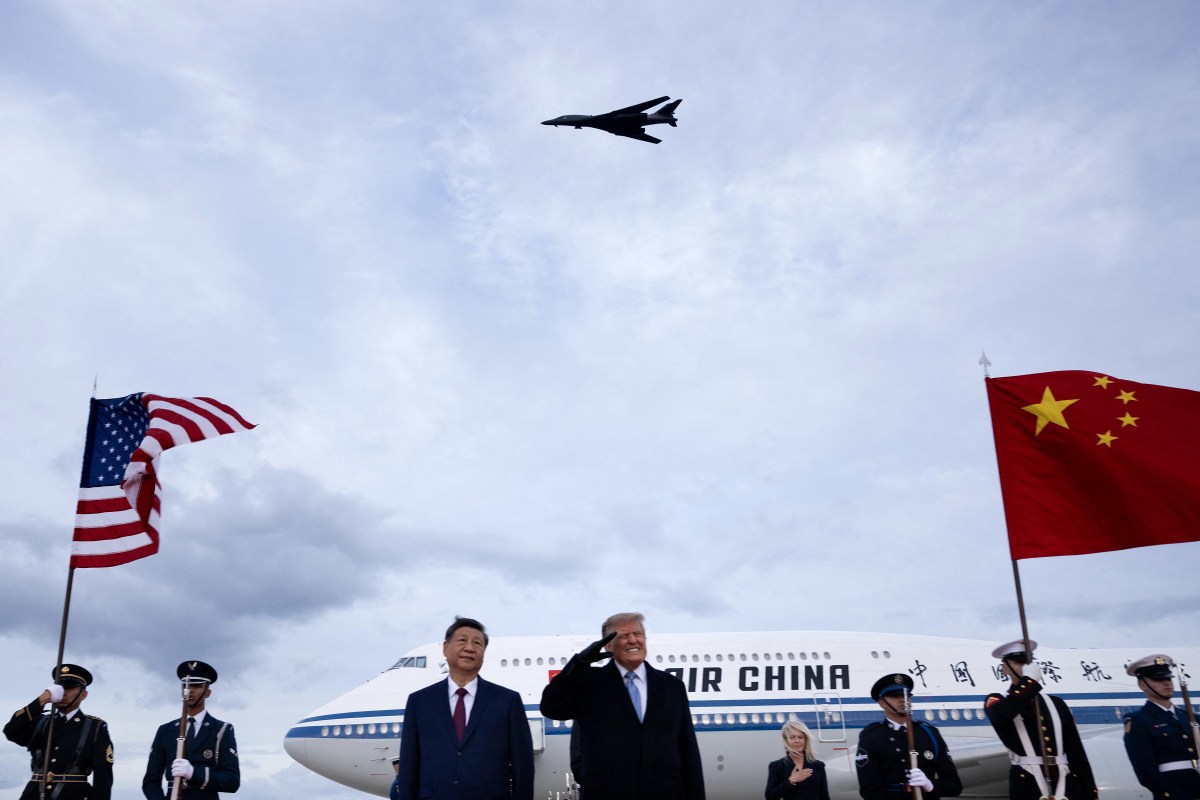
As two B-1 Lancer bombers roared overhead, President Donald Trump physically and visibly recoiled at the thunderous sound of pure American air power.
Yet the man standing next to Trump, and for whose arrival at Joint Base Andrews on Wednesday the flyover was intended to honor, perhaps even intimidate, didn’t flinch.
Chinese President Xi Jinping has an unreadable facial expression at the best of times, a deliberate feature of Beijing’s approach to diplomacy: give nothing away.
Xi merely followed the aircraft with his bored eyes, mouth flattened into neutral.
"That was really loud," Trump remarked to Xi, who didn’t reply.
One social media user described the moment as perhaps the “biggest loss of aura we've ever witnessed,” adding that Trump had been “absolutely deaf-mogged by China.”
Mogging, if you’re unfamiliar with this piece of internet slang, means when one person dominates or outshines another in some way. Looks, performance, whatever.
The flyover might be taken as an attempted mogging of Xi by Trump. But it wasn’t just the pair that caught Trump by surprise on display for his Chinese rivals.
Six F-16s and six F-22 Raptors also lined the tarmac. A B-2 Spirit and four F-22s are due over the White House on Thursday in another mogging-by-air.
These are formidable machines, certainly. But like Trump, they are also surprisingly old for how they look and sound. The Air Force's F-16s average nearly 34 years, its B-1Bs 37, its B-2s nearly 29 and its F-22s 19.
Xi has some younger models to toy with. He didn’t bring them with him. But China’s latest contribution to the world of military aviation is a sharp-edged stealth fighter jet that looks more like a fei biao throwing dart than a plane. It was on show across the internet this week, as new footage of the J-36 jet circulated.
The J-36 matters not because it is a better fighter than the F-22, but because China appears to have decided the future need not look much like one of those at all.
It seems built to reach past America's fighters and threaten the system that keeps them flying. This is a flex against America's flex, and it’s about Taiwan.
The J-36, an unofficial name taken from the serial number on its nose, first appeared over Chengdu in December 2024.
At least four, and possibly five, prototypes are now thought to be flying. It is huge, tailless, three-engined and two-seat, and analysts still argue over whether it is a fighter, bomber, or command node, or all of them at once.
Intelligence firm Janes's early estimate put its wingspan at 24.8 meters. Later satellite imagery analyzed by The War Zone suggested nearer 20. Either way, that is far wider than the 13 meters of China’s current stealth fighter, the J-20.
The volume buys fuel, sensors and internal weapons. Jane's judged the main bay, at about 7.3 meters, long enough for China's PL-17 very-long-range air-to-air missile.
Then there's what's missing, and what gives the J-36 its bizarre appearance. Vertical fins give conventional jets directional stability, but they are flat surfaces that reflect radar.
The J-36 has none, relying on complex flight controls. There are split rudders on each wing, and some later prototypes carry F-22-style two-dimensional thrust-vectoring nozzles.
Its design looks drawn around mission priorities other than combat agility. Stay hidden, fly far, carry a lot, see first, shoot from long range—and skip the dogfight altogether.
The three engines are stranger still, because having three rather than two means adding an inlet, an exhaust, weight, drag and maintenance. One explanation for that is unflattering. When the design was conceived, two Chinese engines may not have produced enough thrust.
But the other is more unsettling: sixth-generation aircraft are expected to carry power-hungry sensors and perhaps, eventually, lasers. Three engines also mean more power generation.
The cockpit points in a similar direction. The crew sit side by side, suiting a second seat that manages sensors, electronic warfare, long-range weapons and drones.
Andreas Rupprecht, an analyst of Chinese military aviation, cites J-20 chief designer Yang Wei in arguing the J-36 could be a penetrating command node, directing other aircraft while striking high-value targets from stand-off range.
So it’s appropriate to measure the J-36 not against an F-22, but everything that sits behind one.
The tankers, early-warning planes, satellites, data links, and bases American fighters depend on—that’s where a J-36 may well be aiming.
Because of the distance to Taiwan from the nearest U.S. bases in the event of a Chinese attack on the island, aerial refueling would be indispensable. However, tankers are big, slow aircraft that cannot follow stealth fighters into defended airspace.
This would matter most of all in the event of a sudden Chinese invasion, not anticipated quickly enough for the U.S. to move aircraft carriers closer in the Pacific.
The further fighters have to travel, the more fuel they have to burn, with time on station shrinking and sortie demands climbing. The U.S. Air Force's KC-135s are nearly 63 years old on average, around retirement age for a human.
A stealthy jet with long endurance, a very large radar and a missile apparently designed to hunt big support aircraft doesn’t have to beat an F-22. It only has to make it harder for the F-22 to fly at all.
Nor would the J-36 be fighting alone. China has spent years building missiles aimed at regional air bases, runways and fuel stores, and the International Institute for Strategic Studies counts more than 300 J-20s delivered, plus the first J-35As in 2025.
The nightmare for U.S. planners is therefore not a cinematic duel between a J-36 and America's forthcoming F-47, the kind of Hollywood dogfighting that made Tom Cruise famous.
It’s a system attack, and that could be pivotal in a hot conflict over Taiwan.
The war with Iran has offered a preview, from a far weaker adversary.
The Pentagon's inspector general reports that Iranian munitions hit five KC-135 tankers parked in Saudi Arabia, along with an E-3 AWACS radar jet that the Congressional Budget Office counts as a $500 million battle loss.
Neither type is still in production. The larger warning, though, is ammunition.
CBO estimates the U.S. has probably used between one-half and two-thirds of its Patriot, THAAD, SM-3 and SM-6 interceptors since June 2025, and that rebuilding those stocks would probably take at least five years.
China, CBO notes, has many more missiles than Iran did and a far larger economic base to make them.
That’s the real mogging behind Xi’s expressionless indifference to an American flyover.
To be fair, none of this means China has overtaken the U.S. The B-21 Raider stealth bomber is well into flight testing and due at Ellsworth Air Force Base in 2027. China's H-20 stealth bomber, however, has yet to be publicly shown.
The fighter race is closer. Boeing is building the first F-47 for a 2028 first flight, drawing on X-planes the Air Force says flew hundreds of hours.
Its planned combat radius of more than 1,000 nautical miles, against roughly 590 for the F-22, shows Washington understands the range problem.
But the philosophies differ. The War Zone sees signs the F-47 as putting more emphasis on maneuverability, while the J-36 prioritizes payload, range and straight-line performance.
The Pentagon expects Chinese sixth-generation jets to be operational by 2035. So, less than a decade from now.
It’s a timeline that perhaps brings the Taiwan crisis we’ve all feared closer.
The aircraft Trump displayed at Andrews aren’t museum pieces. They’re advanced and highly capable machines, and you wouldn’t want to be in their sights. And Xi did not watch them knowing he had already won this race.
But his military has spent decades studying its rival, and its most interesting answer to American air might is no longer a stealth fighter shaped roughly like America's.
Instead, it is an aircraft built around range, stealth, sensors and long-range weapons—what it takes to reach past the fighter and contest the whole system behind it.
American air power remains extraordinarily capable, at the cutting edge of what’s possible. But what looks less secure is the assumption that its margin over rivals will remain extraordinary simply because it has been. Leads can be lost.
After decades studying how America rules the skies, China appears to have decided there is no point building an F-22 of its own. It’s trying to mog the U.S. on a whole new level.