Will Lindsay Clancy's Case be Retried? What Experts Think Ahead of Court Appearance - Newsweek
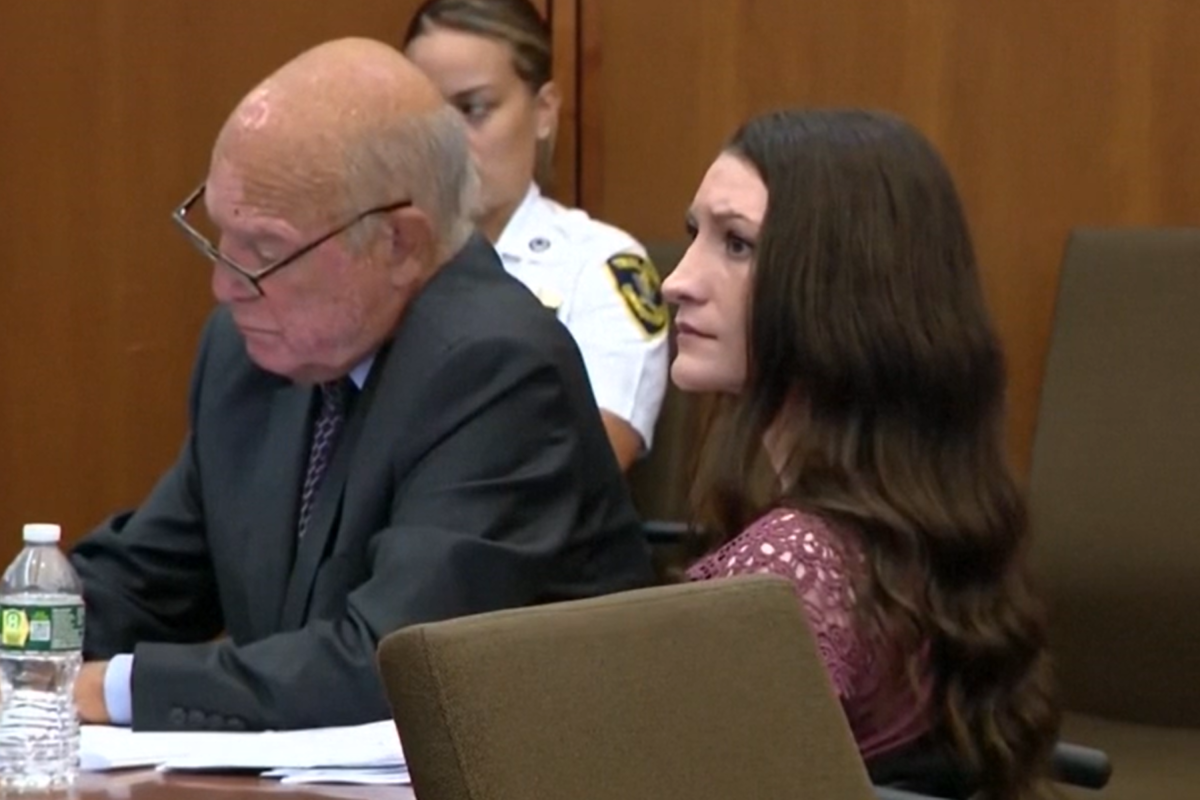
Lindsay Clancy returned to court Tuesday for the first time since her murder trial ended in a mistrial, for a hearing that will offer the first indication of whether prosecutors will pursue another trial or consider a plea deal.
Clancy’s lawyer Kevin Reddington argued before Judge William Sullivan for an overrule of the mistrial verdict to find Clancy not guilty, citing a "hideous" police investigation, among other things.
“I submit to the court that a motion for a required finding of not guilty should have been entered on the total and complete lack of evidence,” Reddington said.
“Where’s the evidence that she did this?” he asked at one point.
Reddington added that “if any case justifies a Bowden instruction it’s this one,” and that the jury “immediately assumed this woman is guilty.”
A Bowden instruction is a court direction that lets a jury consider mistakes or missing elements of a police investigation when deciding if a defendant is guilty.
Seth J. Zuckerman, a criminal defense attorney and former New York prosecutor, told Newsweek that Clancy's defense faces an uphill battle in trying to prevent a retrial.
"The United States Supreme Court has previously ruled that when a mistrial is declared due to a hung jury, the government may retry the defendant," he said. He also noted that judges have "wide discretion" as to when to declare a mistrial after a jury indicates that it is deadlocked.
The hearing, taking place at Plymouth Superior Court, comes amid a growing dispute over the jury itself. Reddington has asked the court to investigate the holdout juror, raising questions about his conduct during deliberations and whether he accurately disclosed information during jury selection. Zuckerman said an investigation would be more likely to arise if there were evidence the juror had lied to the court during jury selection, rather than simply because he held an unpopular position during deliberations.
The defense is also asking the judge to find Clancy not guilty, arguing that prosecutors failed to present sufficient evidence to establish her criminal responsibility for the January 2023 deaths of her three children.
Zuckerman said that argument is legally distinct from the double-jeopardy claim and, if successful, could end the case without a retrial.
"If the court agrees, the case is over," he said. "The standard is whether the evidence, viewed in the light most favorable to the prosecution, would permit a rational trier of fact to find each element beyond a reasonable doubt. Basically, the defense is asking the court whether any rational trier of fact could find her guilty of each and every element. If the motion is successful, a finding of not guilty by reason of lack of criminal responsibility would be entered, and the prosecution would be unable to retry her."
"It is not realistic to expect the judge to resolve complicated legal issues tomorrow," Zuckerman added.
However, he did confirm he expects to see one of two things tomorrow: "I am watching for whether the prosecutor indicates they need more time to decide whether they intend to retry Clancy or if they indicate that they are in negotiations regarding a potential deal for reduced charges," he told Newsweek.
Newsweek has reached out to Reddington and Assistant District Attorneys Jennifer Sprague for comment.
Clancy, 36, is charged with three counts of first-degree murder in the January 2023 deaths of her children, Cora, Dawson and Callan. Her defense argued during the six-week trial that she was not criminally responsible because she was suffering from postpartum psychosis.
The jury deliberated for seven days before becoming deadlocked, reportedly 11-1 in favor of finding Clancy not criminally responsible. Judge William Sullivan declared a mistrial on September 4.
The mistrial does not, by itself, prevent prosecutors from trying Clancy again. Reddington, is instead asking the judge to dismiss the case on double-jeopardy grounds, and has separately asked Sullivan to find Clancy not guilty, arguing that the evidence presented at trial was insufficient to establish that she was criminally responsible for the killings.
In his motion arguing that a second trial would violate Clancy's constitutional protection against double jeopardy, Reddington contends that the jury's deadlock was driven by a single holdout juror who allegedly acknowledged having doubts about the prosecution's case but refused to apply the court's instructions on reasonable doubt.
Sullivan previously declined requests during the trial to remove the juror or further question jurors about the deadlock. The judge has impounded some of the records sought by the defense but has not issued a final ruling on the new requests.
The Plymouth County District Attorney's Office has not publicly committed to a retrial.
Tuesday's hearing could provide more clarity about the prosecution's plans, although it is not certain that prosecutors will announce a final decision or that Sullivan will rule immediately on all of the defense motions. The hearing is officially focused on the status and next steps in the case following the mistrial.
If prosecutors pursue another trial and the defense motions are rejected, the case could move toward a second prosecution. If Sullivan grants the defense's request for an acquittal or agrees that a retrial is barred by double jeopardy, the murder case could end without another jury hearing the evidence.
The judge could also take the motions under advisement, leaving the case unresolved after Tuesday's hearing.
For that reason, one of the most consequential questions Tuesday may be whether the hearing clears the way for prosecutors to pursue a retrial—or forces the parties into another round of litigation before that question can be answered.
Michael Desronvil was the lone holdout during the jury's deliberations, maintaining that Clancy was criminally responsible for the deaths of Cora, Dawson and Callan. After the mistrial, Desronvil disputed the characterization that he had acknowledged having reasonable doubt, saying he "didn't have any doubts" about his conclusion and believed the evidence showed Clancy knew what she was doing.
The disagreement over Desronvil's conduct has now become part of the post-trial legal fight. Clancy's defense has asked Sullivan to conduct a limited inquiry into the juror, to examine his questionnaire from jury selection, cellphone records and other records connected to the deliberations. The defense has raised questions about whether the juror accurately disclosed information during jury selection and whether he used his cellphone during deliberations.
Desronvil's attorney has pushed back strongly against the request for an investigation, arguing that jurors must be able to reach an independent conclusion based on the evidence without fear that their personal history will later be subjected to scrutiny simply because they were in the minority. Desronvil has maintained that his position was based on the evidence presented at trial.
The juror dispute matters because the defense is connecting it to its argument that the mistrial was not necessary. Reddington has argued that the court should have investigated the disagreement more fully before declaring a mistrial. Whether the judge agrees—and whether any alleged juror misconduct could legally affect the status of the case—will be questions for the court to determine.
If prosecutors do not pursue another trial, or if the court ultimately bars a retrial, the murder prosecution would not proceed to another jury. The precise legal consequences would depend on how the case ends and what ruling the court makes on the defense's motions.
One route being pursued by the defense is a finding of not guilty. If the judge grants such a motion, the prosecution would be barred from simply retrying the same charges.
If the case ultimately ends without a conviction, Clancy's status would also depend on the legal basis for the outcome and her existing circumstances. She has remained at Tewksbury Hospital during the proceedings and has been receiving psychiatric treatment.
On Monday Plymouth County prosecutors filed a motion for a gag order that would prohibit lawyers and their agents from making public statements that could potentially prejudice future proceedings.
“Legal trials are not like elections to be won through the use of meeting hall, the radio and the newspaper,” the filing read. “In the current digital age, trials are not to be tried through social media posts, blogs, podcasts and clips on local, national and international media outlets.”
It also argues that Clancy's lawyer, Reddington, has been actively speaking to the media and commenting on issues such as how the defendant was doing and feeling, and how witnesses testified.
As a result, the filing asks the court to "limit the extrajudicial statement made in this case to ensure the fair administration of justice.”
Several motions were discussed as part of the hearing on Tuesday, including a defense motion related to further questioning of the holdout juror, Clancy’s legal team’s filed motion to dismiss the case on double jeopardy grounds and a gag order that would prohibit lawyers and their agents from making public statements that could potentially prejudice future proceedings.
With many of these motions filed just hours before the hearing, parties agreed these would be further discussed on November 2.