Will renewed conflict derail Ethiopia's economic growth?
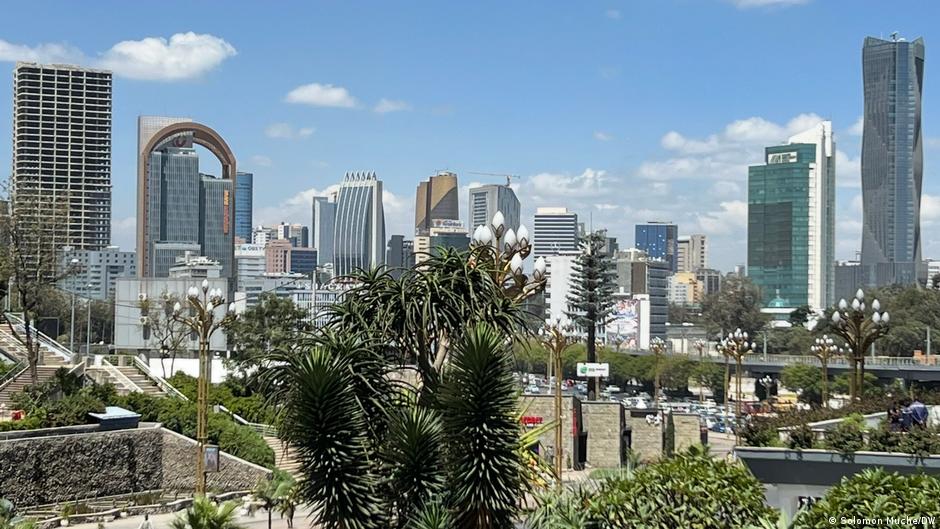
Service and financial sector growth has transformed Addis Ababa's skyline. Could the new conflict halt the boom?Image: Solomon Muche/DWAdvertisementEthiopia's economy is growing strongly. The International Monetary Fund (IMF) forecasts real growth of 9.2% for the 2025–26 fiscal year. But renewed fighting in the north, high reconstruction costs and climate-related crop problems are threatening the country's economic recovery.
London-based financial analyst Abdulmenan Mohammed warns of the consequences of a renewed escalation. "If there is a major conflict [...] the current economic growth will not be sustainable," he told DW.
The war that raged in Tigray and other parts of Ethiopia between 2020 and 2022 left extensive damage. Infrastructure was destroyed, businesses lost production capacity and agricultural land could no longer be cultivated in some areas.
A World Bank-backed damage and needs assessment puts the damage caused by several conflicts in Ethiopia between November 2020 and December 2021 at more than $22.6 billion (€20.2 billion). Economic losses amounted to around $6 billion. The estimated funding required for reconstruction and economic recovery stands at approximately $19.7 billion. This figure represents the total funding requirement, not annual costs or damage caused by the current escalation.
A reconstruction plan covered the period from 2023 to 2028. However, it remains uncertain whether the work can be fully funded and completed within that timeframe.
Financial analyst Abdulmenan Mohammed believes the economic consequences of the Tigray war were even more severe. In addition to the direct destruction, he points to lost economic output, high inflation and foreign currency shortages at the time. International trade conditions also deteriorated: in 2022, Ethiopia lost its benefits under the US African Growth and Opportunity Act (AGOA), which had allowed certain African exports to enter the US market duty-free.
Following the Pretoria peace agreement in November 2022, the economy began to recover. According to the IMF, it grew by 7.2% in 2022–23 and 8.1% in 2023–24. The organization puts growth at 9.2% for 2024–25 and forecasts a further 9.2% for 2025–26. Agriculture, mining and electricity generation are among the main drivers of this growth.
This does not contradict the economic damage caused by the war. Gross domestic product (GDP) measures the total economic output of a country. If major sectors outside conflict-affected areas continue to expand, the overall economy can grow even while individual regions are still suffering the consequences of violence.
However, high growth rates do not mean that the country's economic problems have been resolved. Reconstruction remains a major challenge, inflation continues to put pressure on households and the government has to service its debt. In late 2023, Ethiopia defaulted after missing an interest payment on a Eurobond. Reforms supported by an IMF program launched in 2024 are intended to address structural weaknesses in the economy.
A renewed escalation could put additional pressure on public finances. The government would have to spend more on military personnel, equipment and logistics. At the same time, economic activity and, consequently, tax revenues could decline in the affected regions.
"A substantial share of government resources would be tied up in military spending that would otherwise be available for infrastructure, education and social services," warned Abdulmenan Mohammed. The extent of this impact would depend on the scale and duration of any renewed conflict.
A prolonged war could also prompt businesses to postpone investments. International lenders and donors might become more cautious, while the government would need additional funds for security and humanitarian assistance. This could leave less money available for roads, energy infrastructure and other development projects.
The IMF forecasts an average inflation rate of 11.7% for 2025–26. Prices are therefore expected to continue rising, although at a slower pace than in previous years.
Abdulmenan Mohammed expects a further escalation to intensify inflationary pressures. "If the conflict escalates further, inflation is likely to rise," he said. To finance additional spending, the government might resort to more domestic borrowing. This could crowd out private businesses by making it harder for them to access credit and finance investments.
The military also needs foreign currency to purchase equipment from abroad. If this demand increases, fewer foreign exchange reserves could be available to private businesses for imports. This would put further pressure on the birr exchange rate and drive up the cost of imported goods, fuel and industrial inputs.
The extent of these effects on the BRICS member state would also depend on export earnings, monetary policy and developments in international markets. A new surge in inflation is therefore a risk, but not an inevitable consequence of the escalation. A combination of rising prices and uncertain incomes would be particularly difficult for poorer households.
Abdulmenan Mohammed sees agriculture, as well as the tourism and hospitality sectors, as particularly vulnerable. "Agriculture is especially exposed because much of the fighting takes place in rural areas where farmers work," he said.
Insecurity around farmland, disrupted transport routes and shortages of agricultural inputs can undermine production. At the same time, parts of the country are experiencing insufficient rainfall and poor harvest prospects. Failed harvests reduce farmers' incomes, while lower food supplies can push prices even higher.
Tourism is also highly sensitive to security risks. Travel advisories and reports of fighting can deter visitors, reducing revenues for hotels and tour operators.
When making investment decisions, international investors consider not only market size but also political stability, security and the reliability of state institutions. A further escalation could therefore delay investment decisions or prompt companies to consider alternative locations.
However, there is currently no concrete evidence that companies are already withdrawing investments from Ethiopia because of the fighting and relocating them to neighboring countries such as Kenya. Abdulmenan Mohammed also sees no demonstrable economic advantage for Kenya at this stage. Beyond security, factors such as tax administration, public services and governance also play a decisive role.
This article was originally published in German.