Will Tough Talk From Trump at UNGA Bring the Iran War to an End? | Opinion - Newsweek
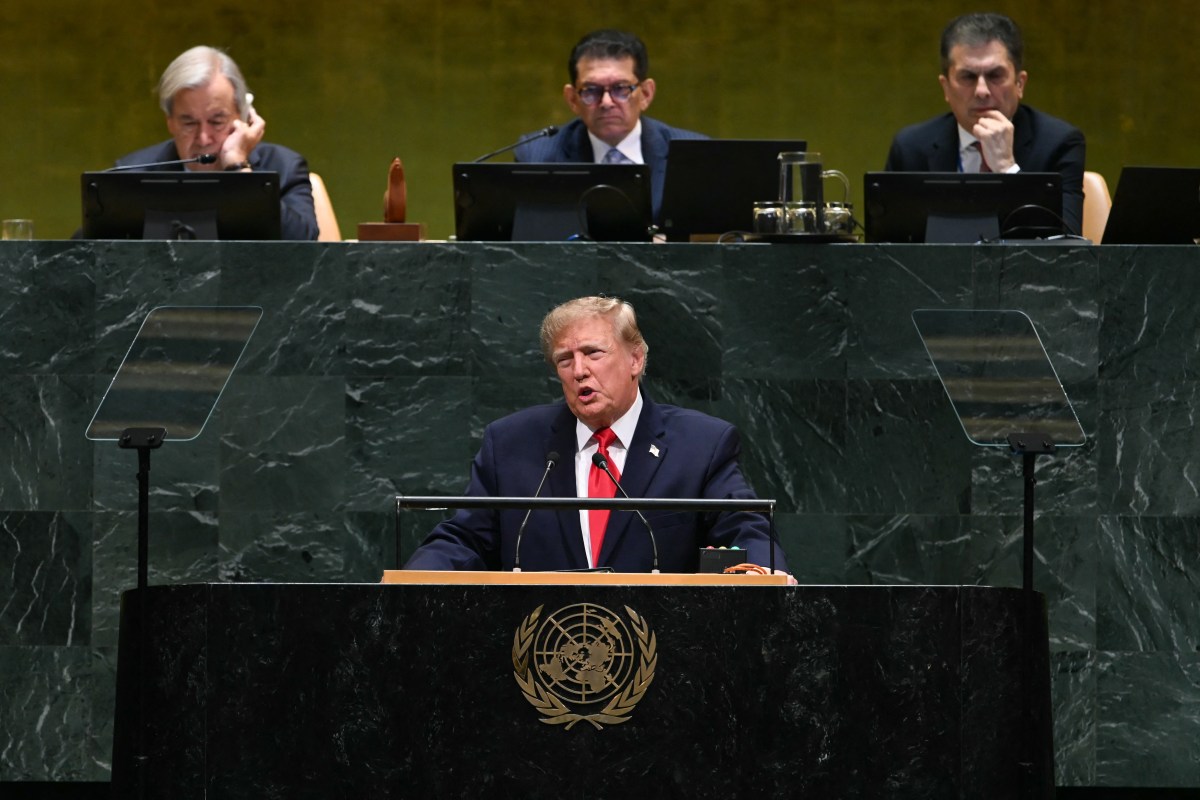
In his speech Tuesday to the United Nations General Assembly, U.S. President Donald J. Trump reframed his choice on Iran in stark terms: Tehran reaches out for a deal that allows it to rebuild and eventually become a great nation or face overwhelming destruction.
Critics will say this is yet another act of bluster as well as a promise to destroy not just the regime, but the people. In fact, considering Iran’s almost 50-year record of attacks on American people and interests, it’s a long overdue clarification of the pathways ahead for the radicals who seized power there in 1979.
There’s a truism in politics that, when someone tells you who they are, believe them. So, when leaders of the regime as well as the people are busy chanting “Death to America,” consider at least the possibility they may mean it. We live in a world where despots expect not only to be able to insult America and the American way of life at will, but that we will pay them to do so.
The ultimate goal of the Iranian leadership, even beyond the destruction of Israel and the elimination of American influence in the region, is to become its dominant power. Not just a regional power, but a global one. That all the nations of the Arab and Muslim world will speak with one voice, emerging from Tehran.
They’ve dug in for a long struggle. Which is why Trump’s U.N. speech urged other nations to assist in isolating Iran economically. They too would be under constant threat if Iran obtained a nuclear weapon, but they’ve chosen for the moment to sit this one out. Not just because they believe Trump started it, but because, for their own domestic political reasons, they cannot join him on causes as basic as restoring freedom of navigation to the Strait of Hormuz.
For now, America is on its own. Strip away the rhetoric and the strategic question is clear: Can the United States make Iranian aggression costlier than restraint?
For nearly half a century, Iran has practiced aggression below the threshold of conventional war. It has armed militias, threatened American personnel, menaced commercial shipping, developed increasingly sophisticated missiles and drones, pursued nuclear capabilities and used proxies to destabilize the Middle East.
It’s a smart strategy, correctly assuming that democratic governments will typically absorb provocations rather than impose meaningful costs. Trump is different, and the world should pay attention. The U.S. military campaign of the past six months should be understood as an effort to restore deterrence after sanctions, negotiations, warnings and limited responses failed.
Instead, it’s presented constantly as a disconnected series of strikes, none of which has achieved its objective. Delay is itself a decision. When the threat includes nuclear weapons, ballistic missiles, drones, proxy warfare and attacks on critical infrastructure, delay can become ruinously expensive.
None of this gives Washington a blank check. The use of military power must be tied to objectives Americans can understand. The goal is not conquest, occupation or regime change for its own sake. It should be deterrence: making the cost of attacking the United States and its allies greater than any benefit Tehran expects to gain.
Operation Economic Outcast has made that a more credible concern by targeting what Iran needs as much as missiles and drones: money. The point is not punishment for its own sake. It is to deny the regime access to the middlemen who provide the revenue, financial access and shipping networks the Iranian Revolutionary Guard Corps needs not just to keep the war going, but to expand the battlefield.
Nowhere is the connection between security and economics clearer than the Strait of Hormuz. Iran has turned one of the world’s most important waterways into a pressure point. A ship delayed in the Persian Gulf can affect an insurance contract in London, an energy purchase in Europe and the price at the pump in America. Maritime intimidation becomes a tax on everyone.
As soon as America began to regain the upper hand, Iran used its terrorist proxies in Yemen to expand the war by targeting Saudi oil exports. Freedom of navigation is not an academic principle. It is an economic necessity. If Iran learns it can disrupt traffic in critical international waterways and order pipelines and facilities bombed without paying a meaningful price, other governments will notice. America’s adversaries study hesitation as carefully as they study military strength.
Economic pressure matters only if it is enforced. Unenforced sanctions are suggestions. Iran has become adept at routing oil through intermediaries, changing flags and corporate identities, moving payments through third countries and buying technology through brokers. The world’s financial system has many doors; Washington’s job is to lock the ones Tehran uses to finance aggression.
That makes secondary sanctions and enforcement actions central to the outcome. Companies should have to decide whether commerce with Iran is worth jeopardizing access to American markets and the U.S. financial system. The dollar, American banks and the reach of the Treasury are instruments of national power. Used intelligently, they can constrain Iran more sustainably than military action alone.
Military force and diplomacy are not opposites. Diplomacy without leverage is usually just conversation. Iran understands this: negotiations buy time. Agreements read narrowly can exploit ambiguities. Only credible military and economic pressure can create room for serious bargaining, provided Washington defines achievable terms and remains willing to accept real, verifiable change.
The United States does not seek an endless war, nor should. It is not wrong to insist on a few verifiable outcomes before peace can be made. Iran must reject the pursuit of nuclear weapons and allow for verification that it is not doing so; attacks on Americans and allies must still carry consequences; sea lanes must remain open; and international commerce cannot finance the forces threatening those interests. Those objectives are limited, defensible and worth pursuing.
Iran’s strategy depends on a gray zone: enough violence to intimidate, enough deniability to confuse, enough commerce to survive and enough diplomacy to delay. Operation Economic Outcast challenges that arrangement by treating the financial system that sustains hybrid war as part of the battlefield.
That is not warmongering. It is common sense. Serious deterrence is neither passive nor limitless. It joins force, finance and diplomacy in service of a clear end state.
Iran has spent decades betting that America will tire of sanctions, enforcement, deployments, allies and attention. Perhaps that was once a reasonable bet. It should not be anymore. The lesson of the last half-century is not that Iran is unstoppable. It is that Iran is persistent—and persistence succeeds when each missile launch, proxy attack, shipping threat or sanctions evasion scheme is treated as an isolated incident. America’s answer must target the system as a whole. Iran’s war machine has a bank account, and Washington is going after it. That’s the most important battle of all and its outcome will determine whether Iran is welcomed back into the family of nations or obliterated
A veteran journalist and commentator, Newsweek contributing editor Peter Roff is also chairman of the Transatlantic Leadership Network’s Free Media Initiative and appears regularly in policy debates on global television. He can be reached by email at RoffColumns@gmail.com and followed on social media @TheRoffDraft
The views expressed in this article are the writer's own.