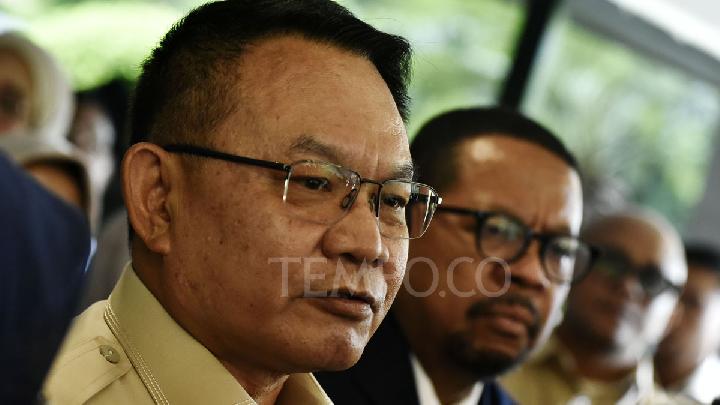
With minister of solid minerals, Dele Alake, at the table - Punch Newspapers
Days back, Nigeria’s Minister of Solid Minerals Development, Dr Dele Alake, sat at a table and signed an agreement with the US on this sector. He says this will strengthen Nigeria-US cooperation on the nation’s solid minerals, while the framework covers geological data and exploration, mineral development and processing, infrastructure, and technical capacity. This makes me ask: Does this agreement have as backdrop an existing blueprint for Nigeria’s solid minerals sector? Is the agreement strictly situated within the framework of the blueprint? These are parts of other questions the agreement brings to mind, even as I join the minister to celebrate his win, as I always do when any government official demonstrates zeal for their job. Alake wins something in his corner, although I’m waiting for other ministers to win something and show it to Nigerians. This is important because a minister isn’t appointed to bear the title without bringing anything to the table, without adding any value to their office. How many times has it been said that the cabinet ministers a former president trusted disappointed him? It’s a submission in our public space that I refer to often. Reason? Back in 2015, a politician had engaged me in a related conversation. He had looked at the chaos on the ground at the time and wondered how the then-incoming president would handle the situation. I didn’t only explain how delegated authority works, I assured him that all a president needed to do was appoint capable hands to represent him across Ministries, Departments, and Agencies. In the end, many of those ministers did what they did, and the nation found itself where it was by 2023. This, for me, raises the debate about where the buck stops. We say it stops at the president’s table. Good. But a question must follow: if the president can do everything himself, why is there a constitutional provision for cabinet ministers? We can argue that the president has the power to sack every minister who doesn’t perform. This overlooks the practicalities of administration. Is it practical that a president should be sacking heads of MDAs every day once he hears they don’t perform? How tidy is this for the government, the nation, and external bodies who watch what we do? Another argument can be raised that ministers don’t have all the funds, or enabling laws they need to do some things. I submit thus: It’s not every measure MDAs undertake that requires funds or new laws. Some are basically about reading the riot act and imposing heavy sanctions to serve as deterrent. In any case, what heads of MDAs actually have funds to do, do they do them? Take enforcement for instance. MDAs have the power to enforce government policies and make industry players do what the law says, which should make life easier for Nigerians. Doing this alone, if it’s all that any MDA does, can make a huge difference for Nigerians. If industry players are made to comply with laws, the multiplier effect will be so much that some of what the public blames the president for won’t arise. However, the situation is such that we see the president appeal to industry players, when they visit him, to do some things right and thereby make life easier for Nigerians. These are the same issues MDAs should have attended to based on the enforcement powers they have. It happens when heads of MDAs don’t have the drive to make a difference. No zeal to do something for their nation. People are placed in positions of authority, but they do nothing. It’s the greatest disaster that any nation can experience. The reason is simple. Even basic knowledge of public administration shows that a nation can have all the natural resources. It can have all the human capital. It can have all the fantastic blueprints and laws. If the person sitting atop any MDA isn’t interested in doing a thing, or all they care about is loot, such a nation crawls. Once a minister sits at the table but won’t lift a finger, all is lost. The nation has to wait for another tenure, helplessly hoping a better time will come. For how long can this continue in Nigeria? If no president can do everything alone, and he needs capable hands to assist him, I think we need to pay attention to the performance of those who are appointed by the president. This is even more so if we can’t expect a president to continue to sack every minister at the slightest excuse. Now, my take is that no minister can do it all at the same time, not in four years, and not in eight years. But failing to do a thing is worse. Each minister can just do that little, bring some zeal and passion to their job. They can move a few things around, get enforcement and compliance done. They can identify a few areas in the larger blueprint of any MDA, know the problem, know what needs to be done, focus on it, and move it to the next stage. Whatever is done, the next appointee can continue from there. It’s the gradual but steady step every nation takes. Without it, nothing happens for a nation. Incidents of doing nothing during a tenure have happened too often in this nation. I think it’s time Nigerians take note of appointees who do nothing, rather than saying the buck stops at the president’s table and leaving the public discussion there. It was reportedly stated that Alake asked for the Solid Minerals Ministry and the president gave it to him. Now he’s doing the best he can with what he’s given. Challenges confronting the solid minerals sector in years past are many, and they aren’t much different from the experiences in other sectors that have to do with natural resources. Illegal mining is rampant. Around it has been mentioned insecurity issues linked to banditry, local community tensions, etc. Unregulated small-scale extraction means massive revenue losses, dangerous working conditions that have led to needless loss of lives, and social disorder. Infrastructure deficits lead to higher operational as well as capital costs due to transport networks, unreliable power supply, and an absence of dedicated logistics. Governance issues include overlapping control between federal and state authorities. This complicates licensing and compliance. In this mix have been incidents of environmental degradation where uncontrolled extraction leads to land degradation, deforestation, water pollution, and loss of local biodiversity. There have been fewer domestic economic gains as there’s little value addition to raw minerals. It’s gratifying to see that Alake comes to the table at the ministry with a determination to bring changes to these challenges. He has driven reforms which attract billions of dollars in foreign direct investment to the sector. This has boosted revenue for the federal government. Under his watch, the solid minerals ministry has instituted a policy that makes local processing and refining a mandatory requirement for new mining licenses. This creates jobs. The mine marshals, a specialised security force that Alake masterminded, are combating illegal operators, and have taken back illegal mining sites. Unlike what transpired in the past, communities have been brought into the picture. There are Community Development Agreements by which the FG ensures mining operators benefit host communities. And, unlike in the past, there’s now a framework which makes states participate directly in the sector. As for the agreement with the US, which Alake says “covers geological data and exploration, mineral development and processing, infrastructure, and technical capacity”, I have my concerns. Will geological surveys be carried out and data gathered by the US, without the involvement of Nigerian geologists? How advisable is it for the US to handle geological data gathering without compromising our nation’s independence and human capital development? I’m not asking this for the first time. When a former governor gave the task of gathering geological data to foreigners in Rivers State, I asked similar questions on this page (“How Ayade gives our jobs to the Chinese” – Aug. 18, 2017). Does the agreement with the US come under a larger blueprint for Nigeria’s solid minerals sector? Is the agreement strictly within the framework of the blueprint so that subsequent occupiers of this office will be properly guided, ensuring continuity? Also, how integrated will Nigerians be in each of the other areas Alake itemized in the agreement between Nigeria and the US? Tunji Ajibade
All rights reserved. This material, and other digital content on this website, may not be reproduced, published, broadcast, rewritten or redistributed in whole or in part without prior express written permission from PUNCH.
Stay informed and ahead of the curve! Follow The Punch Newspaper on WhatsApp for real-time updates, breaking news, and exclusive content. Don't miss a headline – join now!
Stay in the know—fast. Get instant alerts, breaking headlines, and exclusive stories with the Punch News App. Download now and never miss a beat.