World's first 4,000-meter-class airborne wind power system completes urban test flight in China - CGTN
By continuing to browse our site you agree to our use of cookies, revised Privacy Policy and Terms of Use. You can change your cookie settings through your browser.
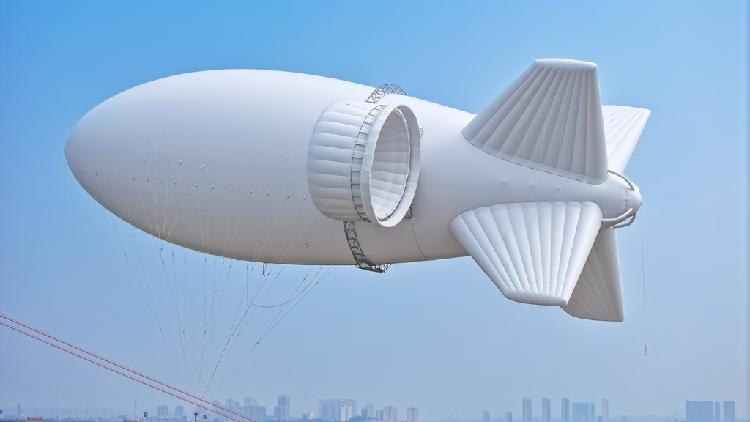
Engineers test the world's first 4,000-meter-class airborne wind power system over the central China city of Yueyang on November 6. /CMG
The world's first 4,000-meter-class airborne wind power system on Friday successfully completed a test flight in Yueyang, central China's Hunan Province, marking the first time a system of its kind has undergone a flight test in an urban setting.
During the flight, the China-made S4000 airborne wind power system conducted a series of tests to verify its stability control under complex airflow conditions and its power generation performance in complex magnetic environments.
Measuring 67 meters long, 40 meters wide and 23 meters high, the system can reach an altitude of up to 4,000 meters. It has an output voltage range of 10 to 35 kilovolts with a designed service life of 20 years.
The system uses a helium-filled platform to lift lightweight power generation modules thousands of meters into the sky, where it utilizes stable high-altitude winds to generate electricity. The electricity is then transmitted to the ground through its tether cable.
The China-made S4000 airborne wind power system. /CMG
Testing in an urban environment assesses whether the system can operate safely and reliably near populated areas, Dun Tianrui, chief architectural designer of the system, told China Media Group.
As major hubs of electricity demand, cities are the ultimate target areas for the deployment of these power generation systems, said Dun.
High-altitude wind energy, an unexplored renewable energy resource, has huge potential for its high wind speeds, stable wind directions and great wind energy density.
In August, the S4000 system completed a full-process validation at a remote test base in northwest China, demonstrating its adaptability to harsh conditions, including high-altitude environments, intense ultraviolet radiation and large temperature variations.
Friday's test validated the reliability of the entire airborne system and demonstrated its potential for engineering deployment under real-world conditions around cities, said Cai Rong, a researcher at the Aerospace Information Research Institute of the Chinese Academy of Sciences.
The test has also promoted the transition of high-altitude wind power equipment from technological validation to industrial application.