WRAP-UP - Trump, Xi, Putin discuss nuclear risks, UN reform, energy in historic trilateral meeting - Anadolu Ajansı
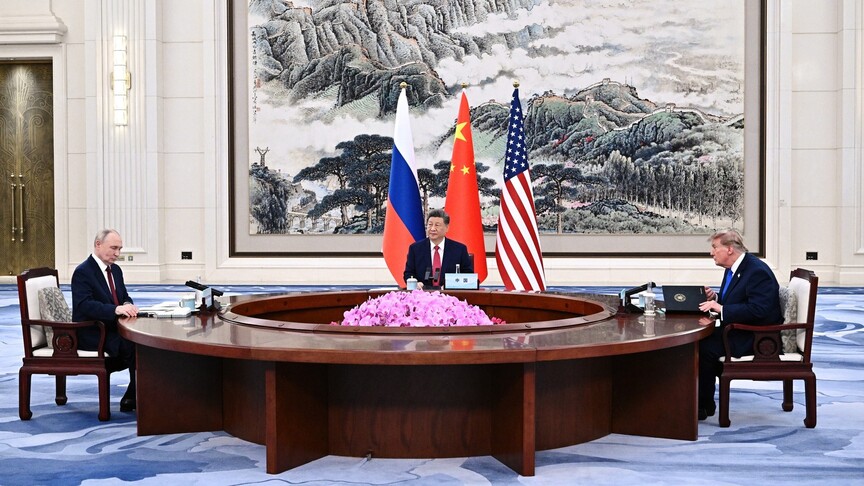
US President Donald Trump, Chinese President Xi Jinping, and Russian President Vladimir Putin met in Shenzhen, China on Thursday and adopted a joint Declaration on Peace pledging dialogue on nuclear risk reduction, United Nations reform, and stable global energy supplies.
The inaugural face-to-face trilateral summit, held on the sidelines of the Asia-Pacific Economic Cooperation (APEC) Economic summit, lasted roughly 80 minutes from 4.30 p.m. local time (0830GMT) to 5.50 p.m. (0950GMT).
In a four-point declaration, Trump and Putin praised Xi for hosting the gathering.
All three heads of state reaffirmed their commitment to maintaining strategic stability and international security.
Beyond the formal declaration, the three leaders exchanged views on ending the Russia-Ukraine war, curbing nuclear proliferation amid the ongoing Iran war, and shielding state officials from the International Criminal Court (ICC).
The leaders hailed direct great-power engagement as essential for global stability.
In the joint declaration, the leaders reaffirmed that "a nuclear war cannot be won and must never be fought," committing to dialogue aimed at reducing nuclear risks and preventing the proliferation of nuclear weapons.
During the meeting, Trump described the US, Russia, and China, the world's three largest nuclear powers by far, as "uniquely positioned" to discuss cutting nuclear arsenals and lowering the risk of their use, even as he acknowledged the reluctance of major leaders to relinquish "thousands of weapons."
"Once you have the nuclear weapons, it's very hard to not have them," Trump said.
The discussions follow the expiration of the US-Russia New START arms control treaty earlier in 2026, which left the world's two largest nuclear stockpiles without bilateral treaty limits.
Trump also called three-way cooperation "vital" to combat nuclear proliferation worldwide, pointing to the Iran war that erupted with large-scale US-Israeli strikes in late February.
"We're not going to let Iran have a nuclear weapon," Trump said.
Putin highlighted common interests in resolving regional conflicts, noting that the ongoing Russia-Ukraine war, which began in 2022, featured in his meetings with both Xi and Trump.
Confirming that his bilateral session with Putin focused largely on the conflict, Trump expressed hope that both Moscow and Kyiv "would like to see an end to that war," following US-mediated peace talks in Abu Dhabi last week that yielded an agreement in principle on a large-scale prisoner swap.
All three leaders portrayed direct engagement among major powers as indispensable to resolving international crises. Trump called the inaugural trilateral summit "really making history" and argued that "[n]o peace was ever forged by declining opportunities for engagement."
Xi similarly framed strategic stability as a core duty of major powers, urging Beijing, Washington, and Moscow to foster "peaceful coexistence, overall stability and balanced development."
He maintained that "positive interactions" among China, the US, and Russia are "not an option but a must," warning that peace among major powers brings global stability whereas "their contention would only lead to chaos in the world."
He urged the three nations to uphold "mutual respect, peaceful coexistence, win-win cooperation, and dialogue and consultation."
He also urged the nations to respect each other's "sovereignty and territorial integrity," and avoid interfering in domestic affairs.
Putin stressed that constructive and partnership-based cooperation could significantly strengthen global security.
On economic and energy matters, the declaration said they plan to increase the production and supply of refined petroleum products for the benefit of all nations, underscoring the importance of stable energy supplies.
Putin called for broader cooperation on "global and regional economic ties, as well as food and energy security," while Xi urged major powers to pursue "win-win cooperation" that benefits both their own populations and the wider world.
The joint emphasis on refined fuel production and supply stability comes as hostilities in the Iran war continue to threaten maritime transit through the Strait of Hormuz, a critical chokepoint through which more than one-fifth of global petroleum cargo normally passes.
As permanent members of the UN Security Council, Russia, China, and the US expressed their commitment in the declaration to reforming the UN so it can respond to global challenges "more effectively" and fulfill its "foundational mission regarding international peace and security."
Putin emphasized the three countries' historic role in creating the world body following World War II, saying: "We were among the founders of the UN. Therefore, it falls upon us to preserve and strengthen the system of international law that took shape alongside this universal organization, a system that includes the UN Charter and the principles enshrined within it."
Both Putin and Xi invoked their nations' wartime alliance more than 80 years ago, with Xi describing China, Russia, and the US as the world's "key anti-fascist forces" that "fought shoulder to shoulder and achieved great victories." Putin pointed to their shared status as World War II victors conferring a common responsibility for global peace.
The declaration underscored that the principles of "state consent and the observance of the immunities of state officials" are of fundamental importance, recording the three leaders' agreement that the ICC and similar bodies "must not abuse their authority."
In his remarks during the gathering, Trump announced plans to propose joint measures with China and Russia to protect national sovereignty from what he termed "rogue globalist organizations," claiming the Hague-based tribunal has "gotten out of control" and strayed far beyond its jurisdiction.
None of the three powers, the US, China, or Russia, is a party to the ICC's founding Rome Statute. Washington recently imposed sanctions on the ICC, escalating its campaign against the court following November 2024 arrest warrants for Israeli Prime Minister Benjamin Netanyahu and former Defense Minister Yoav Gallant over alleged war crimes in Gaza.
Putin himself is wanted under a March 2023 ICC arrest warrant over the alleged unlawful deportation and transfer of Ukrainian children.