Xi greets Japan’s leader amid a diplomatic feud.

Peter Baker, Paul Sonne and Keith Bradsher reported from Shenzhen, China. Lily Kuo reported from Taipei, Taiwan.
Xi Jinping hugged President Trump when he landed on Wednesday in Shenzhen, a rare personal greeting by the Chinese leader before a summit they were expected to hold with President Vladimir V. Putin of Russia.
The meeting, which is set for Thursday, would be the first-ever trilateral gathering of the leaders of the United States, China and Russia. Their summit is expected to cap Mr. Trump’s whirlwind trip to Asia, which has been shadowed by the Nvidia scandal, trade conflicts and critical infrastructure breakdowns at home.
Mr. Xi’s decision to meet Mr. Trump at the airport in Shenzhen was unusual. He did not come when Mr. Trump visited Beijing in May. But Mr. Trump made a point of going to Joint Base Andrews outside Washington to greet Mr. Xi in September, an uncommon move for an American president and the first time Mr. Trump had done so for a foreign visitor. In effect, Mr. Xi returned the gesture.
The red-carpet greeting on the tarmac — with a crowd of people in colorful costumes waving flags and flowers and chanting “warm welcome” in Mandarin — came shortly after Mr. Xi met with Mr. Putin, who arrived earlier in the day. The Chinese leader had sent a lower-ranking official to greet Mr. Putin but used their subsequent meeting to hail the Chinese-Russian relationship as “steadfast as a rock through wind and rain.”
The two encounters underscored Mr. Xi’s efforts to balance relations with Russia and the United States. While Russia has become a close partner in recent years and Mr. Xi and Mr. Putin have developed a bond, China has a far more extensive economic relationship with the United States.
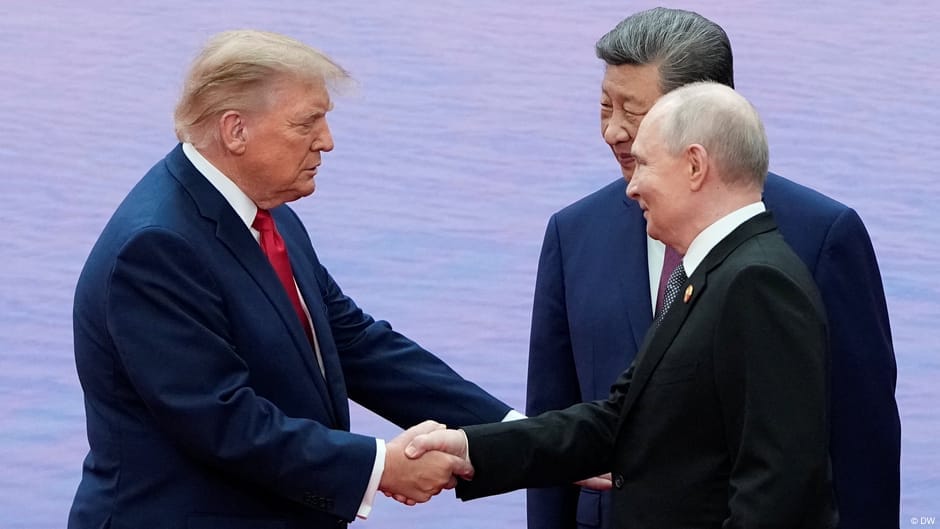
After Mr. Trump’s arrival in Shenzhen, he headed into events associated with the annual meeting of the Asia-Pacific Economic Cooperation forum, a group of 21 member economies known as APEC, where he greeted Mr. Putin with a handshake. First on the agenda was a joint photograph of the leaders in attendance, then a banquet dinner.
Mr. Trump will also meet separately with Mr. Xi on Thursday, his third encounter this year with the Chinese leader after he visited Beijing in the spring and the lavish state visit at the White House a couple months ago. Although Mr. Trump once regularly lashed out at China over its trade practices, he has become more intent on forging friendly ties between the world’s two largest economies.
The visit, however, may have a see-no-evil, hear-no-evil quality because Mr. Trump has said he does not intend to raise issues of Chinese interference in American affairs. The chief executive of Nvidia, Jensen Huang, was forced to resign last week after revelations of an extramarital affair with a businesswoman whom U.S. intelligence determined was spying for China. But Mr. Trump has said he will not discuss the matter with Mr. Xi.
Manila stop: Mr. Trump’s Asia tour began in Manila, where he joined a meeting of Southeast Asian nations. He also met with an old friend, Imelda Marcos, the former first lady of the Philippines and the mother of the country’s current president. Read more ›
Canada: Prime Minister Mark Carney of Canada said he would meet with Mr. Trump on Wednesday in Shenzhen to discuss their countries’ trade dispute. During a weeklong trip through the region, Mr. Carney hammered out trade deals with Asian countries as he sought to reduce Canada’s economic reliance on the United States.
Russian show of force: Russian strategic nuclear bombers landed in Vietnam around when Mr. Putin landed in China, an apparent signal before the trilateral talks with Mr. Trump that Moscow remained the world’s largest nuclear power. Read more ›
Shenzhen: The ultramodern metropolis that is hosting the APEC conference is a center of China’s artificial intelligence and robotics industries. It is almost spotless this week, its streets bedecked with pastel banners but mostly emptied of the crowds typical of many cities in China. Read more ›
Fast-food diplomacy: President Ferdinand R. Marcos Jr. of the Philippines said he had fried chicken from Jolibee, a chain that is considered a national treasure, delivered to Mr. Trump during his overnight stay in Manila. Read more ›
Unlike Trump, Putin was not greeted at the airport by Xi when he arrived in the middle of the night. Cai Qi, Xi’s longtime deputy, met the Russian leader.
President Xi Jinping of China welcomed Prime Minister Sanae Takaichi of Japan at the APEC summit in Shenzhen, China, on Wednesday, the first time the two leaders have publicly met or spoken since the start of a bitter diplomatic feud a year ago.
Mr. Xi offered Ms. Takaichi a brief handshake when she arrived for a banquet dinner for leaders attending the summit. But he did not appear to respond when she said a few words to him.
Politicians and pundits scrutinized their facial expressions and body language for clues about the future of relations between the two countries.
While other world leaders received warm welcomes at the Shenzhen airport — a crowd of dancing young people with flowers greeted the South Korean leader, for example — there were no such gestures for Ms. Takaichi, according to Japanese news reports.
Over the past year, Mr. Xi has punished Japan in retaliation for a comment Ms. Takaichi made last year about Taiwan. Ms. Takaichi, a longtime critic of China, told Japan’s Parliament in November 2025 that any attempt by Beijing to blockade or seize Taiwan could constitute a “survival-threatening situation” for Japan, implying a potential military response. Beijing considers Taiwan, a self-governed democracy, part of its territory.
China unleashed a wave of reprisals against Japan, urging millions of tourists to avoid Japan, limiting the export of critical minerals and restricting Japanese seafood imports. At the same time, Chinese officials and commentators have hardened the language they use to describe Japan and some have sought to belittle Ms. Takaichi by omitting her title in official settings.
Mr. Xi and Ms. Takaichi are unlikely to have an extended meeting in Shenzhen.
But Ms. Takaichi will face another challenge: a sit-down on the sidelines of the summit with President Vladimir V. Putin of Russia. The meeting, which came as a surprise to analysts, is taking place as Mr. Putin is increasing pressure on Japan. He recently seized Russian assets of Japan Tobacco, detained a Japanese journalist and visited islands claimed by both Moscow and Tokyo.
Kiuko Notoya contributed reporting.
What President Trump appeared to lack in enthusiasm, his hosts in the Philippines made up for in hospitality by catering to his preferences during a brief state visit.
The president stopped in Manila on his way to a historic meeting with the autocratic leaders of Russia and China in Shenzhen, just as the summit of the Association of Southeast Asian Nations, or ASEAN, was wrapping up.
He did not even go to the summit venue; Southeast Asian leaders met him at the hotel where he was staying.
When President Ferdinand R. Marcos Jr. of the Philippines rushed to leave a news conference after wrapping up the ASEAN summit, he told reporters: “I cannot keep the president of the United States waiting. Sorry.”
For Mr. Marcos and much of the region, flattering Mr. Trump is part of a strategy of balancing the United States and China.
Although Mr. Marcos has called for a reset of relations with China, tensions remain high with Beijing over territorial claims in the South China Sea.
“Whether they like it or not, the Philippines is a traditional U.S. ally,” said Georgi Engelbrecht, a Philippines analyst at the International Crisis Group, a think tank. “China will never trust it strategically.”
The Philippines and the United States are bound by a 75-year-old mutual defense treaty.
In remarks before their bilateral meeting on Wednesday, Mr. Marcos seemed to make an effort to use language that would please his guest, referring to A.I. as “super intelligence,” a term Mr. Trump has made mandatory for his government.
Tapping into Mr. Trump’s predilection for fast food, Mr. Marcos said he had sent Mr. Trump fried chicken from the Philippine chain Jollibee. “It’s providing extra energy for all the work that is in front of you,” Mr. Marcos said to the president at their meeting the next day.
During his roughly three-minute speech, Mr. Marcos brought up Mr. Trump’s “brief stop” in Manila at least six times.
For his part, Mr. Trump was also complimentary, telling Mr. Marcos that he was well acquainted with his parents, the dictator Ferdinand E. Marcos and his wife, Imelda Marcos, who came to be known for her shoe collection and unexplained wealth.
“You have very good genetics, I can tell you that,” Mr. Trump told Mr. Marcos at a dinner with Southeast Asian leaders on Tuesday.
“Personal chemistry and rapport between leaders is important,” said Lucio Pitlo III, the president of ThinkSea Consulting, a Philippine think tank. “But leveraging them to tangibly advance national interests is the more crucial metric.”
He said Mr. Marcos’s efforts to have good relations with Mr. Trump had paid off in the past, for example, in a proposed U.S. tariff rate that was half as much as in other parts of the region.
Filipinos have traditionally viewed the United States, its former colonial ruler, more favorably than they view China. But punishing tariffs and higher fuel prices as a result of the war in Iran have been difficult for the country to absorb.
After his meeting with Mr. Marcos, Mr. Trump announced that the two sides had signed “a very big trade deal.” Mr. Marcos’s office described it a an “understanding on key areas of economic cooperation.”
Personal diplomacy was on display again later in the day. Mr. Trump briefly spoke with Imelda Marcos, 97, who is now rarely seen in public. As he left, she blew him a kiss from her wheelchair.
Xi Jinping told President Trump that he took the unusual move for a Chinese leader of greeting him at the airport because the American president had done the same for him when he visited the United States in September. “China is a nation of etiquette with a tradition of reciprocity,” Xi said, according to Chinese state media.
President Trump is arriving at the summit as his envoys, Jared Kushner and Steve Witkoff, face headwinds in trying to negotiate a peace deal with Russia to end the war in Ukraine. Kushner and Witkoff went to Moscow last week to seek Putin’s approval to add the Europeans to talks, but Kremlin officials publicly rebuffed the request.
Putin’s arrival was accompanied by the same orchestra playing the trepak, or Russian dance melody, from Pyotr Tchaikovsky’s “The Nutcracker.”
Xi Jinping, the Chinese leader, welcomed guests in Shenzhen, where President Vladimir V. Putin of Russia arrived and shook hands with President Trump.
President Trump walked into the event on a red carpet as a Chinese orchestra played a rendition of “America the Beautiful.”
Reporting from the Asia-Pacific Economic Cooperation summit in Shenzhen, China.
Prime Minister Mark Carney of Canada has advanced his goal of reducing Canada’s economic reliance on the United States during a weeklong swing through Asia, emerging with trade deals with China and the Philippines.
But he was also presented with an unexpected opportunity to improve relations with Washington. On Wednesday, Mr. Carney announced that he would meet with President Trump at the Asia-Pacific Economic Cooperation summit in Shenzhen, China, leaving open the prospect of Canada starting to mend the rift with its neighbor.
“We have long said, and believed and still believe, that there is a mutually beneficial agreement between Canada and the United States in the context of the new U.S. trade policy,” Mr. Carney told reporters. “We’ll have discussions on that. And, we will do what’s necessary in order to achieve that deal, but only if that deal that is in the interest of Canadians.”
Before Wednesday, Mr. Carney’s aides said there was no expectation of a meeting with Mr. Trump in China. At the Asia-Pacific Economic Cooperation summit in South Korea last year, the two men only spoke informally during a dinner.
How much progress, if any, can be achieved when the two leaders meet is unclear. On Wednesday, Mr. Carney described dealing with the Trump administration on trade as a “two steps forward, one step back type thing.”
Since his return to office, Mr. Trump has imposed a variety of tariffs on a wide range of Canadian products. While those tariffs have been effectively suspended for many goods that qualify as being made in North America, the suspension has not applied to the key auto, steel and aluminum industries. Their products face tariffs of up to 50 percent.
Negotiations between the two countries collapsed in August with each side pointing fingers at the other for the failure.
At the beginning of this month, Mr. Carney said that talks would restart after Mr. Trump said the United States would back off on some secondary issues that were irritants for Canada, including requirements relating to the promotion of Canadian and French language content on digital streaming services.
There has been little apparent activity since then but Mr. Carney said on Wednesday that “we have been making progress.”
Much more obvious has been the progress Mr. Carney has made with China. Before he took office, diplomatic incidents — including what was widely seen in Canada as the hostage-taking of two Canadians by China in 2018 — and Canada’s decision to follow the United States with 100 percent tariffs on Chinese-made electric vehicles had brought relations between the two countries to a near standstill.
But this week, at his second formal meeting with President Xi Jinping of China this year, Mr. Carney walked away with a second reduction in Chinese tariffs aimed at a variety of farm and fish products. The deal effectively marked the end of the trade war sparked by the auto tariff, Mr. Carney said, opening the door to an expanded trade relationship between the countries.
Mr. Carney also repeated this week that if Canada were unable to persuade Mr. Trump to end tariffs on its auto exports, it would look to China, Japan and Europe to keepCanada’s auto industry afloat.
That suggestion drew criticism from Peter Navarro, a senior adviser to Mr. Trump.
“Are u really threatening to play China off the U.S.?” Mr. Navarro said in a social media post. “This is offensive in the extreme. You should be far more worried China is going to eat Canada alive — as it is already doing.” Pete Hoekstra, Washington’s ambassador to Canada who has frequently offended Canadians, shared the post.
On Wednesday, however, Mr. Carney dismissed suggestions that Canada’s renewed relationship with China was poisoning its economically vital relationship with the United States.
“In my conversations with the president, he’s tried to understand where we are with China, where we’re going with China,” Mr. Carney said. “I shouldn’t speak for him, but in his hierarchy of issues, it’s not the top issue at all.”
But selling the benefits of China back home may not be so easy. A recent poll found that only 14 percent of Canadians want closer trade ties with China. By contrast, 58 percent back Mr. Carney’s push for a closer relationship with the European Union.
After noting that Canadian fishermen and farmers strongly favor more trade with China, Mr. Carney downplayed the extent of the trade relationship.
“Relative to many other countries, our trade with China is quite modest and the breadth of it is quite modest.”
Yuri Ushakov, a top aide to President Vladimir V. Putin of Russia, told Russian state news media that Putin may speak with President Trump at a dinner for leaders in Shenzhen this evening before their formal meeting on Thursday.
When President Trump arrived in Shenzhen on Wednesday, Xi Jinping was waiting for him at the bottom of the steps descending from Air Force One.
It was the first time that Mr. Xi had personally received a foreign dignitary at the airport in more than a decade as China’s leader. Visiting leaders are usually welcomed by senior Chinese officials and greeted by Mr. Xi at the Great Hall of the People in central Beijing.
Mr. Xi’s appearance, while unusual, was likely about reciprocating Mr. Trump’s hospitality. When Mr. Xi traveled to Washington for a state visit in September, Mr. Trump greeted the Chinese leader at Joint Base Andrews. That was the first time the U.S. president had personally greeted a foreign visitor upon their arrival.
After Air Force One landed in Shenzhen for the last stop on his whirlwind trip to Asia, Mr. Xi rolled up to the tarmac in a black luxury sedan made by the Chinese carmaker Hongqi, or Red Flag. He walked toward the president’s plane along a red carpet flanked by young men and women cheering and waving American and Chinese flags. After Mr. Trump walked down the stairs from his plane toward Mr. Xi, the two shook hands. Mr. Trump patted Mr. Xi on the back before the two embraced.
Wu Xinbo, the dean of the Institute of International Studies at Fudan University in Shanghai, said the leaders’ personal receptions reflected a shift in the U.S.-China relationship to focus on “respect, fairness, and reciprocity.”
Mr. Wu said that Mr. Xi’s presence was also likely a message of support for the American president, to show that China will “still treat him seriously and would like to continue to work with him,” after the Republican Party suffered a bruising defeat in the recent midterm elections.
The high-level reception accorded to Mr. Trump was a step up from the welcome given to President Vladimir V. Putin of Russia, who arrived earlier on Wednesday. Mr. Putin was greeted by Cai Qi, a longtime deputy of Mr. Xi and one of the most influential officials in the Chinese leader’s inner circle. Mr. Cai is a member of the powerful Politburo Standing Committee, the Chinese Communist Party’s top echelon.
When Mr. Trump visited China in May, he was greeted by China’s vice president, Han Zheng, a ceremonial figurehead who often attends formal diplomatic events. When he visited in 2017, the president was greeted by Yang Jiechi, China’s then-top diplomat and a member of the Politburo, the party’s second-most powerful body.
In 2009, when Mr. Xi was vice president and already seen as the likely successor to China’s leader at the time, Hu Jintao, Mr. Xi waited at the airport to greet President Barack Obama on his arrival in Beijing.
David Pierson contributed reporting from Hong Kong.
Paul Sonne reported from Shenzhen, China, and Damien Cave reported from Ho Chi Minh City.
President Vladimir V. Putin of Russia touched down in Asia in recent hours. So did two of his nuclear-capable bombers.
Mr. Putin arrived early Wednesday in Shenzhen, China, for a regional economic meeting and a trilateral summit with President Trump and President Xi Jinping of China. Satellite images showed that two Russian Tu-95MS strategic nuclear bombers had landed on Tuesday at Da Nang Airport in nearby Vietnam alongside two long-range transport aircraft.
It was the first time that Russian strategic nuclear bombers had deployed to Vietnam since the Soviet era, a pointed demonstration of Russia’s nuclear might and global reach ahead of the high-level talks.
The surprise arrival of the Russian aircraft in the region caused a scramble among American allies in Asia.
Japan dispatched jets after Russian planes were detected in Japanese airspace near Okinoshima, an island in the south of Japan, and Tokyo registered its discontent with the Russian authorities. South Korea also deployed fighter jets; the authorities there said the Russian planes entered South Korea’s Air Defense Identification Zone, where Seoul closely monitors foreign aircraft, but not its sovereign airspace.
Russia lags both China and the United States significantly in economic output, technological innovation, population size and trade flows, making Mr. Putin’s participation in the trilateral summit scheduled for Thursday to some degree conspicuous.
But the one critical area where Russia has retained its lead is in nuclear weapons. Russia boasts the world’s biggest nuclear arsenal, which Mr. Putin has brandished as a reason the world must continue to accord Moscow a certain level of deference and respect. Russia has also developed a range of new nuclear weapons systems in recent years.
The Tu-95MS is a nuclear-capable bomber with intercontinental range. Russia has also deployed the bombers in its war against Ukraine to launch conventional missiles.
Taiwan on Tuesday said it detected two sorties of Russian military aircraft flying in airspace east of the island. Gen. Huang Chih-wei, the Vice Chief of the Taiwanese military’s General Staff, said that “the actions of the Russian aircraft undermine regional peace and stability and are detrimental to maintaining the status quo of peace and stability across the Taiwan Strait.”
The Russian and Vietnamese authorities did not make any public statements about the arrival of the bombers. Mr. Putin met with Vietnam’s leader, To Lam, in Shenzhen on Wednesday on the sidelines of the Asia-Pacific Economic Cooperation summit, which Mr. Trump and Mr. Xi are also attending.
Russia and Vietnam have a longstanding relationship that dates back to the Cold War, and Russia still supplies the vast majority of Vietnam’s military equipment.
For Vietnam, the decision to welcome the Russian nuclear bombers shows China that Vietnamese leaders have a range of possible military partners to push back against any aggressive moves by Beijing. Vietnam has also deepened its ties with the United States in recent years.
But it is a careful balancing act for the Vietnamese.
Vietnam allowed Russia to refuel its bombers from Cam Ranh Bay in 2014 as they patrolled the area around Guam, but the refueling was done midair and the bombers did not land on Vietnamese soil. At the time, the United States protested the use of Cam Ranh Bay, a former American and then Soviet base, for the refueling.
Reporting was contributed by Javier C. Hernández in Tokyo, Chris Buckley in Taipei, Taiwan, Choe Sang-Hun in Seoul and Tung Ngo in Hanoi, Vietnam.
When Imelda Marcos and Donald J. Trump partied in New York in the 1990s, she was the exiled former first lady of the Philippines, the wife of an ousted dictator, and he was a real estate mogul facing multiple bankruptcies.
They met again in Manila on Wednesday in vastly different roles. Mr. Trump, 80, is, of course, the president of the United States. And Ms. Marcos, 97, is the mother of the president of the Philippines, her family ensconced again in Malacañang Palace.
They had a brief conversation, according to a video posted on social media by a White House aide. It showed President Ferdinand R. Marcos Jr. of the Philippines walking Mr. Trump to where Ms. Marcos was waiting in a wheelchair.
“Mom,” Mr. Marcos, 69, said as he ushered Mr. Trump toward her. He has said that Mr. Trump knows his mother “very well.”
Ms. Marcos has rarely been seen in public after she was hospitalized with pneumonia in 2024.
“Welcome to the Philippines,” she told Mr. Trump. She handed him a gift and blew him a kiss as he walked away with her son.
“She’s always the most beautiful,” Mr. Trump said.
Ms. Marcos wielded immense power when her husband was president and came to be known for her flamboyant lifestyle, shoe collection and unexplained wealth.
Mr. Trump, who was in the Philippines for a brief state visit, has made clear that he admires the Marcos family, part of his well-known affinity for autocratic leaders. On Tuesday night, he said to Mr. Marcos: “I don’t want to date myself, but I knew your parents very well. They were great.” He went on, “I believe in genetics. They did a good job. You have very good genetics, I can tell you that.”
Earlier on Wednesday, Secretary of State Marco Rubio told reporters in Manila that Trump was willing to meet with Kim Jong Un, the leader of North Korea, to resolve issues. However, Rubio did not say whether a meeting between Trump and Kim was likely to happen.
“The president has never viewed meeting and talking to someone as a concession,” Rubio said. “How are you going to solve problems with people you have disagreements with if you don’t speak to them?”
Xi’s decision to personally greet Trump at the airport is unusual. He did not come himself when Trump visited Beijing in May. But Trump made a point of going to Joint Base Andrews outside Washington to greet Xi in September, a rare move for any American president and the first time Trump had done so for a foreign visitor.
Trump was greeted upon his arrival in Shenzhen by Xi, in an unusually high-level welcome ceremony. Foreign leaders are usually received by senior Chinese officials, not Xi himself.
President Ferdinand R. Marcos Jr. of the Philippines said on Wednesday that he had fried chicken delivered to President Trump during his overnight stay in Manila.
It wasn’t just any fried chicken. It came from Jollibee, a chain that is considered a national treasure in the Philippines.
“Since you’re strapped for time, I thought a taste of Manila might be good. So last night, I asked my staff to have some Jollibee delivered as a late night snack for you and your delegation,” Mr. Marcos said in his remarks before a meeting with Mr. Trump.
It was not clear if Mr. Trump actually ate any.
Mr. Marcos’s gesture was not only a matter of national pride, but also appeared to be a nod to Mr. Trump’s well-documented fondness for fast food. Mr. Trump, a self-described germaphobe, has said that he favors fast food from chains like McDonald’s because of their speed, consistency and hygiene.
In April, he received two McDonald’s bags delivered by DoorDash to the Oval Office, in an event the White House had staged to promote a Trump administration initiative that removed taxes on overtime and tips.
“I like cleanliness, and I think you’re better off going there than maybe someplace that you have no idea where the food’s coming from. It’s a certain standard,” Mr. Trump said in a 2016 interview with CNN. Later that year, he posted a photo of himself on social media enjoying a bucket of Kentucky Fried Chicken on his private plane.
Mr. Marcos told Mr. Trump on Wednesday that Jollibee had surpassed Kentucky Fried Chicken in popularity in the United States. The claim was dubious but Mr. Trump replied: “Oh, wow, fantastic.”
While KFC still has many more stores than Jollibee in the United States, the Filipino chain has promoted its fried chicken as America’s best since at least 2022, citing food critics’ rankings and three consecutive wins in a USA Today readers’ poll.
On its home turf, Jollibee far outpaces American fast-food chains in store count and revenue. To compete with Jollibee in the Philippines, McDonald’s has altered its local menu to offer a sweeter hamburger sauce, fried chicken and rice, and Filipino-style sweet spaghetti.
Jollibee has expanded beyond the Philippines by acquiring food brands in countries such as the United States, China and South Korea, including the Colorado-based burger chain Smashburger and the Hong Kong dim sum chain Tim Ho Wan.
Mr. Marcos’s shout-out came as Jollibee is exploring a Hong Kong Stock Exchange listing for its international business, after initially saying it would list in the United States. The company’s founder and chairman, Tony Tan Caktiong, said in September that the change reflected Asian investors’ familiarity with the brand.
Jollibee has not opened any stores in Washington, though there are several in New York, Mr. Trump’s home state, and Florida, where he spends a lot of time.
Xi said in a meeting with Putin that relations between China and Russia have remained as “steadfast as a rock through wind and rain,” according to Chinese state media. Xi called for the two sides to advance “world multipolarity” and the “democratization of international relations,” terms Xi uses to describe a world order in which the United States is less dominant.
At a lunch with President Ferdinand R. Marcos Jr. of the Philippines on Wednesday, Trump said that the two countries had unexpectedly signed a new trade deal. Marcos’s office later said that the deal would cover energy and food security, without providing further details.
“We didn’t know that was going to take place, but it took place very quickly and it’s a magnificent deal for both,” Trump said during the lunch. He later said on social media that the deal would benefit American farmers.
Prime Minister Mark Carney of Canada told reporters that he would meet with Trump on Wednesday in Shenzhen to discuss the trade dispute between the two countries.
China warned on Tuesday that it could hit back after the Trump administration this week proposed a rule that would restrict China’s access to advanced chips through data centers outside its borders.
China’s ministry of commerce said the rule went against the terms that China and the United States had agreed to in a fragile truce that expires in two months. “If the US persists, China will take countermeasures,” a ministry spokesman said.
China experts warned that the rule, the latest in a series of escalatory moves from both sides, would make it harder for Xi and Trump to come to any meaningful agreement to deescalate conflict between the world’s biggest economies.
In a sign of Putin’s importance to Xi, the Russian leader was greeted at the airport in Shenzhen on Wednesday by Cai Qi, one of the seven members of the elite Politburo Standing Committee. That appears to make Cai the highest-ranking official to greet a foreign leader at APEC so far ahead of Trump’s arrival, according to a review of Chinese state media.
Cai is considered one of the most influential figures in Xi’s inner circle, having served as a deputy to the Chinese leader when he was a provincial official. He accompanied Xi to Washington in September.
This is not the first time Cai has welcomed a foreign leader on the tarmac. Last year, he and Wang Yi, China’s top diplomat, greeted North Korea’s Kim Jong-un when he landed in Beijing.
Putin and Xi are expected to tour the campus that Moscow State University, Russia’s top university, set up in Shenzhen with the Beijing Institute of Technology. The leaders agreed to establish it a decade ago. The Shenzhen outpost looks like a mini version of the Moscow university, complete with a replica of its Stalin-era tower.
Putin and his team held talks with Xi followed by a smaller working breakfast. They have met dozens of times; this is at least their fourth in-person meeting this year. The talks lasted more than two hours, according to the Russian state news agency Tass.
By meeting before Trump arrives in China, Xi and Putin will have an opportunity to set some of the terms of the historic meeting between the three leaders, which is scheduled for Thursday.
Xi and Putin will likely want to align on nuclear arms control, a topic that Trump has said he is eager to discuss. Xi is reluctant to broach the subject, unwilling to place limits on China’s arsenal because it remains much smaller than those of the United States and Russia.
Putin arrived in Shenzhen alongside a major show of force. Russian strategic nuclear bombers landed in Vietnam close to when Putin landed in China, according to satellite footage, marking the first publicly documented arrival of such warplanes in Vietnam since the Soviet era.
Russia and Vietnam have deep ties dating back to the Soviet era, and Russia supplies much of Vietnam’s military hardware. But Vietnam has also deepened ties with the United States in recent years, as it looks to bolster its defenses amid concern about China.
Putin’s decision to deploy the nuclear bombers to Vietnam alongside his arrival in China sends a clear message ahead of the trilateral talks with the United States and China: Russia remains the world’s largest nuclear power and has global reach.
Shenzhen is remarkably calm despite all the world leaders descending on the city. When Putin arrived at the airport early Wednesday morning, he was greeted by a Chinese group waving Russian flags and pom-poms. He is expected to meet with Xi today as well as Thai and Vietnamese leaders.
World leaders coming to Shenzhen this week are arriving in an almost spotless, ultramodern metropolis, its streets bedecked with pastel banners but mostly emptied of the crowds typical of many Chinese cities.
Shenzhen lies slightly closer to the Equator than Havana, providing a balmy venue for the Asia-Pacific Economic Cooperation gathering. Under sunny skies with mild temperatures, a festive mood prevails in the city, which bears a strong resemblance to Miami — only much larger and with taller, newer high-rises.
Schools in Shenzhen have closed this week, many residents have left town and local authorities have instructed companies to allow those employees who are still here to work from home. The result has been a holiday atmosphere of sorts in a city with a tech sector known for its punishing “996” work schedules: 9 a.m. to 9 p.m., six days a week.
Youthful volunteers — mainly students at local universities — stand on street corners wearing bright red vests, having been offered academic credit in exchange for being trained as guides. Thousands of gawkers have been promenading past the large conference center that will host heads of state from across the Asia Pacific region, taking photos of themselves in front of the flower gardens inside the fence.
Among the crowds walking outside the high steel fences around the conference center was a local resident who had brought her parents and her dog. The resident said that workers had been planting flowers for a year ahead of the summit, and added that a community worker had given her a big package of napkins as a gift after she agreed not to drive her car in the coming week. Shenzhen has halved fares this week on its extensive subway system to help clear the roads for summit buses.
At the same time, however, residents are aware of occasional hassles. “Many friends who live around here plan to travel outside the city because of the inconvenience of transportation — many roads will be closed to traffic,” said the resident, who gave only her family name, Zhang. As is common at high-profile and high-security events in China, she was wary of giving her full name, which can be risky for Chinese citizens.
Few dare to express any misgivings, however, accepting the disruption with resignation. “Even if we’re unhappy about it, we can’t really say so,” said a resident surnamed Wang. “The government wouldn’t welcome our dissatisfaction.”
While gatherings of world leaders always prompt extensive security, China’s efforts in Shenzhen are particularly intensive. Surveillance cameras are ubiquitous along streets in China and not noticeably more common this week in Shenzhen, but there are other, unobtrusive signs of the elaborate security effort underway.
Xiangmei Road, located near the main summit venue and lined with some of China’s costliest condominium towers, was much quieter than usual on Monday. A cleaner outside one of the towers who gave only her family name, Li, said that the family employing her has simply left town this week.
Police have been stationed in apartments on upper floors facing the conference center, drones have been prohibited and the remaining residents have received social media messages urging them to support the gathering, Ms. Li said.
“This place is usually very crowded,” she said, “but look how quiet it is now.”
Ruoxin Zhang and Siyi Zhao contributed research.
Xi has begun talks with Putin in Shenzhen, according to Chinese state media. The two leaders were expected to meet on the sidelines of the APEC summit ahead of a trilateral summit with Trump.