
Xi Jinping, Donald Trump and the strange politics of living forever
Want to bookmark your favourite articles and stories to read or reference later? Start your Independent Membership today.
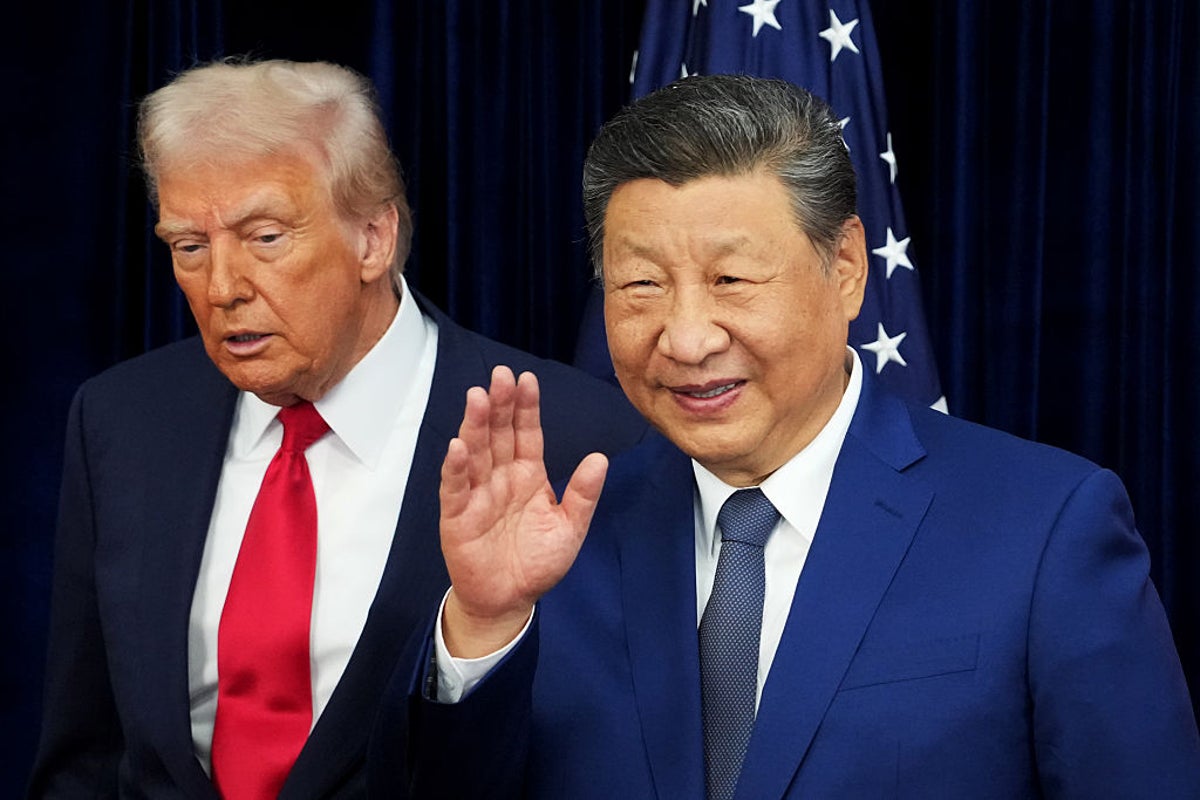
When Xi Jinping meets Donald Trump in Washington this week, there will be plenty to discuss: trade, AI, Taiwan, Iran, and the increasingly strange business of American-Chinese relations. According to first lady Melania Trump’s office earlier this week, there will be a truly stunning array of activities, too, ranging from an Armed Forces-led “arrival ceremony” and “military demonstrations” to an impressively coordinated flyover.
There will also, inevitably, be questions about how healthy the two men are.
Xi, who is 73 years old, is at the center of a fresh swirl of health rumors after skipping a dinner at the BRICS summit in India earlier this month and subsequently disappearing from public view for several days. There is no confirmed evidence that he is seriously ill, and Indian officials have dismissed claims that he fell sick at the summit. But the speculation has flourished in the vacuum created by the secrecy surrounding the health of China's leader.
Trump, meanwhile, is 80 and has insisted that he is in “perfect” health after a recent Walter Reed check-up, even as his bruised hands and occasional stumbles over speeches have raised eyebrows. The scrutiny over his aging is hardly new (and was applied to former President Joe Biden while he was in office, too.) But when two elderly leaders meet to discuss the future of the world's most powerful countries, the question of what happens when the men at the top eventually leave the stage becomes rather difficult to avoid.
This is especially concerning when some of them seem determined not to leave the stage at all.
Last September, Xi and Vladimir Putin were caught on a hot mic discussing the possibility of immortality. Tellingly, Xi said that 70 used to be an old man’s age but now, “at 70, one’s still a child.” Putin responded that through repeated organ transplants, it should be possible to achieve immortality; his counterpart said that during this century, it should at least be possible to live to 150.
It was an extraordinarily revealing conversation that captured something increasingly strange about the politics of aging: we might be able to extend our lifespans soon, but doing so will become a wealth and class issue. In some ways, that’s always been true, but when it comes to world leaders, it means the potential stagnation of societies under a few old men (because it is always men) determined to hold onto power, whatever it takes.
The result is a new political preoccupation with the biological limits of the men who run countries. How old is too old to govern? What happens when leaders refuse to contemplate succession? The questions that dominate social media discussions and headlines would’ve been unthinkable a generation ago: Is Mitch McConnell fully conscious? Does Donald Trump wear a diaper? Do Silicon Valley billionaires have so-called “blood boys”? Does Vladimir Putin keep getting organ transplants and if so, where on earth is he getting them?
The question underlying all of this: In an era of billionaires, biotechnology and increasingly fantastical promises about extending human life, what if the powerful no longer regard mortality as a deadline at all?
When health startup founder Brent Franson — whose Silicon Valley-based business DeathClock predicts when you’re going to die — went on the popular OpenAI-owned TBPN podcast, he ventured that we’re all going to die. Before he could finish that thought (that we’re all going to die, so we should think about how to extend our quality of life), the show threw up the big, glaring “X” it usually puts onscreen to call out lies. In northern California, Franson told me, it’s a mainstream idea that immortality will soon be achieved — at least for the people with the requisite wealth and access.
Perhaps unsurprisingly, then, OpenAI’s Sam Altman has invested $180 million into a startup that’s trying to help humans live much longer lives. Both Russia and China are investing vast sums of money into researching how to prolong one’s life; Putin launched a national project to combat aging in 2024. But it remains unclear how much any of this will actually benefit the rest of us.
“From the moment that humans arose, we've been… profoundly motivated by a disinclination to die,” says Sheldon Solomon, a social psychologist at Skidmore University who specializes in existential dread, i.e. the very human fear of our own deaths.
That fear of death has led to religions with promises of immortality and the afterlife, he says, as well as rich and powerful men trying their hardest to guarantee their place there. From well-stocked Egyptian pyramids to quests for the Fountain of Youth to modern biology, “underlying contemporary science has always been: How do we live forever?” and these days “some people argue that the best way to do that is to abandon our wretched carcasses and upload ourselves onto a Google Cloud,” he adds.
The people most concerned with this question, Solomon says, seem to be predominantly two types: “It’s the fascist demagogues — people like Putin and Xi and the dude that runs North Korea and Trump… but then you’ve got the richest people on earth: the Peter Thiels, the folks that run Google. They’re also not obscuring their intentions, and that is to devote trillions of dollars to staying alive. Just them, not the rest of humanity.”
That’s a problem, Solomon says, because the people leading the immortality question in 2026 are not concerned about the trashing of the planet. Instead, “there’s just: We’ll be here forever and we’ll buy New Zealand or whatever it takes… or we’ll go Mars.”
There is peer-reviewed science that underscores what might be useful for living a longer life, but it’s probably not what billionaires are looking for. A long-running Harvard study into longevity has found that socializing with other people is strongly correlated with living longer, and that’s something you can’t really optimize your way into or out of. The same study, however, found that “positive thinking” has a profound effect on how long you live. If denial counts, then perhaps the Silicon Valley founders are onto something.
The problem with the concerns of our current set of very rich death-dodgers is that they’re stubbornly anti-science. New organs or regular blood transfusions can only take you so far. Without even getting into the fact that it’s ethically concerning where those come from, you need the infrastructure to deal with the new blood and organs, and putting a 20-year-old liver into an 80-year-old body doesn’t mean that you’ve now set the clock back by 60 years. You need the infrastructure — the circulatory system and so on — to make the most of that organ. It’s a bit like imagining you can stop a crumbling building from falling down by repainting the walls.
Allowing the longevity conversation to be led by tech bros is, in other words, if not dangerous then pointless. People who see the world in terms of lines of code aren’t especially well-suited to the messy business of improving human bodies. “You’re pre-programmed to die,” said Elon Musk, on a podcast earlier this year. “So if you change the program, you will live longer.”
But an alarming lack of basic knowledge about science and history among some world leaders and tech founders has led them to these kinds of blind spots. Many of them will reference the fact that the average life span was 47 in 1900, for instance: it’s a much-quoted statistic. Now, the average life span in the US is 79. But that doesn’t mean that in 1900, people routinely died around 50 years old.
Throughout history, humans have routinely lived to around 70 or 80 years old if they’ve managed to reach adulthood; the 1900 average was pulled down by increased mortality among the young, particularly among children. Medical developments like antibiotics and vaccines are the real reason for the increase. Some of the most effective modern developments from the past couple of decades are things like coronary stents, which started being widely used in America in the mid-90s: unsexy but extremely consequential, with millions of lives saved and extended.
To be fair to Musk, his perspective on solving death is nuanced. He has said if we do end up living forever, or for decades longer than is expected now, then we will need to make sure there is a mechanism for dealing with aging, power-mad politicians. “If we live for too long, I think it ossifies society,” he opined at a conference in France in 2024. “There’s no changing of the leadership because the leadership never dies.”
Solomon says it’s important to note that the obsession with immortality isn’t only infecting the very rich. Almost everyone is talking about it, partly because the availability of nonstop news app interruption and algorithmic feeds that reward tragic stories means “we’re marinating in death reminders”.
At the same time as talking about it constantly, we hide the reality: “The average American's never seen a dead person, and if they've seen old people, it's from a distance,” Solomon adds. “We spend more money trying to not look old than we do on social services, and old folks go to Florida.”
In some ways, you can’t blame people for that: Solomon, who is 72 and remarkably upbeat for a man with his career, has spent his entire academic life researching death and dying, and his wife is a grief counselor. Discussions about mortality were common and frequent in their home, even as they raised their two children (Solomon says there’s research that shows, despite what parents think, that even two- and three-year-old children are aware of their own mortality.)
But even as he thinks back on his own career as he contemplates retirement, he says with a laugh, he wonders if it was actually “almost 50 years of death denial by turning all of this into an intellectual exercise”. Everybody has their coping mechanism, and being aware of that fact doesn’t make you immune to it.
Solomon had a revelation about his own mortality during the pandemic lockdowns, when he started spending long hours walking with his dog, Scruffy, around his local area. It made him realize “not intellectually, but emotionally, that doing stuff — writing a book, whatever, that's good. But equally good is a face full of fresh air on a day where you walk by somebody you've never seen before and just do like a little nod where you acknowledge each other's existence. And so I feel like it's only been relatively recently that I've begun to overcome the intellectualization of these ideas to try to — without sounding too jargony — to really engage with them as a finite, embodied entity.”
The proliferation of AI has changed the conversation about death, removing the human body from the equation. Even if no one is seriously suggesting (yet) that they can upload your soul to the cloud, many are suggesting that you can upload enough thoughts, ideas and videos to make a realistic facsmile of yourself for your loved ones to converse with after you die. Some people have created them in an effort to deal with grief. Others, faced with terminal diagnoses, have started to compile material that will create an immortal avatar.
The jury’s out on whether such behavior will make it easier or harder to deal with the deaths of friends and relatives, or whether it would make it easier to deal with our own mortality. But Solomon says that it’s important to remember that real developments around longevity have involved collective action rather than individualism.
“I hope I’m wrong — and I’ll probably be in a jar of formaldehyde somewhere — but it is possible, if not likely, that half or more of humanity could be wiped out in the decades or centuries to come,” says Solomon. But he does think there are grounds for hope: “As a species, we've gotten ourselves out of some existential crises by just understanding what it is that's getting us into it in the first place. So, the Plague in the Middle Ages. You know, half of Europe's dead. And they're like: ‘Oh, this is because of evil spirits,’ but that didn't change anything. And then they're like: ‘Oh, it's bacteria!’ and that led us to modern medicine, without which many of us would today be dead.”
There’s nothing inherently wrong with obsessing over your own death. There’s nothing wrong with trying to avoid it. It’s natural to do, and leaning into that obsession can be beneficial for everyone, if it’s harnessed in the right way. In other words: Rather than allowing the conversation to be driven by rockets to Mars and consciousnesses being uploaded onto company servers, we could rapidly improve our lot by focusing on extending proven research, on strengthening communities, and on making healthcare fairer and more accessible. Breakthroughs are more likely to be achieved when groups of people approach a problem together, altruistically, in pursuit of something that will benefit us all.
“In a world run by narcissistic sociopaths, there is no interior,” Solomon says. But if we can reclaim our souls from the circular conversations about sci-fi happening among off-the-wall founders and aging strongmen, we might actually get somewhere: “My cause for optimism is just that if we can collectively and individually step back, and recognize the central role that the awareness of our own mortality plays in our lives and the lives of those around us, then that is a psychological fork in the road.”


