Yalta 2.0 shows just how impotent Europe has become - The Telegraph

European leaders are struggling to get a seat at the table, let alone set the agenda Credit: AP/Ding Lin/Xinhua Con Coughlin Executive Defence and Foreign Affairs Editor Show biography A leading expert on global conflict, international security and the Middle East. Con worked as a foreign correspondent for 20 years in the Beirut, Jerusalem, New York and Washington bureaux. More recently he covered the conflicts in Iraq, Afghanistan and Ukraine. He is a Senior Visiting Fellow at the War Studies Department, King’s College, London.
The world is facing arguably its most challenging security environment since 1945. It is no wonder that expectations are running high for the trilateral summit of the leaders of China, Russia and the United States.
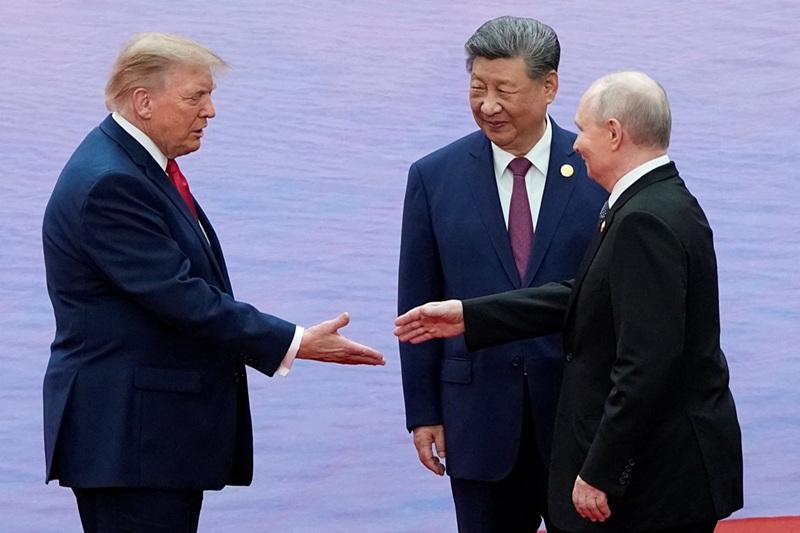
It is not just the wars in Ukraine and Iran that will feature prominently in the discussions between Xi Jinping, Donald Trump and Vladimir Putin in the Chinese city of Shenzhen. The need for a grown-up conversation on the vital issue of nuclear disarmament has never been greater – given Putin’s predilection for threatening nuclear strikes whenever he feels Russia’s military offensive in Ukraine is not going according to plan.
For that reason alone, we should hope that the trilateral talks achieve the Kremlin’s aim of being a “show-stopping event”, one that seeks to defuse global tensions rather than exacerbating them. The chances of the summit achieving its stated goal of advancing a multipolar world would, though, stand a far greater chance of success if the discussions were not merely confined to a small, ad hoc, group of powerful men, all of whom have very different personal agendas.
While the main priority for Xi and Trump is to resolve their long-standing trade dispute, the American leader also will be hoping that his first face-to-face meeting with Putin since their failed summit in Alaska last year will help to deliver his long-standing quest for a ceasefire in Ukraine. At the same time, Xi and Putin are seeking to strengthen their own bilateral ties by forging closer military ties, especially in the field of defence manufacturing.
How these very specific objectives can help to foster a multipolar world remains to be seen. But the prospects of making genuine headway in efforts to establish global stability would be greatly enhanced by the participation of other powers in the process – not least the Europeans.
While comparisons have inevitably been made between this week’s talks in Shenzhen and the Yalta Conference towards the end of the Second World War, there are some obvious differences between the two events. Yalta – on paper, at least – was a summit of Allies, and the Europeans, in the bulldog figure of Winston Churchill, played a dominant role in the proceedings.
Winston Churchill, Franklin D Roosevelt and Joseph Stalin at the Livadia Palace in Yalta on Feb 12, 1945 Credit: AP/British War Office These days, as we have seen with the latest diplomatic efforts to resolve the Ukraine conflict, the Europeans are nowhere to be seen. They struggle simply to get a seat at the table, let alone set the agenda.
Europe’s inherent weakness, and its failure to reach a unified position on Ukraine and Iran, has reduced it to the margins of world events. Jared Kushner, Trump’s son-in-law who is leading US peace talks on Ukraine, could not resist scornfully remarking on Europe’s diminished status when the possibility of European participation in future negotiations was raised last weekend.
Echoing Henry Kissinger’s famous quip, Kushner mockingly commented that it would be a major achievement if the Europeans could “identify one person to speak on their behalf”. Kaja Kallas, who is supposed to be the EU’s foreign policy chief, initially offered to fulfil the role, declaring: “I’m ready to do this job.”
She was immediately put in her place by European Council president António Costa, who announced that Europe’s interests would instead be represented by a team of national security advisers drawn from France, Germany, Poland, Italy and the UK. It is hard to imagine a more farcical European response to Kushner’s put down.
As for Britain, the days when our leaders were able to fulfil the role of a true statesman by setting and steering the international agenda are long gone. With Andy Burnham’s government seemingly fixated on marginal foreign-policy issues – such as imposing sanctions against Israeli settlements in the West Bank – it is hardly surprising that the major players in world affairs do not have much interest in hearing Britain’s take on the issues of the day.
In the same week that the leaders of China, Russia and the US are engaged in their own high-level diplomacy in Shenzhen, Burnham will be in Brussels wrangling over regulatory alignment deals so arcane that ministers have spent the week assuring voters they will not spell the end of smoky bacon crisps.
And so long as British and other European leaders remain preoccupied with such parochial issues, there is absolutely no chance of the old continent’s powers having a serious role to play on the world stage.