You Can See Everything review – Nathan Fielder’s Elizabeth Holmes doc is the best film of the year - The Independent
Want to bookmark your favourite articles and stories to read or reference later? Start your Independent Membership today.
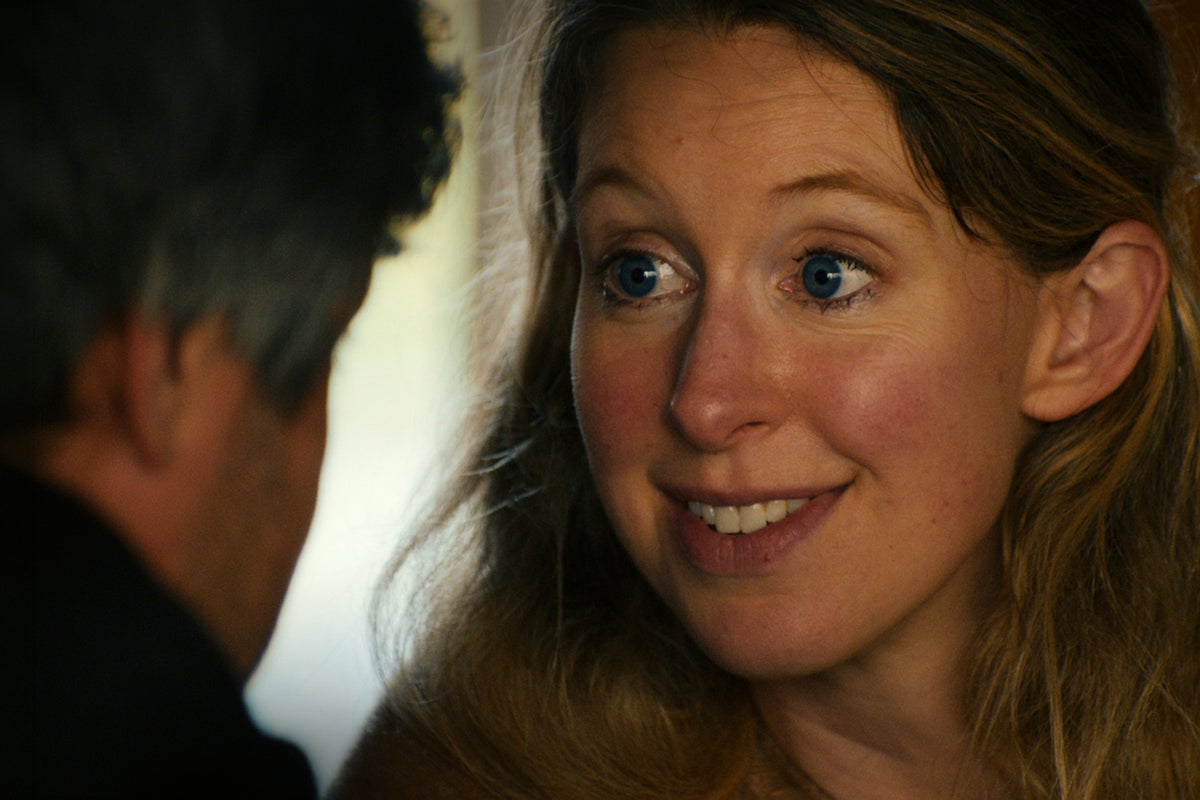
In an interview last week, Lance Oppenheim, co-director of the hit, record-breaking documentary You Can See Everything, described the film’s ostensible subject, Theranos founder and convicted fraudster Elizabeth Holmes, as a “human optical illusion”. He’s got a point. Throughout You Can See Everything – or at least, throughout the sections in which she appears, filmed mostly in the month leading directly up to her imprisonment – Holmes, moon-eyed and taut-voiced, is a figure of total, mystifying opacity.
Holmes may indeed be the illusion, but she’s not necessarily the illusionist. The heart of You Can See Everything, 2026’s very best film, is a triangle: at one vertex you have Holmes, at another, her current partner, Billy Evans. At the third sits Nathan Fielder, the film’s other director, who spends weeks interviewing the couple, eventually moving in to live with them in the days before Holmes surrenders herself to a Texan prison.
Fielder’s main tool has always been irony – pervasive, unspoken irony. When he made his name, as the creator-host of the reality series Nathan For You (2013 to 2017), this irony was already impermeable. The unspoken, never-acknowledged joke of the series was that his leftfield ideas to help real-world small businesses were wildly impractical, occasionally unethical, and wholly disingenuous. It was a dishonesty that made for great television, with moments of absurd and singular genius. His follow-up series, The Rehearsal, added more elaboration and complexity, fractalling inwards, exploring ideas of artifice, performance and sincerity – but the fundamental irony remained. Nothing he ever says on screen should be believed entirely.
It is his presence that makes the first half of You Can See Everything so utterly bewitching. Fielder lurks, voyeur-like, in Holmes’s rented beach house, listening and watching as she lives her final free hours. When he speaks to Holmes and Evans, he is probing and direct – in a way that sometimes recalls the faux-naivete of early Louis Theroux, but with more edge, even less apparent concern about getting on his subjects’ bad sides or turning a scene sour. (And sour they do, more than once, with Evans proving far more prickly and problematic than his partner.) It’s frequently hilarious, sometimes shocking, never anything less than great footage.
Around halfway through the film, Holmes goes to prison. Two years pass. Only then does You Can See Everything introduce its ace in the hole. (Spoilers ahead – but at this point, with the film having debuted Stateside over a month ago, the cat is thoroughly out the bag.) Fielder meets with Amanda Seyfried, who portrayed Holmes in the acclaimed Hulu series The Dropout, and shows her footage he had captured at the Holmes household.
To some extent, what follows – indeed, the whole film, really – is best seen with as little foreknowledge as possible. So I’ll avoid details. But Seyfried is an absolute wonder on screen here, total box office in more ways than one. You Can See Everything keeps moving, and adapting, and subverting itself in clever and unexpected ways, right to the last.
There has been a lot of writing about this film already – some of which is incredibly wise and insightful. But ultimately, Fielder and Oppenheim have made something that seems to resist and confound intellectualisation. You Can See Everything is complicated, and substantial, and thought-provoking, and artful. But it’s also just fascinating to watch on a very simple level. It is in its own way as beholden to pure, brute spectacle as something like Mission: Impossible – Fallout. Only this spectacle is rendered in the human face, in the inscrutable waters of Holmes’s whirlpool eyes.
Dir: Nathan Fielder and Lance Oppenheim. Starring (ish): Nathan Fielder, Elizabeth Holmes, Billy Evans, Amanda Seyfried. 15, 174 mins.